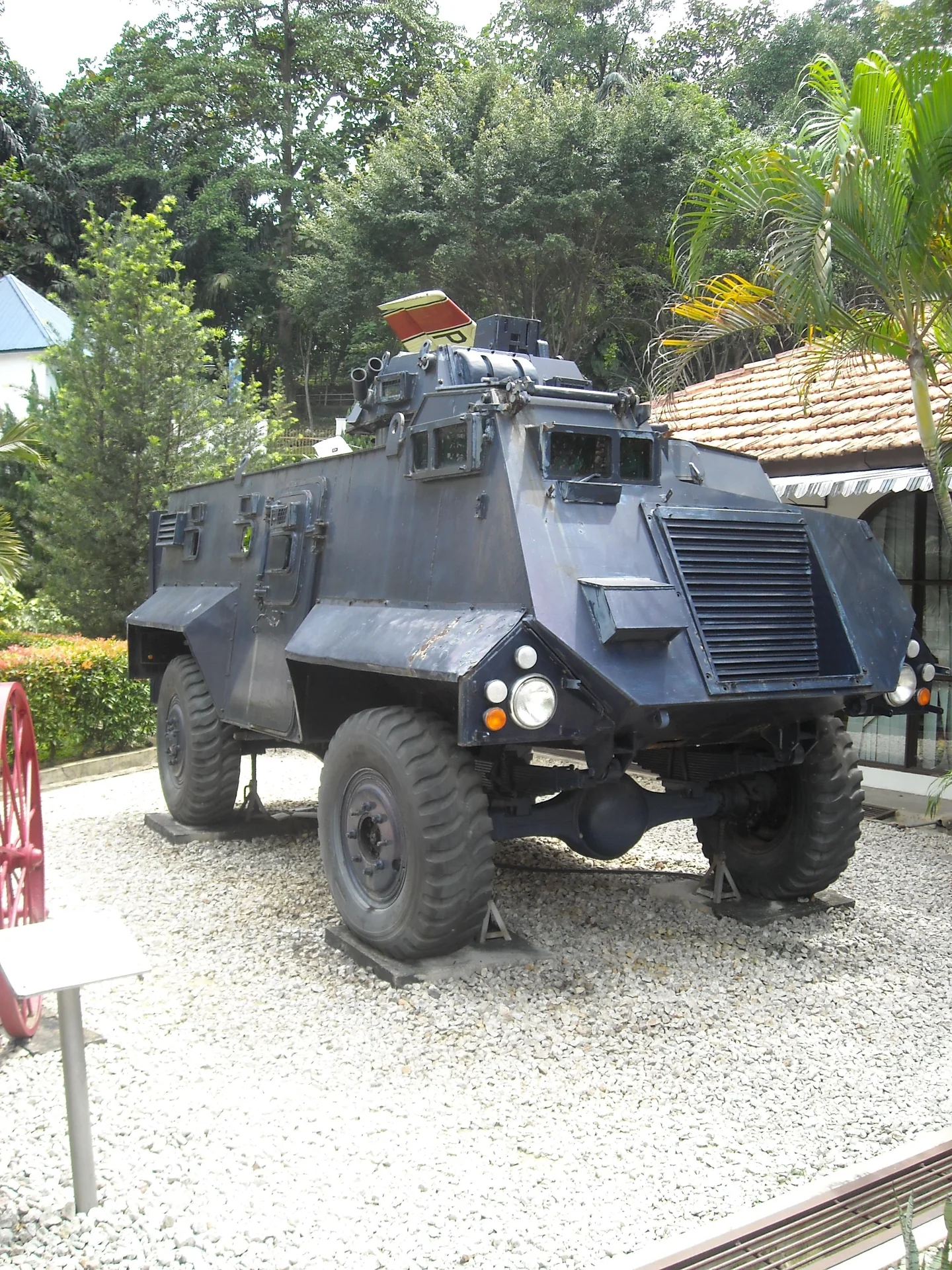
A protected ride to the reinforcement area
Saxon was conceived as transport for troops reinforcing the British Army of the Rhine. GKN Sankey combined an armored body with Bedford four-wheel-drive truck components rather than building a tracked fighting vehicle. Its original purpose was to move soldiers under protection on the journey toward their area of employment. That distinction helps explain both its road-oriented layout and the limits of comparisons with vehicles designed to maneuver and fight alongside tanks. 1
British service began in the early 1980s. Alongside troop carriers, the fleet included ambulance and riot-control versions. The National Army Museum records withdrawal from British service in 2005–06, giving Saxon a service history extending beyond its original reinforcement task. The common name therefore covers vehicles performing different jobs; a troop carrier, an ambulance and an internal-security vehicle did not necessarily carry the same fittings or occupants. 2
In the Commons on 22 October 1984, Armed Forces Minister John Stanley reported that the first Saxons had begun operational service while the tracked MCV80 was undergoing infantry trials. He discussed the two programs together as improvements in protected mobility. The juxtaposition shows that the inexpensive wheeled carrier was not simply a temporary name for the tracked infantry vehicle: both appeared in the Army's re-equipment program, at different stages and for different requirements. 5
The debate also exposed limits to the planned coverage. Asked about protection for reinforcing forces, Stanley distinguished their priority from troops facing the greatest immediate risk and tied wider provision to available resources. When another member challenged the number of vehicles being funded, the minister said follow-on orders had not reached final decisions. Parliamentary questions about larger quantities therefore should not be counted as deliveries. They document an unresolved procurement argument at that date. 5
Truck running gear beneath an armored body
The welded hull enclosed space for ten occupants and offered protection against small-arms fire and shell fragments. Its underside incorporated a V-shaped form intended to divert blast, while a pintle-mounted 7.62 mm general-purpose machine gun provided local armament. None of those features made it a vehicle for exchanging fire with tanks. The same account that describes its protection also records a cramped interior and limited cross-country performance. 1
A wheeled carrier could provide protected movement without becoming a turreted reconnaissance car. The troop space and road-oriented running gear also offered a starting point for specialist conversions. An ambulance’s useful load, a patrol vehicle’s equipment and the troop carrier’s passenger capacity should be considered separately rather than combined into a single supposedly standard configuration. 2
Patrols, training and overseas users
In Northern Ireland, adapted Saxons began replacing Humber Pigs from 1993. Some received extending shields for riot-control work. This was a substantial change in employment from carrying reinforcements in Germany: protection, visibility and movement through a public-order environment mattered more than keeping up with tracked formations across country. The special fittings belonged to that particular job, not to every Saxon produced. 1
An official Army photograph documents a Saxon during an exercise in Cyprus in late 2002. The catalog places the activity within training involving the 2nd Battalion, The Light Infantry, and the King’s Own Royal Border Regiment. It supplies a dated example of the vehicle in use late in its British career, without turning an exercise photograph into evidence of a combat action. 2
Hong Kong Police used Saxons for emergency personnel movement. Their own account places the vehicles at Police Tactical Unit headquarters in Fanling under its commandant. When describing a replacement fleet, the force said the Saxons had served for 21 years. Six purpose-built carriers based on the Mercedes-Benz Unimog U5000 were to succeed them. Here, the relevant continuity was protected police transport, not battlefield infantry assault. 3
A second career did not change the original design
A British Ministry of Defence answer on 25 March 2015 described intended Ukrainian uses for former Saxons. These included reconnaissance and patrol work by two battalions and airmobile units; some vehicles might become medical-evacuation carriers. The answer also said officials were not then aware of plans to arm them. These were stated intentions at that date, not a report that every conversion or deployment had happened. 4
The range of proposed jobs shows why a surplus carrier can remain attractive after its first operator retires it. A protected vehicle may be useful for movement, observation or casualty transport without acquiring new armor or cross-country ability simply through a change of owner. Saxon’s later employment is best understood as adaptation of an existing transport vehicle, with the original mechanical and space constraints still part of the calculation. 4
Sources and further reading
- Airborne Assault Museum / ParaData, AT105 Saxon
- National Army Museum, Saxon armoured personnel carrier in Cyprus, 2002
- Hong Kong Police, New Armoured Personnel Carrier on the way, OffBeat 889
- UK Ministry of Defence, written answer 228444, 25 March 2015
- UK Parliament, House of Commons Army debate, 22 October 1984
Visit an Armor Museum
Explore the worldwide museum directory to find armored vehicles, collections, and visitor-planning information.
Browse armor museums