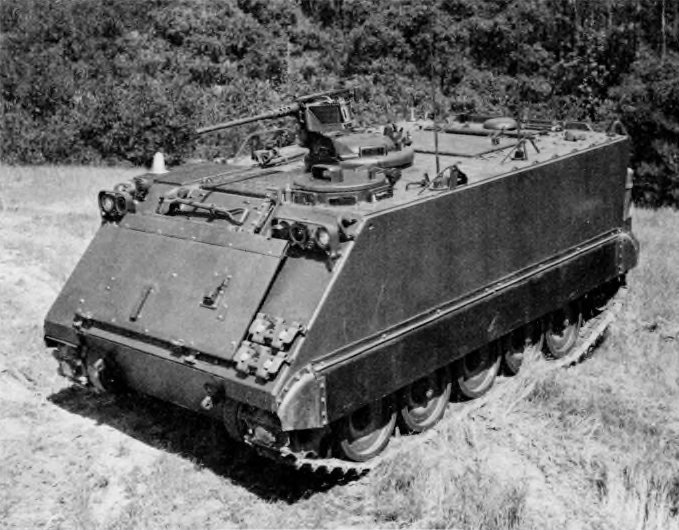

A lightweight armored carrier
The M113 was developed as a light, air-transportable tracked carrier able to move an infantry squad across terrain that wheeled trucks could not reliably cross. The original vehicle used an aluminum armored hull to control weight while preserving basic small-arms and fragmentation protection. 1, 2
Early U.S. service quickly produced the diesel-powered M113A1 and later automotive and survivability improvements. The vehicle’s box-like hull, rear ramp, and relatively generous internal volume made it unusually adaptable to roles far beyond basic troop transport. 1
Vietnam and the mechanized battlefield
M113s became ubiquitous in Vietnam with U.S., Australian, and South Vietnamese forces. Crews frequently adapted the vehicle to local conditions, and its combat use demonstrated both the advantages of protected mobility and the vulnerability of a lightweight carrier to mines, antitank weapons, and heavy direct fire. 1, 3
The experience helped shape later requirements for better protected and more heavily armed infantry fighting vehicles. The Bradley ultimately took over the principal U.S. mechanized infantry fighting role, while the M113 remained useful in command, mortar, medical, support, and other specialist tasks. 3, 4
A chassis that became a family
The importance of the M113 is larger than the base APC. Its common chassis supported command posts, mortar carriers, missile vehicles, engineering and recovery equipment, ambulances, and air-defense systems. That makes it an ideal test of the Armor Archive’s lineage model: variants can share ancestry without being forced into the same vehicle type. 2, 4
The M163 Vulcan Air Defense System is one of those role changes. It belongs in armored air defense, not under APCs, even though its M741 carrier is derived from the M113 family. 5
From M113 to AMPV
By the twenty-first century, decades of added equipment and changing protection requirements had exhausted much of the M113 family’s growth margin in U.S. armored formations. The Armored Multi-Purpose Vehicle program was created to replace remaining M113-based support vehicles in armored brigade combat teams while carrying forward the idea of a common family of specialized protected vehicles. 4
Sources and further reading
Representative source set used for this profile. Primary image source and reuse terms are listed with the image.
- Infantry Magazine, “M113 APC: Four Decades of Service and Still Showing Potential”
- U.S. Army Ordnance Corps Hall of Fame, James M. Hait
- U.S. Army Acquisition Support Center, A Team Effort
- U.S. Army, New armored vehicle tested at Yuma Proving Ground
- U.S. Army Air Defense Artillery Journal, Return of Tactical AAA