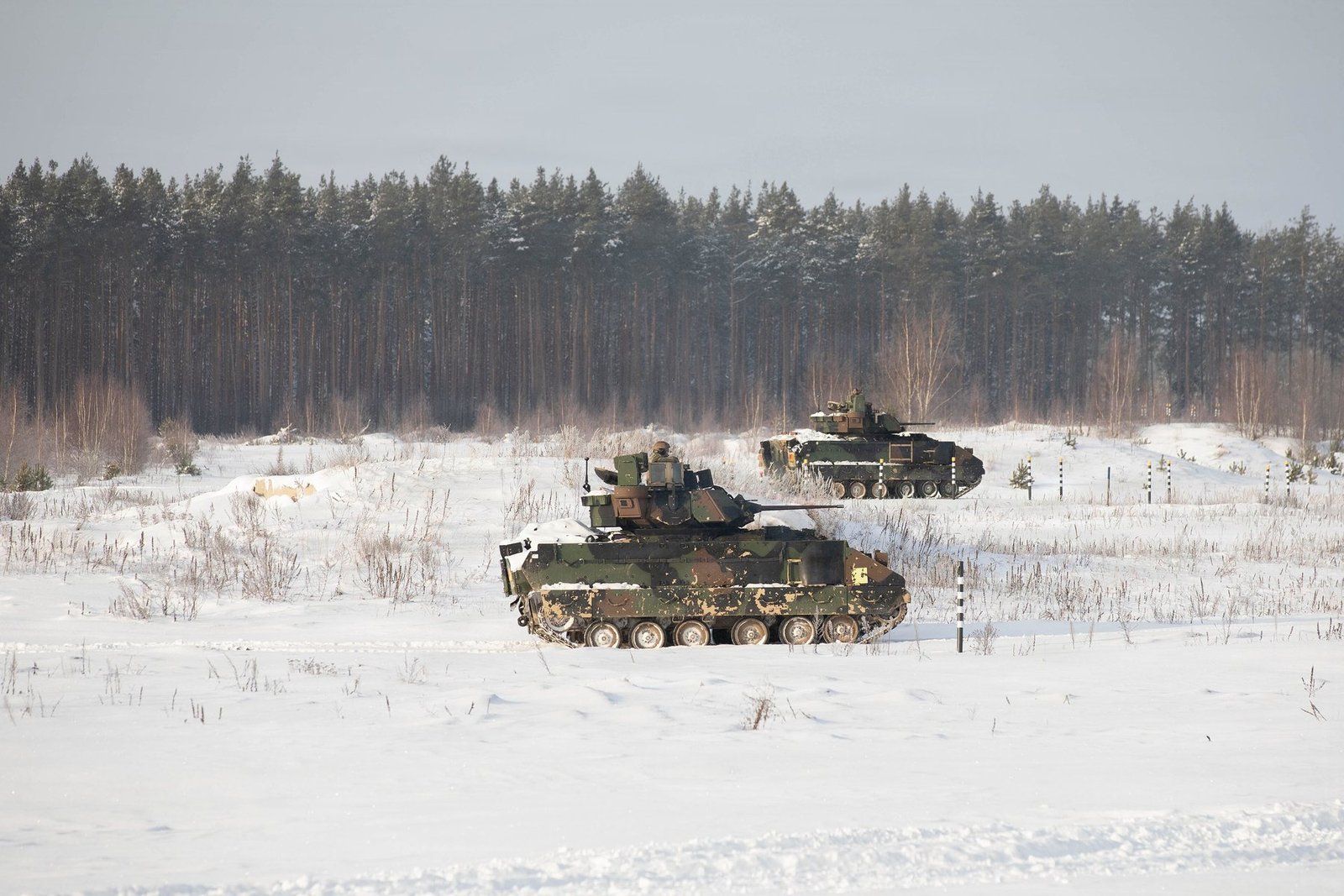
.jpg)
From the M113 to a fighting vehicle
The Bradley grew from the Army’s effort to replace the M113 as the principal vehicle for mechanized infantry. Army historical accounts describe the M113 as a useful armored carrier but increasingly inadequate for accompanying the new M1 Abrams in protection, speed, and mounted fighting power. The emerging vehicle had to carry infantry while also surviving and fighting in the same high-tempo combined-arms environment. 1, 2
The M2 infantry fighting vehicle and M3 cavalry fighting vehicle became part of the Army’s “Big Five” modernization of the late Cold War. The two versions shared the basic hull, turret, 25 mm M242 cannon, coaxial 7.62 mm machine gun, and TOW missile system, but differed in internal arrangement and tactical role. 2, 3
M2 infantry and M3 cavalry branches
The M2 was organized around carrying a mechanized infantry squad, while the M3 supported cavalry reconnaissance and security missions with fewer dismounts and more internal stowage for reconnaissance and antitank work. That difference is important for the Armor Archive: the M3 is not a separate chassis family, but it is more than a simple equipment package on an M2. 2
Survivability changes produced the A1 and A2 generations, including changes to armor, internal stowage, and provisions for additional protection. Later A2 ODS, A3, and A4 work added digital architecture, improved sights and situational awareness, automotive upgrades, and restored growth margin. 2, 4
Combat employment and modernization
Bradleys fought in the Persian Gulf War and later operations in Iraq, where the family’s combination of thermal observation, cannon fire, antitank missiles, and dismounted infantry made it useful across a wide range of missions. Combat also drove protection and survivability upgrades that increased vehicle weight and consumed available electrical and cooling capacity. 4, 5
The M2A4 program restores mobility and electrical growth while retaining the Bradley’s core fighting arrangement. The Army is developing the XM30 as a successor, but the Bradley remains an important reference point for how modern infantry fighting vehicles balance troop capacity, firepower, protection, sensors, and the ability to keep pace with tanks. 3, 4
Family boundaries
Bradley-based command, fire-support, engineer, and air-defense vehicles should be linked through lineage rather than silently counted as ordinary M2 infantry carriers. The archive will use the same approach for other chassis families: shared automotive ancestry does not erase a vehicle’s distinct battlefield role. 3
Sources and further reading
Representative source set used for this profile. Primary image source and reuse terms are listed with the image.
- U.S. Army Center of Military History, American Military History, Volume II
- U.S. Army Weapon Systems Handbook, Bradley Fighting Vehicles Systems (1991)
- U.S. Army PEO Ground Combat Systems, Ground Combat Systems fact sheets
- U.S. Army Acquisition Support Center, Bradley Changes to Upgrade Vehicle Across the Board
- U.S. Army, Bradley’s combat history part of museum