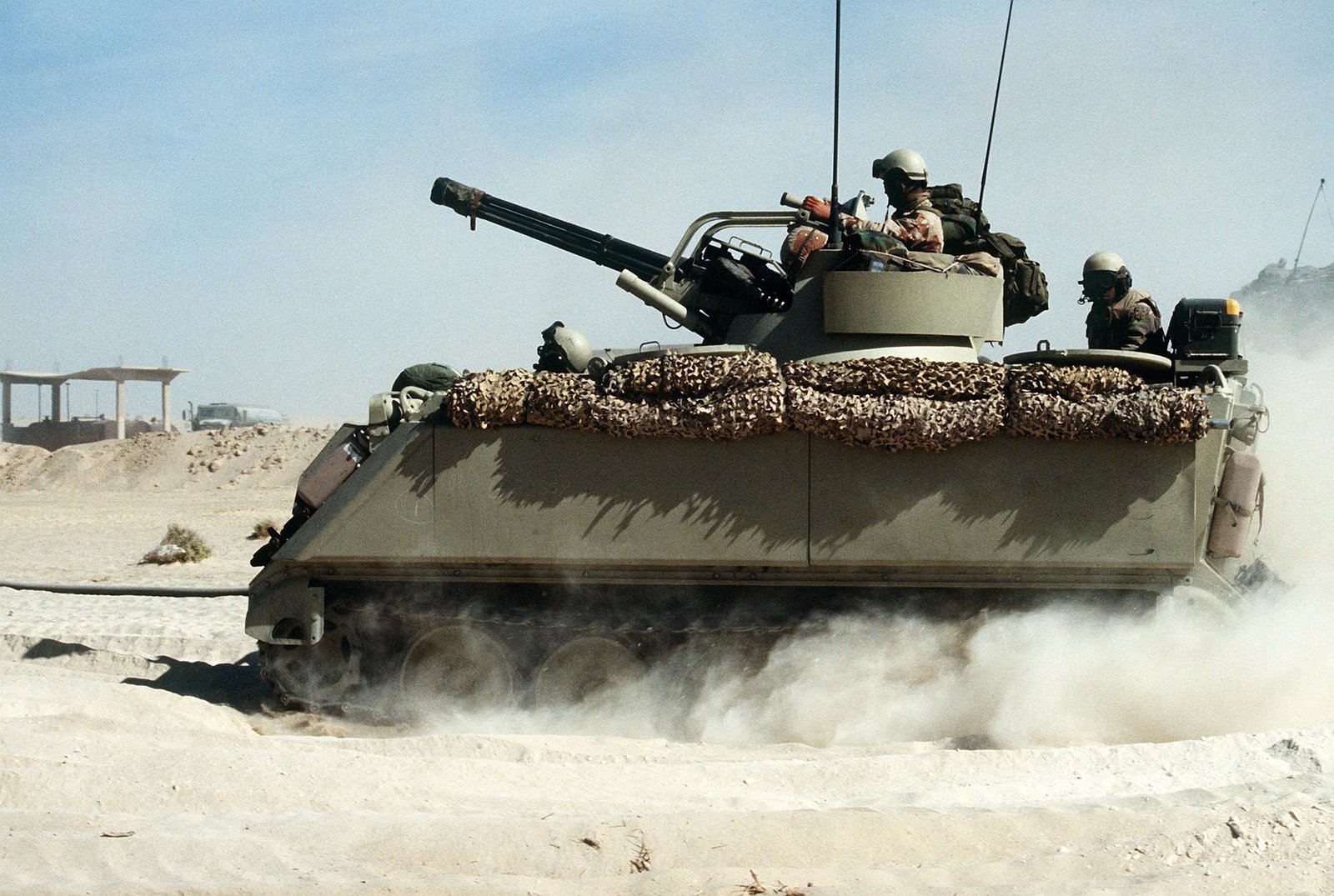

Putting Vulcan on the M113 family
The M163 emerged as a mobile gun component of U.S. short-range air defense. It paired a high-rate 20 mm Vulcan cannon with an M113-derived carrier, giving armored and mechanized formations a weapon that could move cross-country with the force instead of relying on towed or static antiaircraft guns. 1, 2
The installation used the M168, a ground adaptation of the M61 Vulcan family, with optical sighting and range/tracking equipment. The system was optimized for nearby, low-altitude targets rather than long-range area defense. 1, 2
A close-in gun system
The M163’s value was mobility and volume of fire. Its limitations were equally important: range was short, target acquisition was less sophisticated than later radar-guided systems, and improvements could not change the basic geometry of a close-range cannon mounted on a light carrier. 1, 2
Those limits pushed U.S. air defense toward missile-based and combined gun-missile approaches. The M6 Linebacker later used the Bradley chassis with Stinger missiles, while modern short-range air-defense programs return to the problem with new sensors, missiles, cannon, and counter-UAS requirements. 1
Cross-type lineage from the M113
The M163 is exactly the kind of vehicle that would be misclassified in a tank-only archive. Its chassis ancestry is M113, but its role is air defense, not personnel transport. Version 2 therefore links the two vehicles through lineage while placing each profile in its correct operational category. 1, 2
This distinction also prevents family trees from becoming type trees. A common chassis can produce APCs, mortar carriers, command vehicles, tank destroyers, and air-defense systems without forcing all of them under one label. 1
The value of a specialized armored derivative
The M163 illustrates why armored history is often best understood through families and missions rather than silhouettes alone. The system borrowed proven mobility from an existing carrier, replaced troop capacity with a specialized weapon station, and created a new battlefield function without requiring an entirely new automotive platform. 1, 2
Sources and further reading
Representative source set used for this profile. Primary image source and reuse terms are listed with the image.
- U.S. Army Air Defense Artillery Journal, Return of Tactical AAA
- GlobalSecurity.org, M163 Vulcan Air Defense System
- Store norske leksikon, M163 Vulcan