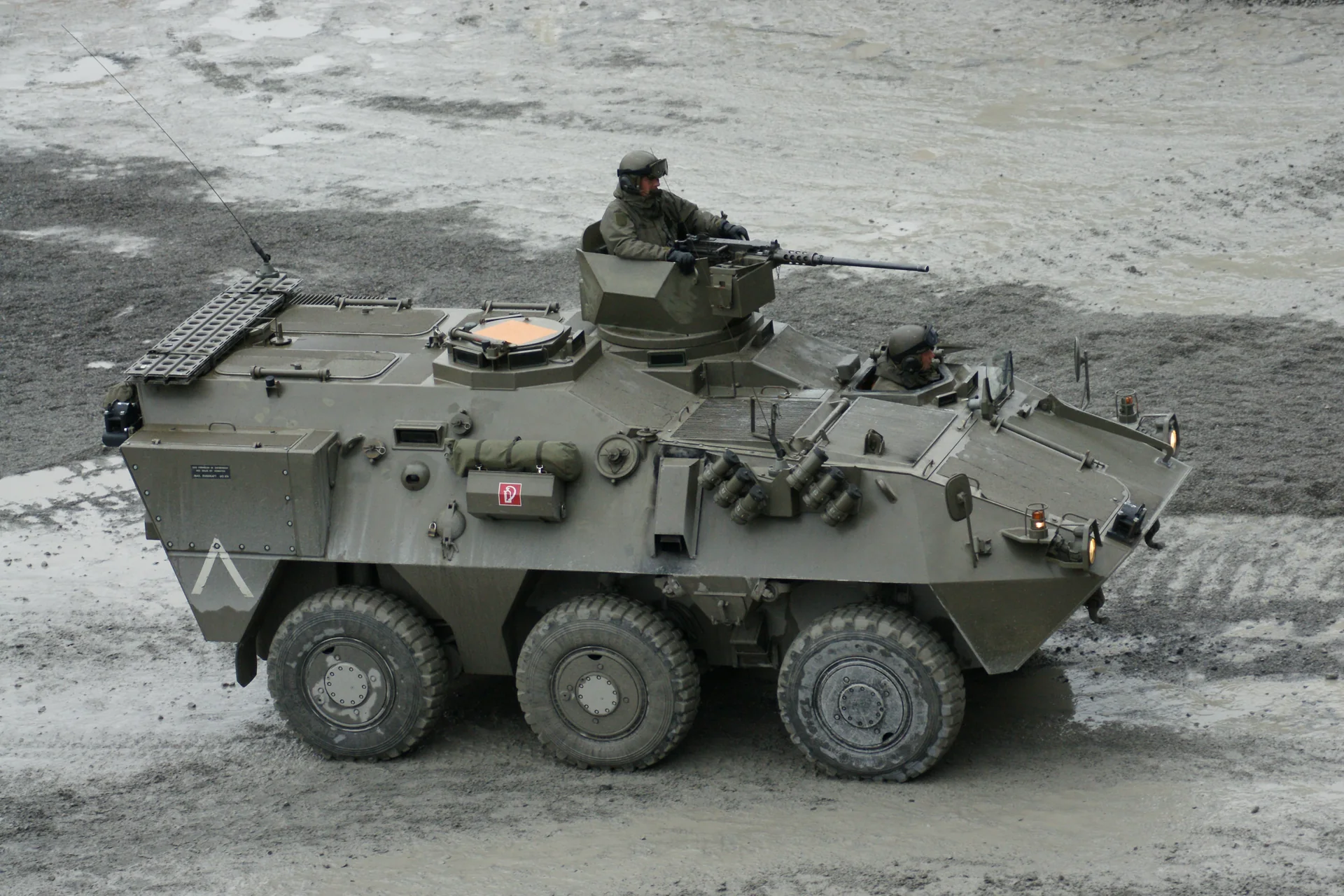
An Austrian design with several branches
Pandur developed from an Austrian armored-carrier program into a family manufactured and adapted for several armies. GDELS places the presentation of its first pre-series vehicle in 1993 and the introduction of an eight-wheeled version in 2002. Austria’s original vehicles entered service in 1996. The later Pandur II and the newer six-wheeled Pandur EVO were not simply alternate names for that first carrier. They represented further development, with different capacities, equipment and national production arrangements. 1, 5
Development continued in both wheel configurations. The eight-wheeled branch expanded the available platform, while the six-wheeled EVO was ready for series production in 2016. Austria continued with six-wheel carriers as the Czech program developed its eight-wheeled fleet. The family’s history is therefore a set of related national programs rather than a universal change from Pandur I to Pandur II and then to EVO. 1, 5
GDELS's current family history places the first pre-series Pandur in 1993 and treats the platform as a continuing family rather than one frozen specification. The manufacturer's present page also covers later 8x8 and 6x6 EVO development. Those milestones help organize the lineage, but current EVO weights, engines, protection and electronic architecture are not retroactive specifications for the original Pandur I or for every national Pandur II configuration. 1
Protected automotive systems and mission space
A characteristic of the Pandur approach is the placement of important drivetrain components within the armored hull. Independent wheel suspension and automatic drivetrain management support mobility without leaving all of the working machinery beneath an ordinary truck-style body. Internal protection is useful for more than ballistic resistance: components also need to survive rough ground and the repeated loads of service. The design still has to divide finite space and weight among machinery, occupants, mission equipment and protection. 1
The Czech Ministry of Defence’s 2011 account described a Pandur II with a 335 kW engine, a maximum weight of up to 20 tonnes and a road speed of 105 km/h. Those figures belong to that early Czech configuration. Later production accommodated heavier equipment and more powerful engines, changing the relationship between available power, payload and combat weight. 2, 6
Carrier, infantry fighting vehicle and support platform
The Czech RCWS-30 installation combined a 30 mm Mk 44 cannon, a coaxial 7.62 mm machine gun and Spike missiles with stabilized observation equipment. Other vehicles carried equipment for command, reconnaissance, engineering or medical work. The reconnaissance branch included versions with and without radar, placing different demands on the same basic platform. 2
Tatra Defence Vehicle offers Pandur II in personnel-carrier, infantry-fighting, command, ambulance, communications, mortar and recovery configurations. The armored body provides a common basis, but each role competes for interior space and payload. A command vehicle needs workstations and communications; an ambulance needs room for casualties and attendants. The platform’s usefulness extends beyond the turreted fighting vehicles that are its most conspicuous versions. 4
Czech assembly and licensed development
Czech procurement established a domestic industrial branch. Apart from the first 17 vehicles, the fleet described by the Defence Ministry was assembled by VOP 025 at Nový Jičín. Local assembly placed production expertise and workshop support inside the purchasing country as well as supplying vehicles to its army. 2
Tatra Defence Vehicle subsequently undertook licensed manufacture, development, modernization and conversion in partnership with GDELS. That arrangement allowed Czech industry to support existing vehicles and offer further configurations. As national branches developed, common ancestry coexisted with different turrets, automotive installations and support arrangements. 4
Austrian service and the 2015 modernization
Austria’s 2015 modernization provides a specific example of an existing fleet being improved without becoming the next generation of vehicle. The new remote weapon station allowed its heavy machine gun to be operated from inside the armor. It incorporated daylight and thermal cameras, a laser rangefinder and a searchlight, together with smoke launchers. The practical change was not just another gun mounting: observation and weapon operation could be carried out without keeping the gunner exposed above the hull. 3
By 16 March 2015, five upgraded carriers had been delivered, three to the 17th Infantry Battalion at Strass. Some of the modernized vehicles were intended for Austrian peacekeepers in Kosovo later that year. The work concentrated on the gunner’s exposure and the crew’s ability to observe around the vehicle, renewing important equipment while retaining the original carrier. 3
The EVO programs
In February 2024, General Dynamics announced an Austrian order for another 225 Pandur EVO vehicles. The order extended beyond ordinary personnel carriers: it included medical and command conversion equipment and additional variants for such tasks as mortar support, air defense and electronic warfare. Earlier EVO vehicles were already under contract. This was a further expansion of the six-wheeled branch, not a decision to replace its name with Pandur II. 5
General Dynamics’ 2024 list of Pandur users included Austria, Belgium, the Czech Republic, Indonesia, Kuwait, Portugal, Slovenia and the United States. Their fleets reflected different choices about wheel arrangement, armament, mission equipment and industrial participation. 5
Reading the specifications by configuration
Later Tatra technical material lists a 405 kW engine and a maximum combat weight of 25 tonnes, with a UT30 MK2 turret. Compared with the 2011 Czech description, both power and maximum weight had grown. This later offering belongs to a different configuration; its figures do not describe an automatic upgrade of the earlier fleet. 6
The Pandur family combined continuity in its basic wheeled-carrier concept with considerable variation in equipment. Austria’s remote-weapon-station refit renewed older vehicles, the EVO order expanded the six-wheeled force, and licensed Czech development sustained the eight-wheeled branch. These were distinct programs serving different requirements, not interchangeable stages in the life of every Pandur. 3, 4, 5
Sources and further reading
References and further reading are listed below. Image identification, credit and reuse terms remain with each photograph.
- GDELS, PANDUR family and development chronology
- Czech Ministry of Defence, Armoured Personnel Carrier Pandur II 8x8 (2011)
- Austrian Armed Forces, Upgrade for Pandur Armoured Personnel Carriers (16 March 2015)
- Tatra Defence Vehicle, Pandur II overview
- General Dynamics, Austrian order for 225 Pandur EVO vehicles (20 February 2024)
- Tatra Defence Vehicle, Pandur II technical data
Visit an Armor Museum
Explore the worldwide museum directory to find armored vehicles, collections, and visitor-planning information.
Browse armor museums