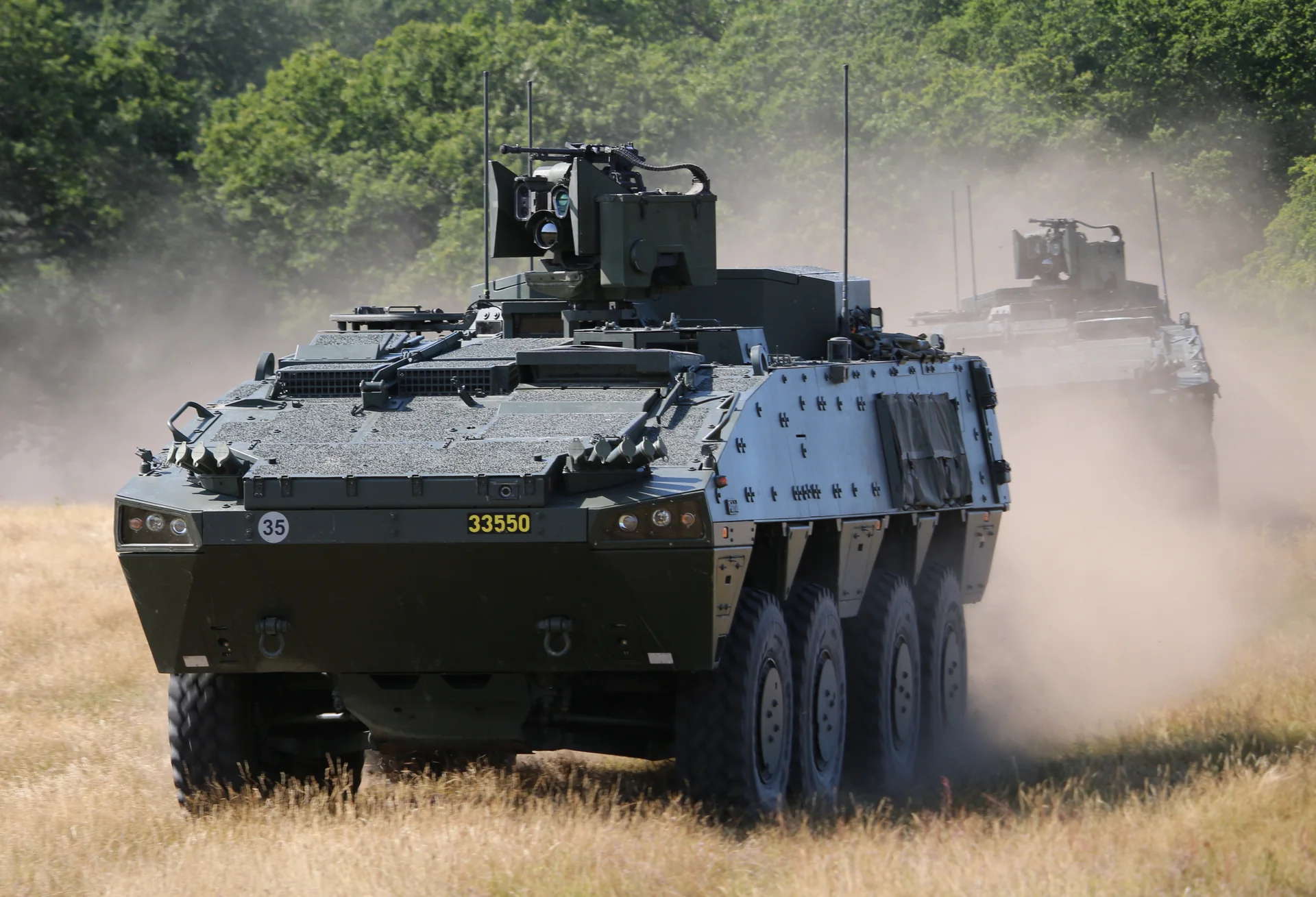
Development and requirement
Patria developed AMV as a new generation of wheeled armored vehicle emphasizing mobility, protection, payload, and customer-specific integration. The family was selected by multiple countries and developed into nationally produced or modified forms. Later AMV XP work increased payload and system growth for heavier modern mission equipment. 1, 2
AMV is a family identity, not a guarantee that every national vehicle has the same internal arrangement or equipment. A customer can combine the automotive platform with a particular turret, protection package and communications system, producing a distinct operational configuration. Later AMV XP offerings also need to be kept separate from earlier AMV vehicles. A growth-capacity claim for XP cannot be used to infer that the original hull or every licensed derivative carried the same payload, dimensions or mission equipment from the start of service. 1, 2
Design, protection, and mobility
AMV uses an 8x8 chassis with modular protection and sufficient payload for configurations ranging from basic troop carrier to IFV, command, reconnaissance, recovery, and mortar systems. Patria emphasizes the ability to tailor weapons and mission equipment without changing the core automotive platform. The family’s high payload also supports substantial armor and large turrets. 1, 2
The wheeled character of the Patria AMV Family is central to how it was intended to be used. Wheeled armored vehicles generally trade some soft-ground and obstacle performance for road speed, range, reduced automotive complexity, and easier long-distance movement without heavy transporters. That trade is especially valuable to reconnaissance, security, and rapidly moving infantry formations, where arriving first, screening a broad frontage, or shifting quickly between sectors can matter as much as maximum armor thickness. Tires, driveline arrangement, suspension travel, and vehicle weight therefore become tactical questions rather than engineering trivia: damage that slows the vehicle can also reduce the unit's ability to observe, disengage, reinforce, or deliver troops on time. 1, 2
Reconnaissance places unusual pressure on internal layout and protection. The vehicle must carry radios, observation equipment, ammunition, and scouts while remaining mobile enough to avoid decisive engagement. Protection is valuable because reconnaissance units operate forward and can be discovered unexpectedly, but excessive weight can undermine the very mobility that lets them break contact. The practical design goal is therefore not invulnerability; it is enough protection and firepower to survive contact, report, maneuver, and continue the reconnaissance mission. 1, 2
Patria’s AMV XP description separates a Basic model from a High Roof model, and offers both with regular or extended wheelbases. The high-roof arrangement is intended for tasks needing more rear-compartment space, such as command, ambulance or workshop work. The same page lists possible infantry, reconnaissance, antitank, repair/recovery, fire-support and Nemo mortar roles. These are configuration options in the manufacturer’s product description, not evidence that every operator fields every role. They also show why a single family-wide passenger count or turret specification would be misleading: the vehicle’s mission installation determines how its available space is used. 2
Firepower and battlefield role
Firepower on the Patria AMV Family has to be read through its mission rather than by caliber alone. Armored carriers and fighting vehicles use their weapons to protect movement, suppress opposition, cover dismounts, and create enough local advantage for the formation to continue its task. The usefulness of that weapon depends on sights, stabilization where fitted, ammunition, crew training, and the ability to detect a target before the vehicle is itself exposed. The vehicle's combat value therefore comes from the integration of mobility, protection, observation, communications, and weapon effect rather than from a single specification in isolation. 1, 2
Service, variants, and modernization
AMV-family vehicles have served with several European and other militaries, including combat and crisis-management operations. National variants such as Poland’s Rosomak demonstrate how a common commercial platform can become a large domestic fleet with unique weapons, armor, and support systems. 1, 2
The history of an AMV-derived national fleet includes local procurement and support decisions as well as the Finnish parent design. Poland’s Rosomak therefore requires its own variant and deployment record, not only a reference to Patria’s current product range. The same distinction applies to modernization: an offered turret or a new protection option establishes a manufacturer’s proposal, not a fleet-wide installation. Describing when a customer accepted and used a particular configuration is more useful than combining every published option into a single notional AMV. 1, 2
How the vehicle fits the formation
In formation use, the Patria AMV Family is most valuable when it helps commanders understand the battlefield before the main body becomes decisively engaged. Reconnaissance crews and scouts screen routes, identify obstacles and enemy positions, watch flanks, and maintain contact while trying to preserve freedom of movement. Mounted weapons are important because reconnaissance units cannot assume they will remain hidden, but the preferred outcome is usually to gain information without becoming fixed in a fight that should belong to heavier forces. This is why speed, communications, observation, and disciplined disengagement are as important to a reconnaissance vehicle as its cannon or armor. 1, 2
Strengths, limitations, and family boundaries
APC/protected mobility is the family’s baseline archive classification, but turreted IFVs, NEMO mortar carriers, and other role-specific derivatives should be classified by mission where separately profiled. National names are treated as branches of the same Patria AMV lineage unless the design diverges substantially. 1
The principal strength of the Patria AMV Family is the mobility and flexibility that come from its wheeled architecture and mission fit. It can cover large road distances efficiently, shift between sectors without the same transporter dependence as many tracked vehicles, and support dispersed operations over a broad frontage. The tradeoff is that wheels, ground pressure, and suspension geometry impose different limits in deep mud, severe obstacles, and some forms of cross-country movement, while protection and turret weight can erode the original mobility margin. The design is strongest when commanders exploit its speed and reach instead of forcing it to imitate a heavier tracked vehicle. 1, 2
Family names can also obscure important differences. A common hull or manufacturer does not mean every derivative belongs in the same operational category. Command posts, mortar carriers, antitank vehicles, recovery vehicles, reconnaissance versions, air-defense systems, and direct-fire variants may share engines and running gear while performing fundamentally different tasks. For that reason the Armor Archive keeps the Patria AMV Family tied to its lineage but classifies individual branches by what they actually do on the battlefield. That approach preserves engineering relationships without turning one successful chassis into an all-purpose label that hides the history of the specialized vehicles built from it. 1, 2
Sources and further reading
References and further reading are listed below. Image identification, credit and reuse terms remain with each photograph.
Visit an Armor Museum
Explore the worldwide museum directory to find armored vehicles, collections, and visitor-planning information.
Browse armor museums