Requirement and development
The Jagdpanzer IV arose from a 1942–43 effort to create a new low-profile Sturmgeschütz-type vehicle on the Panzer IV chassis. As requirements evolved and Heinz Guderian pushed the design toward the Panzerjäger mission, the project became a dedicated tank destroyer with strongly sloped armour and a fixed gun. The first production vehicles used the available 7.5 cm L/48 weapon because the intended long L/70 gun was not yet available in sufficient numbers. Once L/70 production improved, Vomag introduced the Panzer IV/70(V). Alkett also produced a taller interim Panzer IV/70(A), using more of the standard Panzer IV upper hull to accelerate delivery. 1, 2, 3
Layout and engineering
The Jagdpanzer IV family was not a single immutable vehicle. Early production used the shorter 7.5 cm PaK 39 L/48, while the later Panzer IV/70 variants carried the longer 7.5 cm L/70 weapon in different superstructure arrangements. Tank Encyclopedia records delayed early production and distinguishes the Vomag and Alkett branches. Those distinctions affect weight distribution, silhouette, suspension loading, and identification, so a specification from one branch should not be applied automatically to the whole family. 1, 2, 3
The family naming itself reflects the changes. Jagdpanzer IV and Panzer IV/70 describe related but not identical production stages, and the ‘V’ and ‘A’ suffixes distinguish the Vomag and Alkett L/70 arrangements in modern literature. The long gun increased antitank reach but also made front-end weight and running-gear load more consequential. Those mechanical effects belong to the long-gun variants rather than automatically to every early L/48 vehicle. 1, 2, 3
Armament and direct-fire role
The family needs to be divided by weapon as well as silhouette. The earlier Jagdpanzer IV carried the 7.5 cm Pak 39 L/48; later Panzer IV/70 vehicles used the longer L/70 weapon. The U.S. March 1945 handbook describes both configurations separately, although some of its contemporary nomenclature and crew estimates require caution. A long barrel did not provide a turret's freedom of movement: all of these installations had limited traverse and depended on hull movement for larger changes in direction. 4
Protection and survivability
Sloped frontal armour was central to the Jagdpanzer IV concept. The low casemate reduced exposed area, and later vehicles used strong frontal protection without the enormous mass of a Jagdtiger. Side and rear armour were much lighter, so the design remained vulnerable when flanked or caught at close range. The fixed gun also meant that any threat outside the limited traverse sector could force the vehicle to turn, potentially exposing weaker aspects. The overall protection scheme was nevertheless a major step beyond earlier open-topped Panzerjäger and illustrates Germany’s move toward purpose-designed enclosed tank destroyers rather than expedient gun carriers. 1, 2, 3
Mobility, reliability, and logistics
The Panzer IV chassis gave the family a mature automotive foundation, but the long-gun Panzer IV/70 variants pushed weight forward and imposed greater stress on the front suspension. The resulting nose-heavy behavior became one of the family’s best-known practical drawbacks. Earlier L/48 vehicles were better balanced, while the taller Alkett version distributed structure differently but sacrificed the Vomag vehicle’s lower silhouette. All variants inherited the Panzer IV family’s late-war logistical environment, in which fuel shortages, worn components, limited recovery capacity, and increasingly hurried training affected real mobility. Published road speed therefore captures only a small part of operational usefulness. 1, 2, 3
Variants, production, and naming
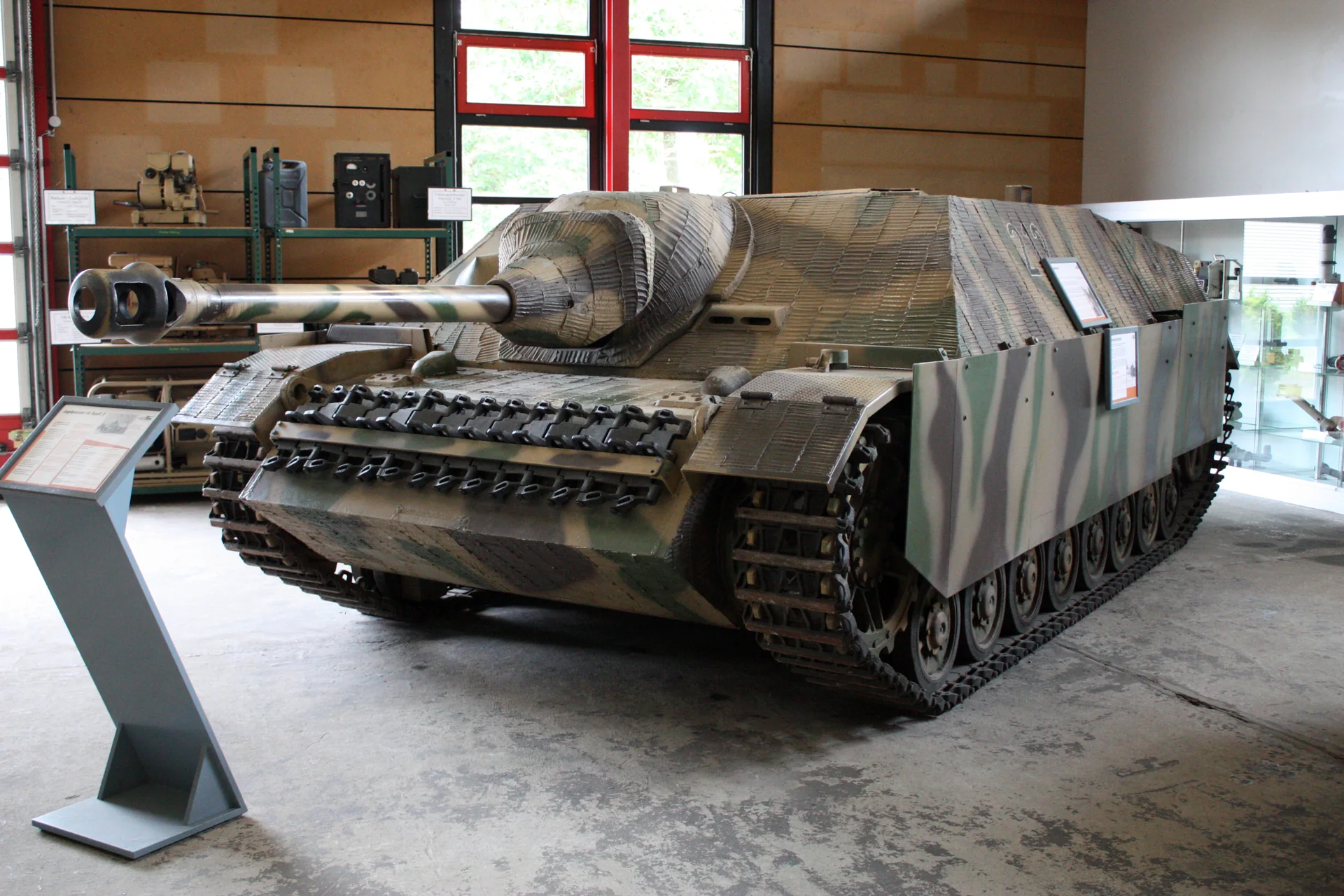
The Jagdpanzer IV family requires careful naming. The initial production Jagdpanzer IV used the L/48 gun. The Panzer IV/70(V) from Vomag used the low dedicated casemate with the L/70 gun, while the Panzer IV/70(A) from Alkett combined the L/70 weapon with a taller superstructure mounted on a more conventional Panzer IV hull. Contemporary designations evolved, and later accounts do not always use the same labels consistently. Production details also changed over time, including armour, suspension fittings, exhausts, and external stowage. A photograph or specification should therefore be tied to a particular builder and production form rather than simply labeled “Jagdpanzer IV.” 1, 2, 3
Operational service
Jagdpanzer IV and Panzer IV/70 vehicles served in German anti-tank and, increasingly late in the war, assault-gun formations on both Eastern and Western fronts. Their low silhouettes and strong guns suited defensive employment, while their enclosed fighting compartments offered crews better protection than Marder or Nashorn vehicles. Shortages and organizational disruption meant they were not always used in the neat unit structures envisioned during development. Late-war allocations placed some Panzer IV/70 vehicles in units that might otherwise have expected StuGs or tanks. This overlap illustrates how German distinctions among Panzerjäger, Jagdpanzer, and Sturmgeschütz weakened as equipment losses and battlefield demand forced more flexible assignment. 1, 2, 3
Limitations and tradeoffs
The family’s greatest limitation was the price paid for placing increasingly powerful guns on the Panzer IV chassis. The L/70 installation made the front heavy, increasing wear and degrading handling on an already mature suspension system. Fixed traverse meant the driver often had to help lay the weapon by turning the hull, and mechanical damage or terrain confinement could sharply reduce tactical flexibility. The Alkett IV/70(A) eased production pressure but was taller and heavier than the Vomag design. None of these shortcomings made the vehicles ineffective, but they demonstrate that the L/70 weapon pushed the basic Panzer IV platform close to the practical limits of a compact casemate conversion. 1, 2, 3
Assessment and related development
Jagdpanzer IV and Panzer IV/70 are best distinguished by gun and hull configuration. The lower Vomag forms and taller Alkett installation were not identical vehicles with different names. Their fixed weapons and Panzer IV ancestry gave them related capabilities and constraints, but did not justify a single specification for the whole family. 1, 2, 3, 4
Sources and further reading
References and further reading are listed below. Image identification, credit and reuse terms remain with each photograph.
- Tank Encyclopedia — Jagdpanzer IV (Sd.Kfz.162) (secondary source; not primary certification)
- Tank Encyclopedia — Panzer IV/70(V)
- Tank Encyclopedia — Panzer IV/70(A)
- U.S. War Department, TM-E 30-451 (March 1945), VII.V.2: Close support and assault guns — transcription hosted by Lone Sentry
Visit an Armor Museum
Explore the worldwide museum directory to find armored vehicles, collections, and visitor-planning information.
Browse armor museums