Development and design
Britain entered the postwar era with substantial experience in self-propelled artillery but with vehicles rooted in Second World War technology. The Royal Canadian Artillery Museum describes Abbot as the British Army's replacement for the Ram-based Sexton, whose basic design dated from wartime. The requirement was not simply to put another 105 mm gun on tracks. The new system had to fit Cold War mechanized formations, provide a protected crew environment, and reduce the time needed to move between firing positions as armored forces operated across a European battlefield shaped by the threat of counterbattery fire and air attack. 1, 2
A turreted gun on the FV430 automotive family
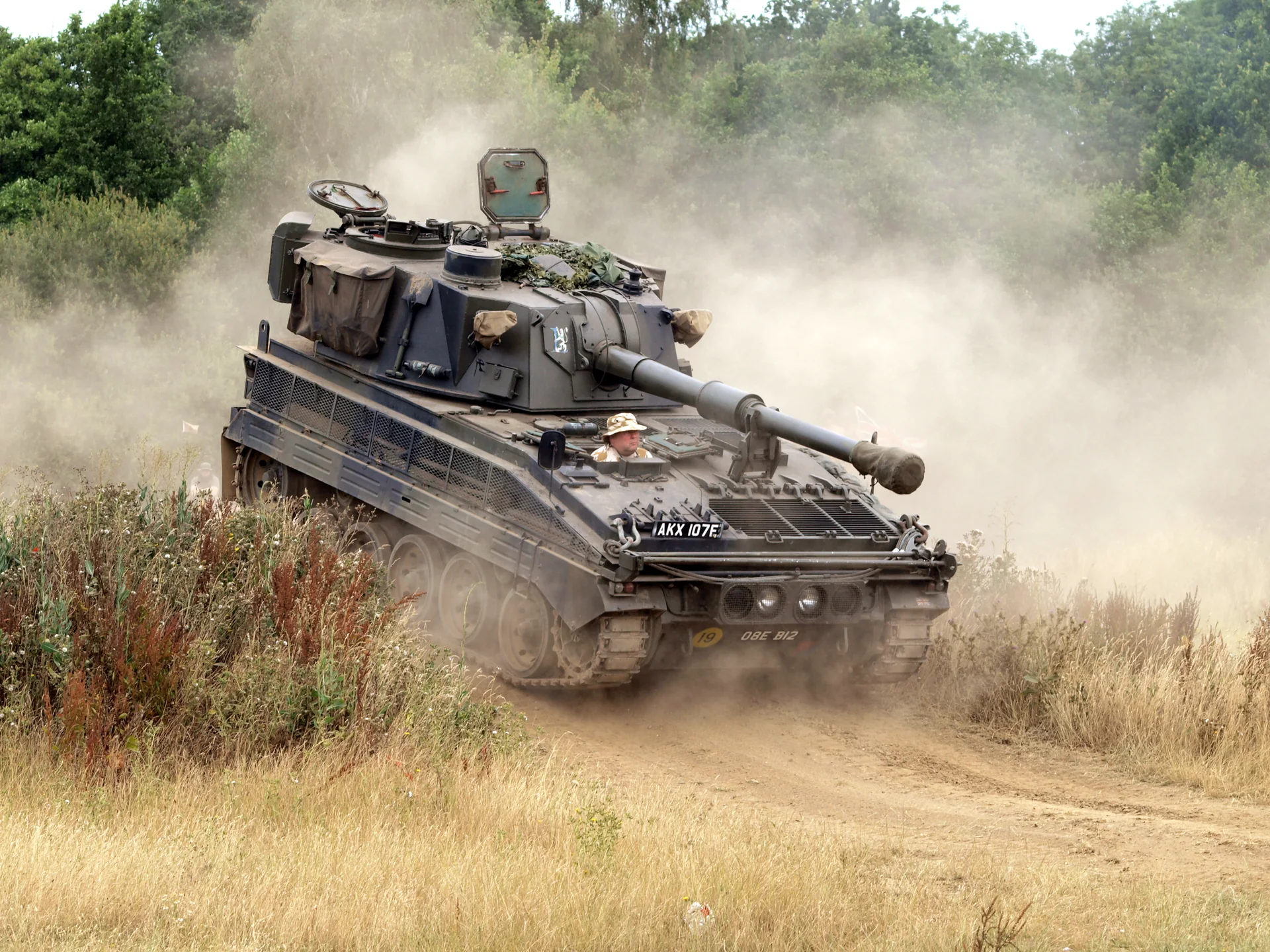
Abbot replaced the open fighting compartment familiar from wartime self-propelled artillery with an enclosed, rotating turret. Its gun crew could work under armor against weather, small-arms fire and fragments. The chassis belonged to the wider FV430 family, but common ancestry did not make every power-pack installation or internal arrangement interchangeable. The driver remained in the hull while the turret accommodated the other onboard crew members and the 105 mm gun system. 2
A new British 105 mm ammunition family
Abbot did not simply reuse every existing 105 mm round. Eden Camp records that a new 105 mm Field ammunition family was developed for the L13 gun, using electrical primers and longer projectiles than the U.S.-pattern 105 mm howitzer ammunition also familiar to British forces. This choice allowed the gun and ammunition to be optimized together but tied the vehicle to a specialized supply chain. Museum figures place conventional maximum range in the mid-to-high teens of kilometers, with exact quoted values depending on the ammunition and source. 1, 2
Mechanized artillery for a European battlefield
Abbot's FV430-derived suspension and Rolls-Royce K60 multifuel engine gave it mobility broadly compatible with British tracked formations of the period. Eden Camp quotes a maximum speed around 29 miles per hour, while museum displays emphasize that the vehicle was intended to move with mechanized forces rather than operate as static artillery. It could also be fitted with a flotation screen for water crossings, an unusual feature that reflected British interest in keeping tracked formations mobile across the rivers and canals expected on a central European battlefield. 1, 2
The museum also notes that Abbot could use a flotation screen and propel itself in water by its tracks. That feature did not turn the vehicle into a general-purpose amphibious carrier, but it shows the emphasis placed on tactical mobility in the original design. The same museum entry lists a six-person detachment, four carried in the vehicle and two associated with the ammunition vehicle, a useful reminder that the gun's full crew system extended beyond the hull. 1
Service history
The Royal Artillery used Abbot from 1965 until 1995. It equipped British field artillery through a period that included the mature Cold War, extensive NATO exercises in Germany, and the transition toward more digitally managed fire support. The Royal Canadian Artillery Museum specifically identifies its eventual replacement by AS-90, while other museum collections preserve vehicles associated with British training in Canada. These surviving examples reflect how widespread the system was within British mechanized artillery even though it did not achieve the global proliferation of systems such as the M109. 1, 3
Protection appropriate to artillery, not tank combat
The enclosed hull and turret offered a far better crew environment than the open wartime self-propelled guns it replaced. They provided protection against small-arms fire, shell splinters, and weather, and they allowed the detachment to remain under armor during movement and much of the gun operation. This was particularly valuable on a battlefield where artillery positions could be attacked by fragments, air-delivered weapons, or small raiding forces. The vehicle was nevertheless lightly armored by tank standards and was not intended to exchange direct fire with enemy armored vehicles. 1, 2
A capable 105 mm system in a 155 mm world
Abbot's most important long-term limitation was caliber. The purpose-designed 105 mm system was effective within its original concept, but the trend in NATO medium artillery favored 155 mm weapons offering heavier projectiles, greater range potential, and wider ammunition commonality. Britain also operated other artillery types during Abbot's service, which complicated a fleet already divided by caliber and role. As technology advanced, the benefits of a compact 105 mm turret no longer outweighed the advantages of adopting a larger standard gun for self-propelled field regiments. 1, 2
Inside the Cold War artillery battery
The Royal Canadian Artillery Museum distinguishes the four soldiers carried in Abbot from the complete six-person detachment, which included two personnel with the ammunition vehicle. That is a useful warning against treating onboard crew and battery support as the same thing. Its surviving example is also tied to British training at Suffield in Canada. Such an individual vehicle history can establish provenance without proving the combat or unit history of every Abbot. 1
Historical place
Abbot gave British artillery a fully tracked, enclosed 105 mm system that sat between wartime Sexton practice and the later 155 mm AS-90 generation. The Royal Canadian Artillery Museum identifies FV433 Abbot as the vehicle that replaced Sexton-based equipment and says it remained in British service until 1995. That chronology matters because Abbot's 105 mm role should not be retroactively described through the specifications or doctrine of its 155 mm successor. 1
Sources and further reading
References and further reading are listed below. Image identification, credit and reuse terms remain with each photograph.
- The Royal Canadian Artillery Museum, 105MM Abbott SP Gun
- Eden Camp Modern History Museum — FV433 Abbot SPG
- Wood Buffalo Military Museum — FV433 105 mm Field Artillery Self Propelled Abbot
See Armor in Person
This vehicle family is connected to 2 verified museums through 2 documented display records.