Development and design
AS90 emerged from VSEL's development work as Britain sought a replacement for older field-artillery equipment. On 20 June 1989, the government told Parliament it had selected 179 AS90 howitzers, subject to satisfactory contract terms, after evaluating the design against the American M109 improvement program. The statement records a procurement decision rather than completed deliveries. It connects the design to a specific British requirement without treating later turret developments as part of the original order. 3
The June 1989 parliamentary record is useful because it captures the program before full fleet service. It describes the 1988 work as a demonstration against the British Army specification, with procurement decisions to follow. Keeping that distinction prevents development-contract dates, production decisions and operational fielding from being collapsed into a single 'entry into service' milestone. 3
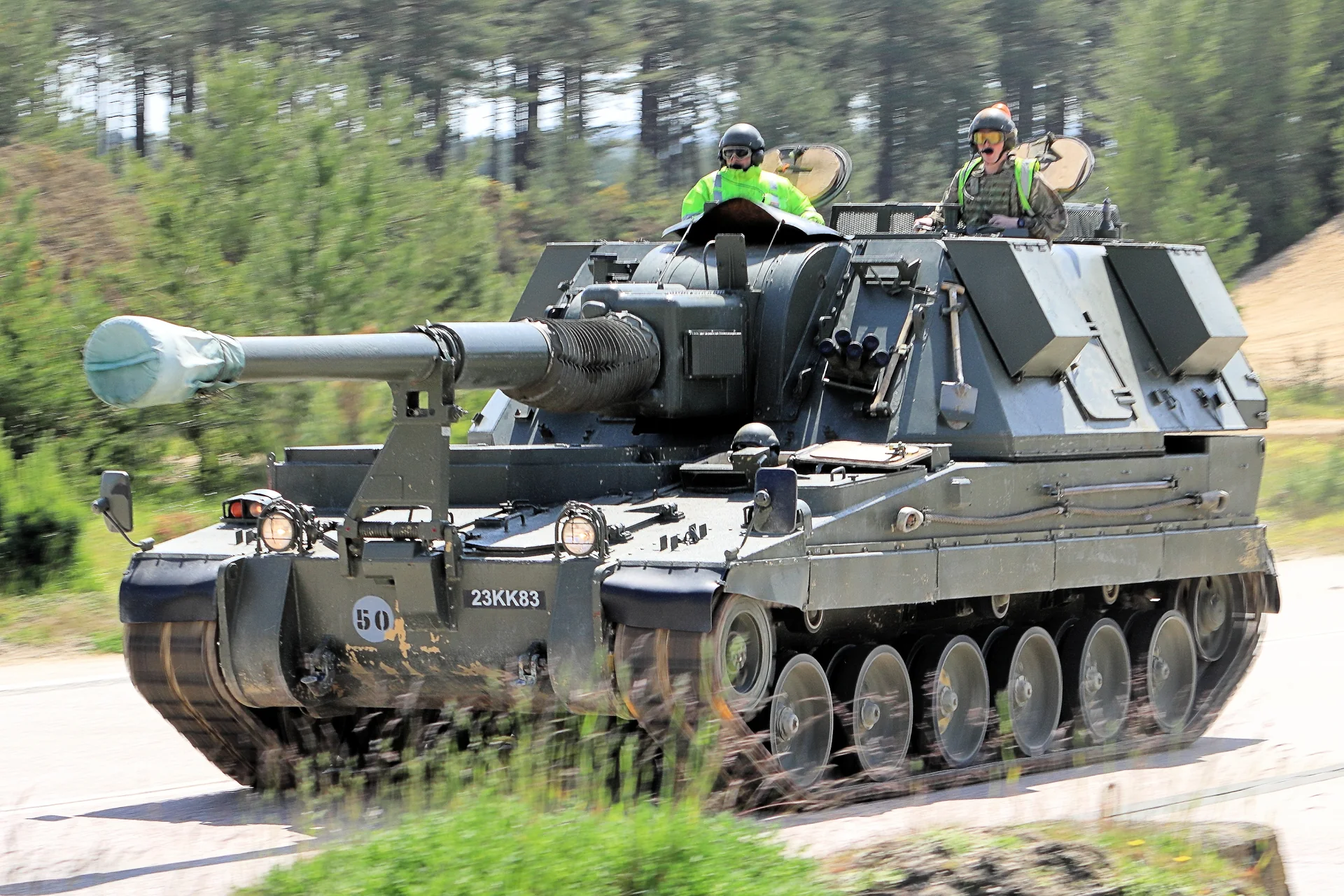
A conventional tracked howitzer with a large turret
AS-90 uses the familiar modern self-propelled-howitzer arrangement of a tracked hull, forward driving and power components, and a large rotating turret carrying the gun crew and ammunition handling system. Unlike the open wartime vehicles that preceded Abbot, the crew works within an enclosed armored structure. The British Army lists a five-person crew and a combat load of forty-eight 155 mm rounds. The vehicle's protection is intended primarily against small arms and shell fragments while allowing the gun to operate from dispersed firing positions rather than from tank-like direct-fire positions. 1, 2
155 mm fire with rapid short bursts
The standard AS90 carried a 155 mm L31 gun with a 39-caliber barrel. Its ammunition-handling system supported a rapid initial burst followed by lower intense and sustained rates, a distinction that matters when comparing artillery specifications. Ammunition type also affected reach. Longer-barreled development proposals and turret technology associated with later projects should not be substituted for the armament of the original British production vehicle. 1, 2
Designed to move with armored formations
The British Army quotes a maximum road speed just above fifty kilometers per hour and a vehicle range around 420 kilometers. A Cummins turbocharged diesel engine drives the tracked chassis, while hydrogas suspension supports cross-country movement and the firing platform. These figures placed AS-90 firmly in the mobility class needed to support armored and mechanized formations. Its operational advantage was not that it could outrun tanks, but that an entire gun could move as a protected vehicle and displace much more quickly than a towed 155 mm system. 1
Service history
Royal Artillery Museum records show AS-90 deployments in Bosnia and Kosovo during the 1990s and in Iraq in 2003, including the Battle of Basra. These operations moved the system from the Cold War environment for which it had been conceived into expeditionary campaigns requiring long deployments, intense maintenance, and integration with multinational forces. The gun remained Britain's principal heavy self-propelled artillery system long after the geopolitical assumptions of its development had changed. 2
A gun system inside a battery network
On 16 March 2023, the Ministry of Defence announced an agreement for an initial 14 Archer systems as an interim replacement after the UK gifted 32 AS90s to Ukraine. The announcement also described cooperation on repair and maintenance. These are dated program statements, not a current count of British or Ukrainian operational guns. They show how the AS90's later service became tied to transfer, training and replacement arrangements as well as to the vehicle's original design. 4
A 1990s design facing longer-range successors
AS90 combined a useful protected working space with the fuel, maintenance and transport demands of a heavy tracked vehicle. Its original gun and electronics reflected the requirements of the late Cold War rather than every later development in long-range artillery. Updating communications and fire control could extend service without changing all of the platform's mechanical limits. Replacement programs consequently involved choices about caliber length, mobility and support, not simply the age of the hull. 1, 4
From regimental gun to national capability
The 1989 production decision was intended to equip multiple self-propelled field regiments, making AS-90 a fleet-level solution rather than a specialist weapon. Standardizing on one principal 155 mm tracked gun simplified training and doctrine compared with maintaining separate Abbot, M109, and FH70 fleets for overlapping missions. It also concentrated risk: as the AS-90 fleet aged, any obsolescence or availability problem affected a large portion of Britain's heavy close-support artillery at once. The system's later replacement therefore became a national capability issue rather than a routine vehicle refresh. 2, 3
Historical place
AS-90 emerged from a defined British procurement process rather than a simple one-for-one technical evolution from Abbot. Hansard records that Vickers Shipbuilding and Engineering received a 1988 contract for further work to demonstrate its design against the Army requirement and secure option prices for later procurement. The 2023 interim Archer purchase, announced after 32 AS-90s were gifted to Ukraine, belongs to a separate later readiness decision and should not be read back into the original AS-90 development story. 3, 4
Sources and further reading
References and further reading are listed below. Image identification, credit and reuse terms remain with each photograph.
- British Army — AS90
- Royal Artillery Museum — AS90 Self-propelled Howitzer
- UK Parliament Hansard, Howitzers, 20 June 1989
- UK Ministry of Defence, British Army announces new artillery deal with Sweden, 16 March 2023
Visit an Armor Museum
Explore the worldwide museum directory to find armored vehicles, collections, and visitor-planning information.
Browse armor museums