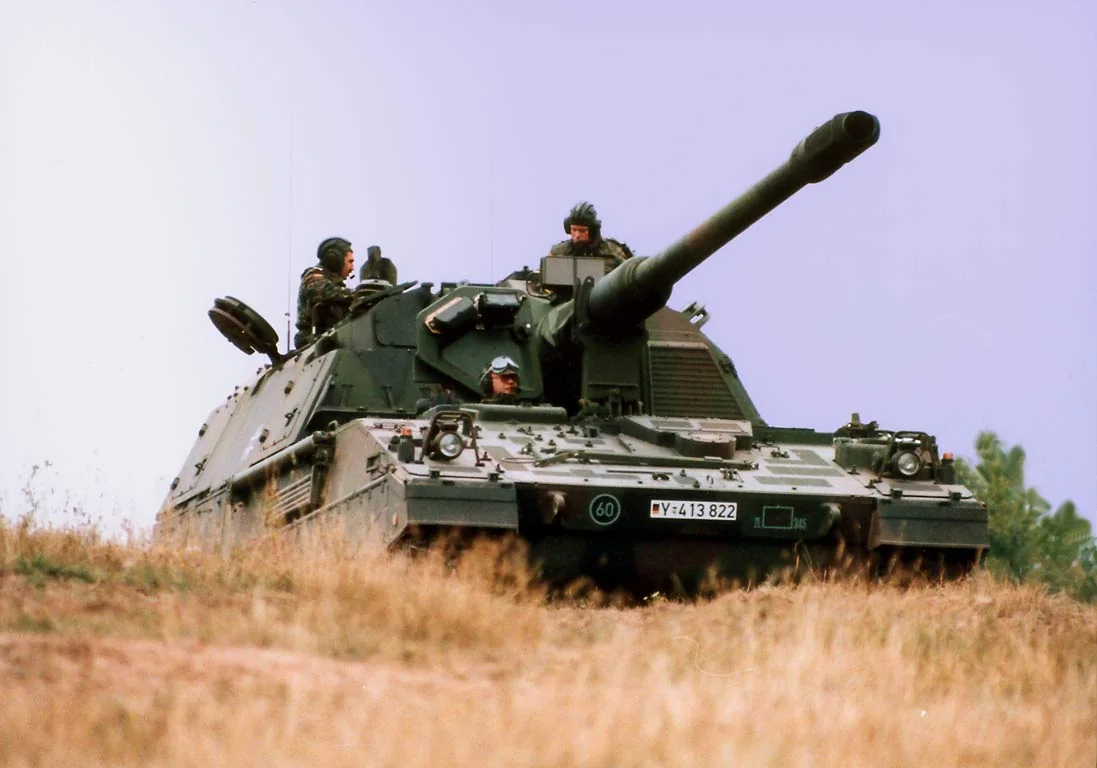
Development and design
The PzH 2000 emerged from a long German effort to replace earlier self-propelled artillery with a system that combined range, high rate of fire, automation, and independent navigation. Bundeswehr historical material notes that the first production vehicle was delivered on 1 July 1998 after a development path stretching across the postwar and post-Cold War transition. The program had to satisfy two competing pressures: the vehicle needed tank-like protection and mobility for mechanized warfare, yet it also had to carry a large ammunition load and sophisticated gun system without becoming tactically immobile. 2, 3
A protected tracked platform built around automation
The PzH 2000 has its engine at the front left and driver at the front right, with the large crewed turret behind them. Mechanized projectile handling reduces repetitive lifting but does not turn the turret into an uncrewed module. The armored structure protects against small-arms fire and fragments, with additional systems addressing contamination and other hazards. It is not appropriate to describe that protection as equivalent to a main battle tank simply because the vehicle is heavy. 1, 2
A 155 mm L52 gun with ammunition-dependent range
The main armament is a 155 mm L52 gun compatible with NATO Joint Ballistics Memorandum of Understanding standards. Bundeswehr sources quote about thirty kilometers with standard ammunition and around forty kilometers with extended-range ammunition in traditional service descriptions. KNDS publishes longer figures for newer projectile types, including base-bleed and specialized extended-range ammunition. These numbers are not contradictory; they reflect different projectile and charge combinations. The important characteristic is that the long barrel and large chamber give the platform substantial growth potential as ammunition technology evolves. 1, 2
Bundeswehr specifications distinguish roughly 30 kilometers with standard ammunition from about 40 kilometers with extended-range projectiles and describe a multiple-round timing capability in which up to six rounds can be fired to arrive on the target nearly together. These are ammunition- and firing-solution-dependent capabilities, not a universal range or sustained rate for every round carried in the vehicle. 2
Heavy but highly mobile tracked artillery
The PzH 2000 was designed to travel with armored formations, using a powerful diesel and tracked running gear to move its heavy gun, turret and ammunition. Cross-country mobility and long-distance transport are different requirements: the vehicle can leave roads, but rail movement, transporters, bridges and recovery equipment still have to accommodate its mass. Its long gun also creates practical clearance constraints. Road speed alone does not describe how easily a battery can move between theaters. 1, 2
Service history
Germany introduced 185 production PzH 2000s between 1998 and 2002 according to Bundeswehr historical material. In a press release dated 18 June 2024, KNDS described Ukraine as the ninth PzH 2000 user and said 400 systems had been ordered by several European customers. That is a dated manufacturer statement about the breadth of the user community, not a census of how many guns were operational in each fleet. Individual users can differ in communications, protection kits, ammunition, and modernization status. 1, 3, 5
A platform designed to evolve
Bundeswehr documentation lists successive German configurations, including A1 and A2 standards, with improvements such as cooling arrangements for propellant charges and electrical generation. These changes may appear minor compared with the gun itself, but they matter because high rates of fire generate heat and modern electronics place heavy demands on electrical systems. A mature artillery fleet often evolves through such reliability, protection, communications, and human-factors upgrades rather than through complete redesign. 2
Performance purchased with weight and complexity
The PzH 2000's long gun, substantial ammunition supply and mechanized handling equipment make it a heavy and complex vehicle. Moving a battery over long distances requires suitable transporters, rail capacity, bridges and recovery support. Keeping the systems serviceable also requires trained technicians and spare parts. Lighter wheeled artillery offers a different balance of road mobility, protection and onboard capacity; the comparison depends on the operating requirement rather than a universal ranking. 1, 3
Crew workload, maintenance, and the ammunition train
The Bundeswehr describes five as the normal PzH 2000 crew while identifying a smaller minimum under automated operation. Those figures answer different questions. Mechanized handling and a 60-projectile capacity do not remove resupply, maintenance or the human workload of prolonged service. The distinction also prevents a reduced-crew capability from being presented as proof that all operators routinely use the same smaller detachment. 2
Historical place
Bundeswehr data describes Panzerhaubitze 2000 as a five-person 155 mm tracked howitzer with a sixty-round combat load, while automated ammunition flow can permit operation with fewer crew members in some circumstances. Those details show why the system is better understood as an integrated gun, handling and fire-control vehicle than as a long barrel on a tracked chassis. Its influence comes from combining those subsystems inside a protected, highly mobile artillery platform. 2
Sources and further reading
References and further reading are listed below. Image identification, credit and reuse terms remain with each photograph.
- KNDS — PzH 2000
- Bundeswehr, Panzerhaubitze 2000
- Bundeswehr Center for Military History and Social Sciences — Panzerhaubitzen im Vergleich
- Bundeswehr — Artillery branch overview
- KNDS — PzH 2000 user-community statement, 18 June 2024
Visit an Armor Museum
Explore the worldwide museum directory to find armored vehicles, collections, and visitor-planning information.
Browse armor museums