Development and requirement
Soviet airborne units needed a roomier companion to the BMD-1 for troop, cargo, and specialist missions. The BTR-D used a lengthened BMD-derived chassis and removed the turret. 1
Design and battlefield role
That change created more internal volume while retaining low weight, tracked mobility, amphibious operation, and compatibility with airborne deployment requirements. 1
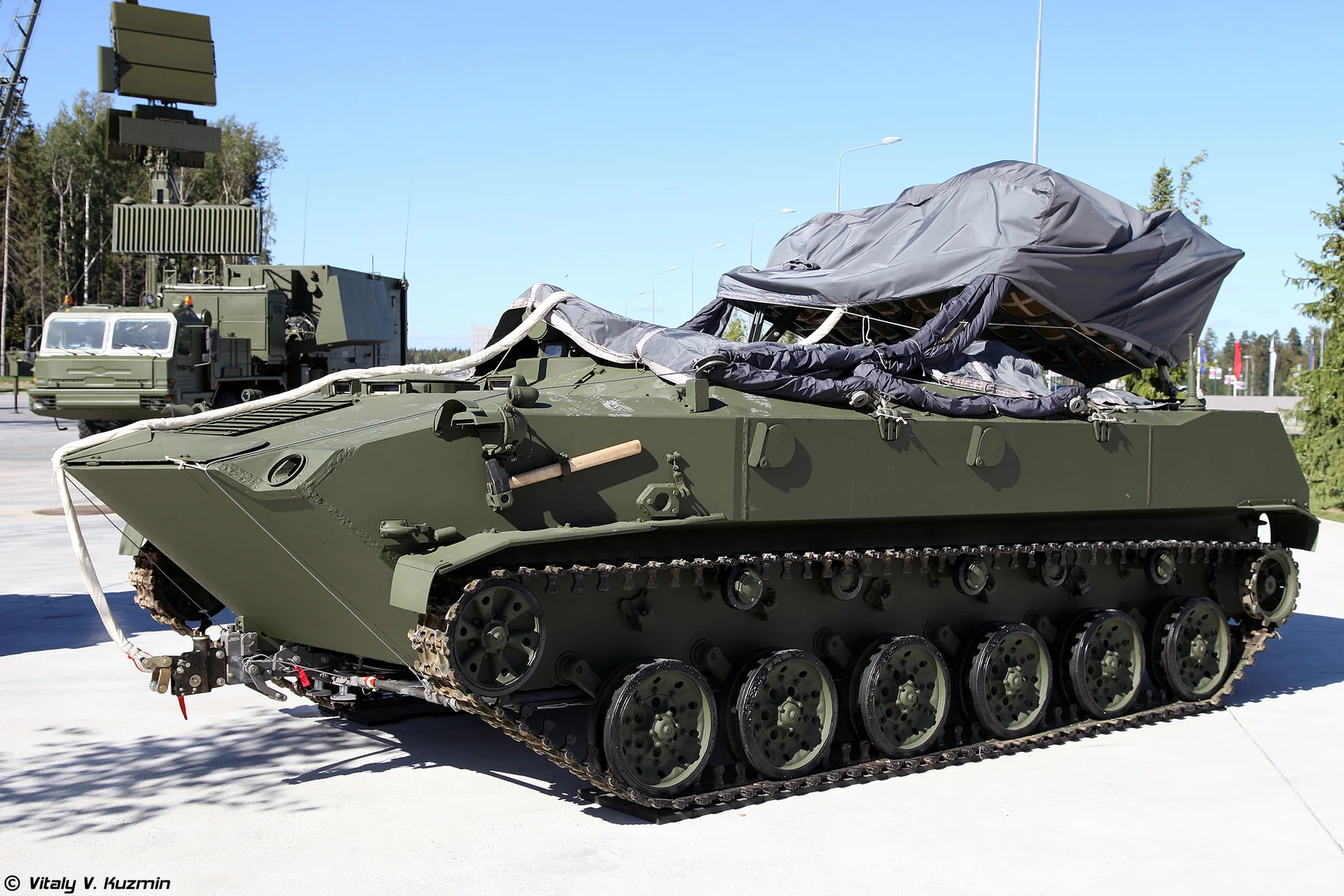
The indexed Army entry distinguishes the BTR-D by six road wheels on each side, compared with five on the BMD vehicle used in its comparison. Wheel count is a useful recognition feature of the stretched carrier. It is not a substitute for a dimensional drawing, and no exact length increase is adopted from the excerpt. The complete ODIN page and the relevant period-manual passage were not available for inspection. 1
Current U.S. Army ODIN material describes the BTR-D as the turretless carrier derivative of the airborne family, lengthened to six road wheels rather than the BMD-1's five. ODIN lists service entry in 1974, an approximate 8.5-ton combat weight, and capacity for ten passengers. Those details are treated here as recognition data for the carrier configuration, not as a blanket specification for every BTR-D-based specialist vehicle. 2
Service and evolution
The BTR-D provided a carrier base for specialist airborne equipment as well as transport. The common chassis relationship is useful for tracing command, communications and weapon-carrying branches, but it does not establish a common payload or crew for every derivative. Equipment fitted for a specialist task can change the available internal space and the way a vehicle is employed. 1
Archive boundaries
The baseline BTR-D is cataloged as an armored personnel carrier rather than a cannon-armed infantry fighting vehicle. Its BMD-derived ancestry describes where the chassis came from; the turretless carrier arrangement describes the baseline transport role. Specialist weapon carriers remain separate configurations within that lineage. 1
Sources and further reading
References and further reading are listed below. Image identification, credit and reuse terms remain with each photograph.
- U.S. Army ODIN, BTR-D equipment entry (indexed excerpt)
- U.S. Army ODIN — BMD-1 family entry including BTR-D carrier
Visit an Armor Museum
Explore the worldwide museum directory to find armored vehicles, collections, and visitor-planning information.
Browse armor museums