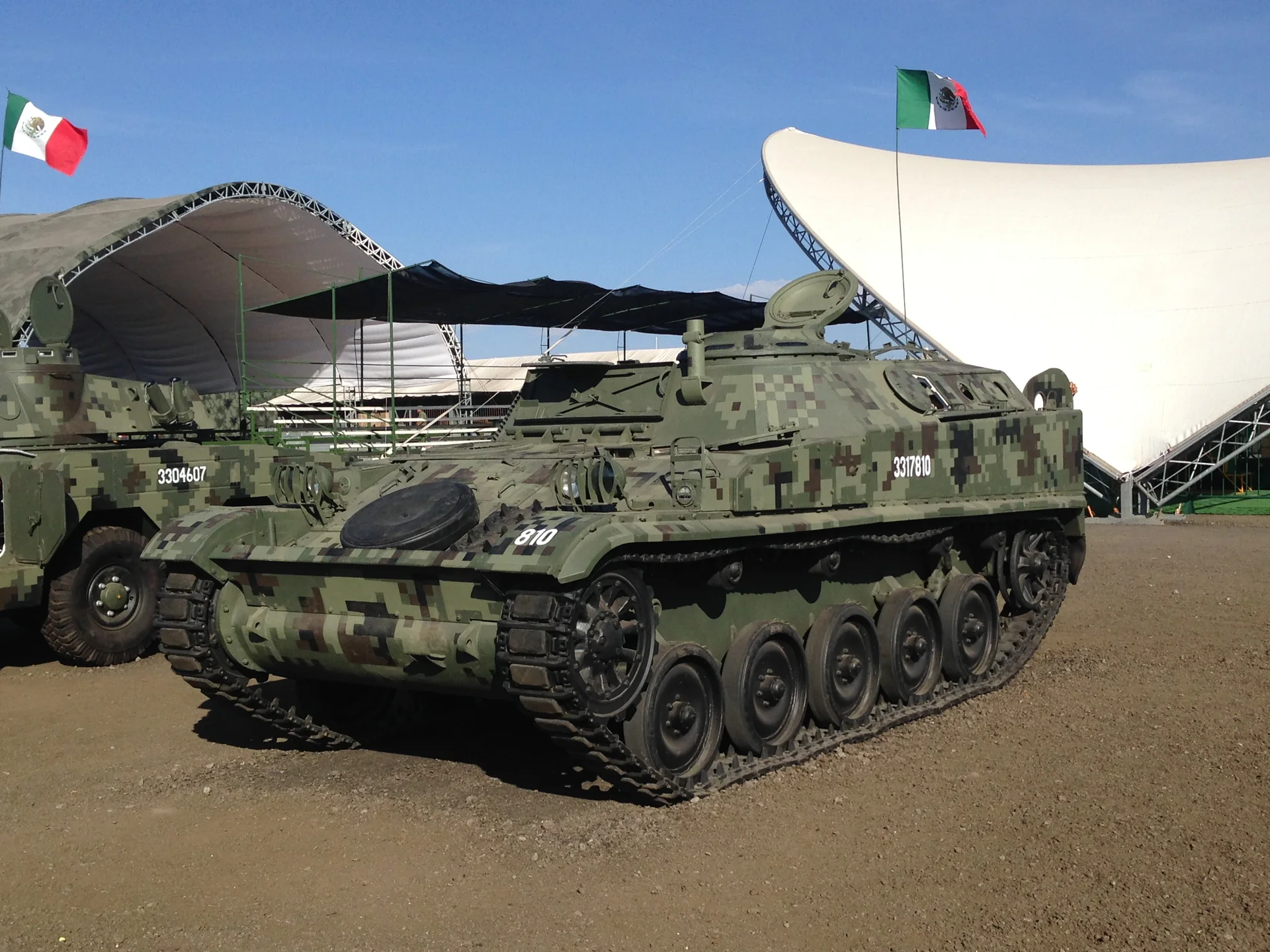
Development and requirement
France used the successful AMX-13 automotive base for more than a light tank. The VTT/VCI branch rearranged the chassis around a troop compartment to support mechanized infantry. 1
The AMX-13 troop-carrier branch adapted the light tank family's tracked automotive base to move infantry under armor. The retained secondary chronology places a prototype in 1955 and production from 1957. VTT, VTP and VCI labels appear across the history of the carrier, so the terminology must be tied to the actual configuration rather than treated as three unrelated vehicles. 1
Design, protection, and mobility
The carrier retained tracked mobility but shifted emphasis from tank firepower to protected transport. Armament varied across versions, reflecting the transitional period before the modern IFV concept became standardized. 1
The carrier retained the AMX-13 family's compact tracked layout but replaced the tank's oscillating-turret fighting arrangement with an enclosed troop compartment. In the reviewed secondary account, the vehicle carried a crew of three plus ten infantry. That capacity and the rear troop space made protected movement the central design purpose even when later versions received more capable turret armament. 1
The VTT/VCI distinction became especially important as armament changed. Machine-gun carrier versions could be fitted with 7.5 mm or 12.7 mm weapons, while later VCI vehicles received a T20-13 or Toucan I turret with a rapid-firing 20 mm cannon. Those configurations should not be collapsed into one universal weapons specification. 1
The Dutch National Military Museum's AMX PRI record describes infantry movement under armor in cooperation with tanks. Its account of the vehicle's .50-inch weapon is unusually useful: operation was possible with the hatches open, using electrical or mechanical control, and with the hatches closed using electrical control. That is a concrete feature of the described Dutch installation, not a reason to assign one weapon station to every French or export VCI. The national designation and equipment fit belong together. 2
Firepower and battlefield role
A 20 mm turret gave later VCI versions more mounted firepower than the early machine-gun carriers, but weapon caliber did not erase the vehicle's troop-carrying function or its protection limits. The archive therefore describes armament by named configuration and avoids presenting the entire AMX-13 carrier family as if every vehicle left production with the same turret. 1
Service, variants, and modernization
AMX-VCI vehicles served France and export users before newer designs such as the AMX-10P took over the infantry-fighting role. 1
The carrier chassis also supported command, engineer, ambulance, cargo, mortar and antitank-missile applications. Those vehicles shared automotive ancestry but consumed interior volume differently and performed different battlefield jobs. Their existence is evidence of a flexible tracked platform, not proof that the baseline troop carrier had the equipment of every specialist derivative. 1
The same museum carefully qualifies the markings on its surviving vehicle. The 42nd Infantry Battalion and B-company identifiers were applied later and are not authentic service markings. A preserved vehicle can therefore document construction and equipment without proving the unit history suggested by its current paint. The catalog dates manufacture to 1962–1965, a range for the object rather than the production life of the whole AMX-VCI family. 2
How the vehicle fits the formation
French service overlapped a transition from wartime-era half-tracks to purpose-built tracked infantry carriers and later to the AMX-10P. The available source is secondary, so unit-level deployment claims are included only where French archival or official records support them. The development and configuration outline is stronger than the current operational-history evidence. 1
A French military film catalog supplies a contemporary doctrinal reference. SCA 840, completed on 29 January 1963, concerns a mechanized infantry section working with armor; AMX-VCI is among its indexed subjects. The synopsis places the film within the period's planning for movement through a battlefield affected by nuclear weapons. This documents the training problem presented to soldiers, not a tested guarantee that the carrier could cross any contaminated area without harm. The catalog synopsis does not establish individual scenes or drills from the full twenty-one-minute film. 3
Strengths, limitations, and family boundaries
The profile remains in the APC category because transport was its core mission, even when particular versions carried heavier weapons. Shared AMX-13 ancestry is represented in lineage rather than by tank classification. 1
The family's strength was reuse of an established light tracked automotive base for protected troop and specialist transport. Its limitation was that successive weapons and mission equipment competed with a compact hull for weight and internal space. That trade is more historically specific than the generic tracked-vehicle sustainment discussion it replaces. 1
AMX-13 carrier designations changed with period and fit. The archive groups VTT/VCI troop-carrying configurations here but keeps command, engineer, ambulance, mortar and missile carriers identified by role. A shared chassis is not enough to make their crews, weapons or mission equipment interchangeable. 1
Another Dutch museum record describes approximately twenty-six AMX PRI vehicles converted into PRAT antitank carriers in the early 1970s. It identifies the armament as TOW and dates the photograph to 1970–1975. This is a documented national branch of the family rather than an additional weapon carried by every troop transporter. The conversion also helps distinguish a family history from a list of optional accessories: a vehicle reassigned to an antitank role was no longer being described solely by its original infantry-carrying function. The approximate number remains a catalog statement, not a newly checked factory conversion ledger. 4
Sources and further reading
- French Wikipedia, AMX-13 VCI (secondary source; not primary certification)
- Nationaal Militair Museum, AMX pantserrups infanterie, object 054576 (indexed evidence only)
- ECPAD ImagesDéfense, Section d’infanterie mécanisée au combat, SCA 840 (indexed evidence only)
- Nationaal Militair Museum, AMX PRI to PRAT conversion photograph, object 00028643 (indexed evidence only)
Visit an Armor Museum
Explore the worldwide museum directory to find armored vehicles, collections, and visitor-planning information.
Browse armor museums