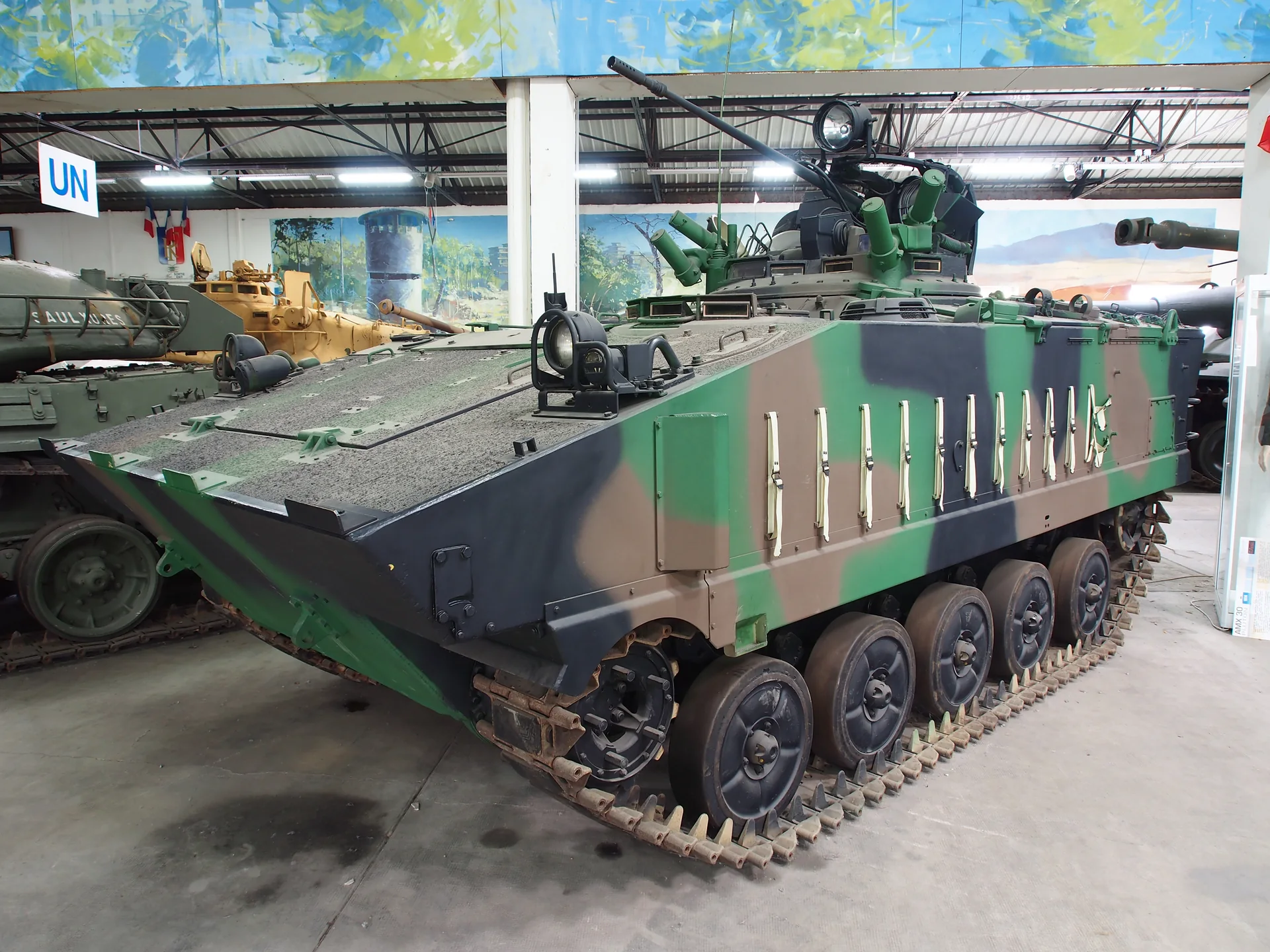
Development and requirement
The AMX-10P was developed to give French mechanized infantry a tracked, amphibious fighting vehicle with a 20 mm cannon and a protected troop compartment. The retained French archival catalog identifies files associated with its development and program history. That catalog establishes the existence and subject of records but does not expose the underlying engineering reports or trial results. The vehicle’s development chronology and early acceptance details are not fully established without those records or an accessible official history. 1, 2
The AMX-10P combined French mechanized infantry transport with a turreted 20 mm cannon in a tracked, amphibious vehicle. Its relationship to the infantry formation is more useful than a simple comparison with a tank: the hull had to move soldiers and their equipment, while the turret supplied mounted fire support. Amphibious capability also imposed limits on the weight that could be added without changing the vehicle’s mobility characteristics. These competing requirements explain why the troop compartment, protection and automotive arrangement must be considered together rather than judged solely from the cannon’s caliber. 1, 2
Design, protection, and mobility
The AMX-10P used a light tracked chassis, rear troop compartment, and amphibious capability. Standard French vehicles carried a turreted 20 mm cannon, providing substantially more support than machine-gun-armed APCs. The platform also proved adaptable to command, fire-support, radar, missile, and other specialized roles, with export customers selecting additional configurations. 1, 2
Amphibious capability strongly influenced the proportions and weight discipline of the AMX-10P. A vehicle that must swim cannot simply add armor without consequence: buoyancy, freeboard, water propulsion, sealing, trim, and the location of heavy components all constrain later growth. That capability can be operationally important where rivers, canals, coastal approaches, or destroyed bridges would otherwise halt a mechanized force, but it also forces a different protection balance than a vehicle designed only for land combat. The most meaningful comparison is therefore with other amphibious fighting vehicles serving the same mission rather than with much heavier non-amphibious designs. 1, 2
Protection and internal volume are especially difficult problems in an infantry fighting vehicle because the hull must serve both a vehicle crew and a dismounted fighting element. The troop compartment needs usable space, access routes, ammunition stowage, communications, and enough separation from fuel and mechanical systems to make the vehicle practical in repeated operations. Adding armor improves resistance to fragments and direct fire, but it also increases weight and can reduce mobility, amphibious margin, payload, or growth capacity. As threats change, many IFV modernization programs therefore become exercises in managing accumulated weight and electrical demand as much as in fitting a new gun or sight. 1, 2
Firepower and battlefield role
The vehicle’s principal armament, 20 mm autocannon on standard French vehicle, defines much of how the AMX-10P can contribute after contact. Cannon and antitank weapons can allow an infantry or reconnaissance vehicle to suppress positions, engage light armor, and threaten heavier vehicles under favorable conditions without depending on a tank for every target. That firepower changes tactics because the carrier can support the infantry before and after dismount, cover movement, and respond quickly to targets that would otherwise require a separate support weapon. At the same time, mounted firepower does not erase the distinction between an IFV and a main battle tank: protection, ammunition, sensors, and survivability remain optimized around different missions. 1, 2
Service, variants, and modernization
AMX-10P served for decades with French mechanized units and was exported to several countries. France later upgraded part of the fleet before replacing the type with VBCI. The transition from AMX-10P to VBCI also illustrates the French move from a tracked Cold War IFV to a heavily protected eight-wheeled vehicle for much of the infantry combat role. 1, 2
The AMX-10P family included specialist arrangements as well as the standard infantry vehicle. Command and support equipment could change the interior and crew’s work even where the exterior remained recognizable. Export or upgraded vehicles therefore need their own configuration records. A catalog entry for development or modification files can establish that relevant documentation exists, but not the contents of a test report or the date when an entire fleet accepted a change. Those distinctions remain open until the underlying records or a sufficiently detailed official equipment description can be read. 1, 2
How the vehicle fits the formation
In combined-arms employment, the AMX-10P is not an independent substitute for tanks, infantry, artillery, engineers, or air defense. Its purpose is to connect protected mobility with the infantry's ability to seize and hold ground. The mounted crew can observe and engage while the dismounted element deals with terrain and threats that cannot be solved from inside the hull. Effective use therefore depends on coordination: tanks provide heavier direct fire and protection, artillery and mortars suppress or isolate, engineers open routes, and the infantry fighting vehicle moves soldiers while contributing its own sensors and weapons. The platform is most effective when those capabilities overlap rather than when it is sent forward alone. 1, 2
Strengths, limitations, and family boundaries
AMX-10P remains a distinct tracked IFV profile. PAC 90 and other heavily armed derivatives are treated as family variants or linked direct-fire systems depending on how prominently they were fielded, while VBCI is a separate vehicle family. 1
The AMX-10P’s design illustrates the balance between a relatively light amphibious carrier and the demands of mounted combat. A cannon and an infantry compartment occupy the same limited hull, while additional protection has consequences for weight and water crossing. Its value to mechanized infantry came from combining these functions, not from matching a main battle tank’s armor or weapon. The vehicle should be assessed as the specific French solution it was, without adding the capabilities of later wheeled vehicles or unrelated designs bearing similar AMX names. 1, 2
AMX-10P and AMX-10RC are not tracked and wheeled versions of one infantry carrier. The former belongs to the infantry fighting vehicle role, while the latter is a distinct wheeled reconnaissance and direct-fire vehicle. Shared elements of a name are not proof of a common hull or mission. Within the AMX-10P family, command and specialist variants also require separate descriptions where their equipment displaced the standard infantry arrangement. Maintaining these distinctions is essential before comparing production history, armament or operational accounts. 1, 2
Sources and further reading
References and further reading are listed below. Image identification, credit and reuse terms remain with each photograph.
- Service historique de la Défense — armored-vehicle program records, including AMX-10P
- AMX-10P development and service summary
Visit an Armor Museum
Explore the worldwide museum directory to find armored vehicles, collections, and visitor-planning information.
Browse armor museums