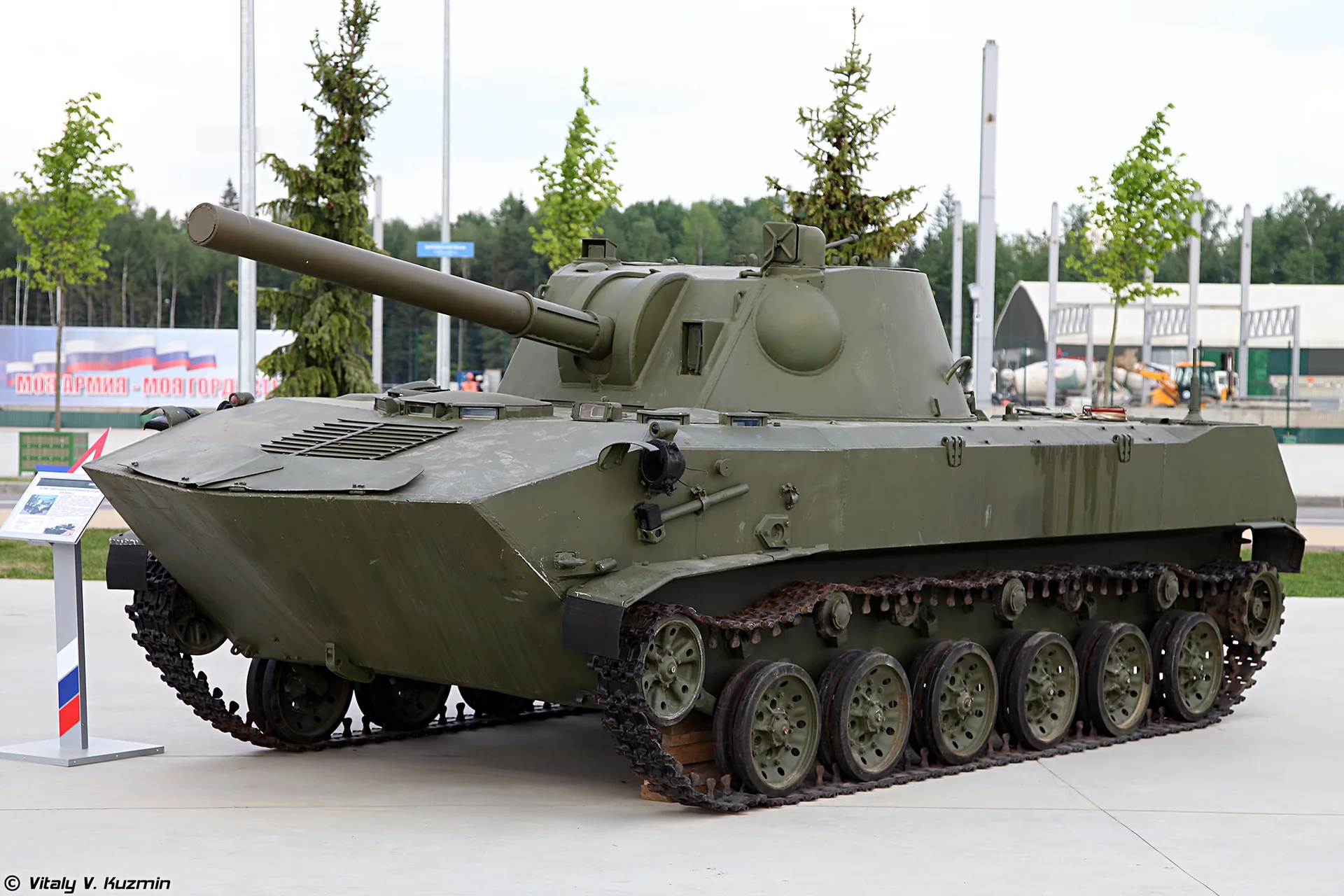
Development and design
Soviet airborne formations had a recurring artillery problem: the guns that delivered useful indirect fire were often heavier and less mobile than the armored vehicles carried by the same air-landing force. During the 1970s, designers therefore pursued a self-propelled weapon light enough for airborne employment but more versatile than a conventional mortar carrier. The result was the 2S9 Nona-S, developed around the BTR-D family of lightweight tracked airborne vehicles and accepted for service in 1981. The vehicle turned a specialized chassis into an organic artillery platform rather than forcing airborne troops to depend entirely on towed weapons after landing. 1, 2
A BTR-D-derived chassis with a compact turret
The 2S9 uses a low aluminum tracked chassis derived from the BTR-D airborne personnel carrier family. Its driver and commander occupy hull positions while the gunner and loader work in the turret. The vehicle's modest size, variable-height hydropneumatic suspension, and relatively low combat weight are consequences of its airborne requirement rather than attempts to match the protection of a tank-based self-propelled howitzer. The design preserves tracked cross-country mobility and amphibious capability while leaving enough internal volume for the turret, ammunition, crew stations, and the mechanical systems needed to operate the 120 mm gun-mortar. 1, 2
The 120 mm 2A51 gun-mortar
The breech-loaded 120 mm 2A51 is the defining feature of the original Nona-S. It combines high-angle fire with a direct-fire capability and uses ammunition developed for the gun-mortar role. That makes the vehicle more than a conventional mortar simply carried inside an armored personnel carrier. Later Nona-family weapons and the modernized 2S9-1M belong to the wider lineage but should not supply automatic specifications for an original 1981 vehicle. 1, 2
Ammunition flexibility shaped the system
The Nona concept combined purpose-built 120 mm gun-mortar projectiles with provision for compatible mortar ammunition. Caliber alone, however, is not proof that every 120 mm round can be used in every configuration. The relevant weapon, ammunition approval and fire-control equipment still matter. Early vehicles and later modernizations also differ in stowage. Their ammunition capacities should not be collapsed into one family-wide figure merely because they share the Nona name. 1, 2
Mobility was designed around airborne employment
The 2S9 inherited the basic mobility logic of the Soviet airborne armored family. A 240-horsepower diesel powered a light tracked vehicle with hydropneumatic suspension, giving it respectable road speed and useful cross-country performance for its weight. The suspension can alter ground clearance, a characteristic associated with BMD- and BTR-D-family vehicles, and the hull is amphibious. These qualities helped the gun keep pace with paratroopers mounted in similarly light tracked vehicles after landing, when road networks, bridging capacity, and heavy recovery support might be limited. 1, 2
From mechanical laying to digital modernization
Early Nona-S vehicles reflected late Cold War artillery practice, relying on the crew, unit observers, communications, and battery-level fire-control procedures rather than the integrated digital architecture expected on modern self-propelled guns. The vehicle itself supplied mobility, protection from weather and fragments, and a flexible weapon, but it did not eliminate the wider artillery system needed to locate targets, compute firing data, coordinate batteries, and sustain ammunition. That distinction is important because the gun vehicle is only one element of an artillery battery's effectiveness. 1, 2
Nona became a family rather than a single vehicle
The tracked 2S9 was only one expression of the Nona idea. The Soviet and Russian families extended the gun-mortar concept to other platforms, including the wheeled 2S23 Nona-SVK and the towed 2B16 Nona-K. Within the tracked line, the 2S9-1 altered internal arrangements and ammunition capacity, while later modernization packages updated electronics. These variants show that the enduring concept was not a particular hull but a 120 mm multifunction support weapon able to serve forces that wanted mortar-like high-angle fire with the ballistic and handling characteristics of a breech-loaded artillery system. 1, 2
The ammunition and fire-control story changed within the family. The same source lists twenty-five rounds for the original 2S9 and forty for the 2S9-1, while later 2S9M work added newer navigation and fire-control equipment. Those differences make variant identification important when comparing endurance, crew workload or responsiveness. 2
Service history
The 2S9 entered Soviet service in 1981 and became closely associated with airborne and air-assault formations. Its operational value lay less in matching the range of heavy artillery than in giving light forces organic fire support with the same general mobility and deployment constraints as their armored carriers. After the Soviet Union dissolved, vehicles remained in Russian and other post-Soviet inventories. The platform's continued presence reflected both the usefulness of the 120 mm concept and the difficulty of replacing a specialized air-droppable artillery system with an entirely new family. 1, 2
Airborne versatility came with strict physical limits
The design's greatest strength was also its main limitation. By keeping weight low enough for airborne use, the 2S9 could not carry heavy armor, a large turret, or the ammunition reserve of a much larger self-propelled howitzer. The crew works inside a compact fighting compartment, and the vehicle's protection remains oriented toward fragments and small arms. Its gun is exceptionally flexible for its size, yet it cannot duplicate the range, projectile mass, or sustained volume of fire available from 152 or 155 mm brigade and divisional artillery. 1, 2
Historical place
Nona-S combined an airborne BTR-D-derived chassis with a 120 mm weapon able to perform both mortar and gun-like fire missions. Weaponsystems.net places development in the 1970s, state trials in 1980 and service entry in 1981. Its historical importance therefore lies in giving airborne forces a compact, paradroppable and amphibious fire-support vehicle rather than in competing directly with full-size divisional howitzers. 2
Sources and further reading
References and further reading are listed below. Image identification, credit and reuse terms remain with each photograph.
- U.S. Army ODIN — 2S9-1M (Nona-S) Russian 120mm Self-Propelled Mortar
- Weaponsystems.net, 2S9 Nona-S (secondary source; not primary certification)
Visit an Armor Museum
Explore the worldwide museum directory to find armored vehicles, collections, and visitor-planning information.
Browse armor museums