Development and design
The 2S31 Vena emerged from the same Soviet interest in multifunction 120 mm artillery that produced the 2S9 Nona-S, but it answered a different set of constraints. Nona-S had to remain extremely light for airborne employment; Vena could use the larger BMP-3 chassis and devote more weight and internal volume to ammunition, fire control, and crew systems. U.S. Army ODIN describes it as a more capable and higher-end alternative to earlier Nona-family systems, especially for direct-fire support and more demanding artillery missions. The design therefore traded air-droppability for a broader performance envelope. 1, 2
A BMP-3 hull converted into an artillery vehicle
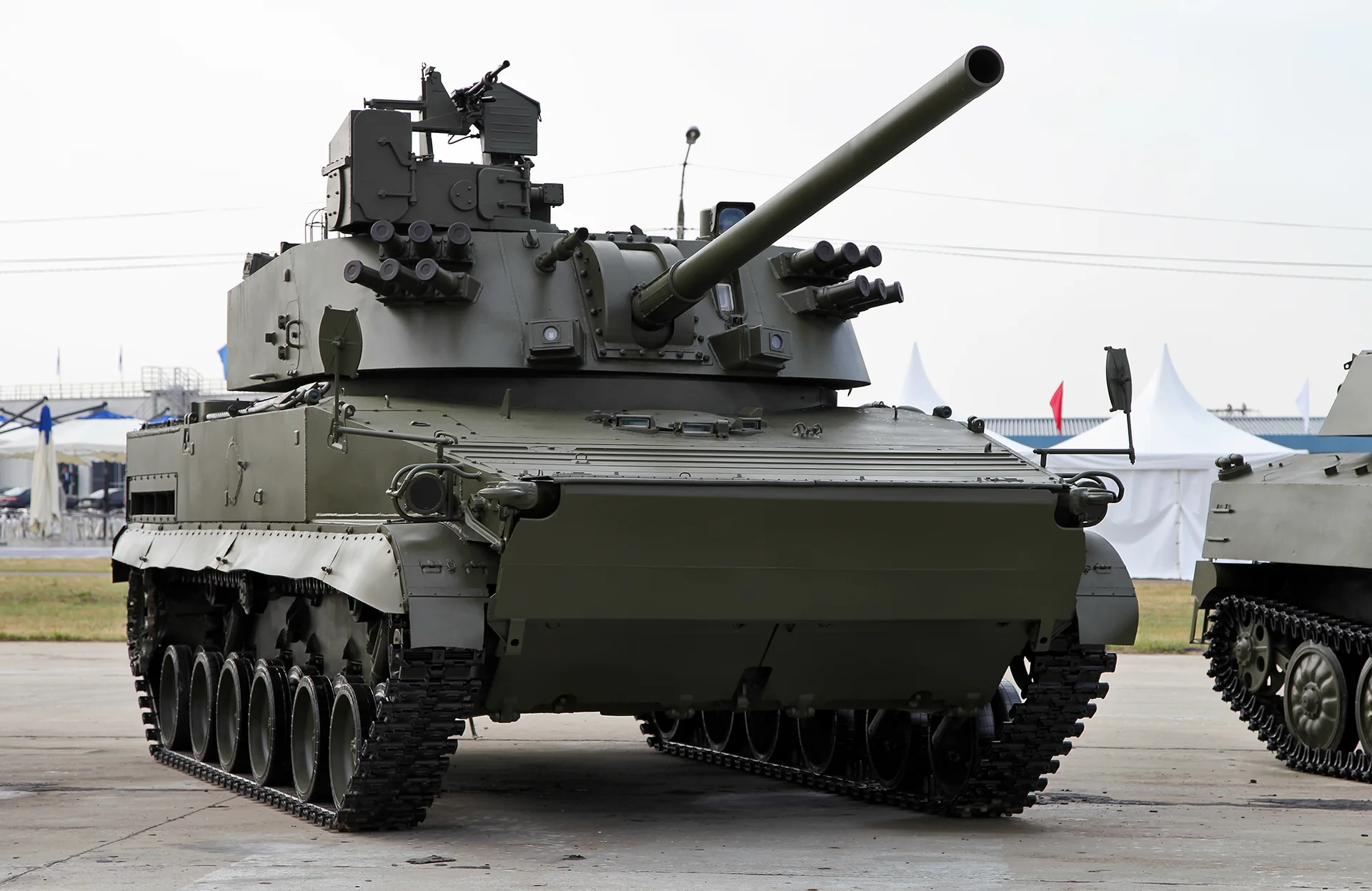
The 2S31 uses a BMP-3-family tracked chassis with the driver forward, a large turret near the center, and engine and drivetrain components toward the rear. This layout differs from many Western self-propelled howitzers, which normally place the engine at the front and turret at the rear. Because the base chassis was designed as an amphibious infantry fighting vehicle, Vena inherited a relatively compact hull, good power-to-weight ratio, and water-jet propulsion. The artillery turret replaces the troop-carrying function and occupies the volume needed for ammunition, crew, sights, and loading equipment. 1, 2
The longer 120 mm 2A80 gun-mortar
Vena's main armament is the 120 mm 2A80 rifled gun-mortar. ODIN notes that it is longer than the weapons fitted to 2S9 Nona-S and 2S23 Nona-SVK, while retaining the ability to use a broad range of 120 mm ammunition. The weapon can perform high-angle indirect fire and can also engage in flatter trajectories when the tactical situation requires it. This makes the vehicle difficult to classify through caliber alone: it is not merely a mortar carrier, yet its 120 mm weapon is not a conventional howitzer in the same sense as a 2S19. 1, 2
Seventy rounds change endurance more than caliber
One of the clearest improvements over Nona-S is ammunition capacity. Published specifications give Vena about seventy 120 mm rounds, roughly doubling the internal load of many earlier gun-mortar vehicles. That larger reserve increases the number of missions a vehicle can support before replenishment and gives crews more room to carry different projectile types. It also demonstrates what the larger BMP-3-derived chassis buys: not just a heavier turret, but greater endurance and flexibility at the firing position. 1, 2
Automation is the real generational leap
The most important distinction between Vena and its predecessors is not simply the longer barrel. ODIN highlights a high level of automation and an advanced fire-control suite. A modern artillery vehicle benefits from knowing its own location and orientation, receiving target data digitally, computing firing solutions rapidly, and laying the weapon without lengthy manual survey. These capabilities shorten the sequence between receiving a fire mission and delivering the first round, which in turn reduces the time the vehicle spends stationary and exposed to counterbattery response. 1, 2
ODIN emphasizes automation and fire-control equipment as defining features of the 2S31. That matters because 120 mm caliber alone does not explain Vena's place in the family: navigation, targeting and command integration were intended to shorten the path from receiving a fire mission to placing rounds on target. 3
BMP-3 automotive commonality and amphibious movement
The BMP-3-derived chassis gives Vena a 450-horsepower diesel engine in commonly published specifications and a road speed around seventy kilometers per hour. More important for mechanized units is cross-country mobility and amphibious capability. Water jets allow the vehicle to swim without a separate bridge or ferry for every minor water obstacle, and the tracked suspension can follow infantry fighting vehicles through terrain where trucks may struggle. This makes Vena particularly suitable for formations that already rely on BMP-3-family mobility. 1, 2
Protected operation, but not heavy armor
Vena provides an enclosed armored workspace for its four-person crew, protecting them from weather, small-arms fire, and shell fragments. ODIN and secondary sources also describe NBC protection and smoke systems, while some prototype descriptions include additional defensive equipment that should not automatically be assumed on every fielded vehicle. The hull and turret do not provide tank-level protection. The vehicle's survivability strategy instead combines modest armor with mobility, low time in firing positions, and the ability to operate with mechanized units rather than remain fixed like a towed mortar. 1, 2
Service history
Published reference accounts place Vena's Russian introduction around 2010 and associate export vehicles with Azerbaijan. They do not establish a complete delivery history or current operational inventory. The vehicle occupied a more specialized position than the mass-produced Soviet howitzers that preceded it. Limited public reporting should not be turned into an exact fleet total, nor does it prove a particular procurement decision was caused by cost or by competition from older vehicles. 1, 2
A sophisticated answer to a relatively narrow requirement
Vena combines a substantial artillery turret with a relatively light amphibious chassis. That arrangement provides more ammunition space and equipment than the airborne Nona-S, but it does not produce the projectile weight or reach of a heavy 152 or 155 mm howitzer. Its protection remains appropriate to a support vehicle rather than a tank. These are design tradeoffs; without procurement evidence, they should not be presented as proven explanations for its limited distribution. 1, 2
Historical place
Vena took the 120 mm gun-mortar concept into a BMP-3-derived chassis with a much more automated fire-control environment. U.S. Army ODIN's indexed description identifies the 2A80 rifled gun-mortar and presents the vehicle as a more capable direct- and indirect-fire system than the earlier wheeled 2S23. The comparison is therefore about an artillery-system generation and chassis choice, not simply about replacing every earlier Nona vehicle. 3
Sources and further reading
References and further reading are listed below. Image identification, credit and reuse terms remain with each photograph.
- U.S. Army ODIN — 2S31 Vena Russian Amphibious 120mm Self-Propelled Mortar
- Weaponsystems.net — 2S31 Vena
- U.S. Army ODIN, 2S31 Vena (indexed asset-page evidence only)
Visit an Armor Museum
Explore the worldwide museum directory to find armored vehicles, collections, and visitor-planning information.
Browse armor museums