
Development and requirement
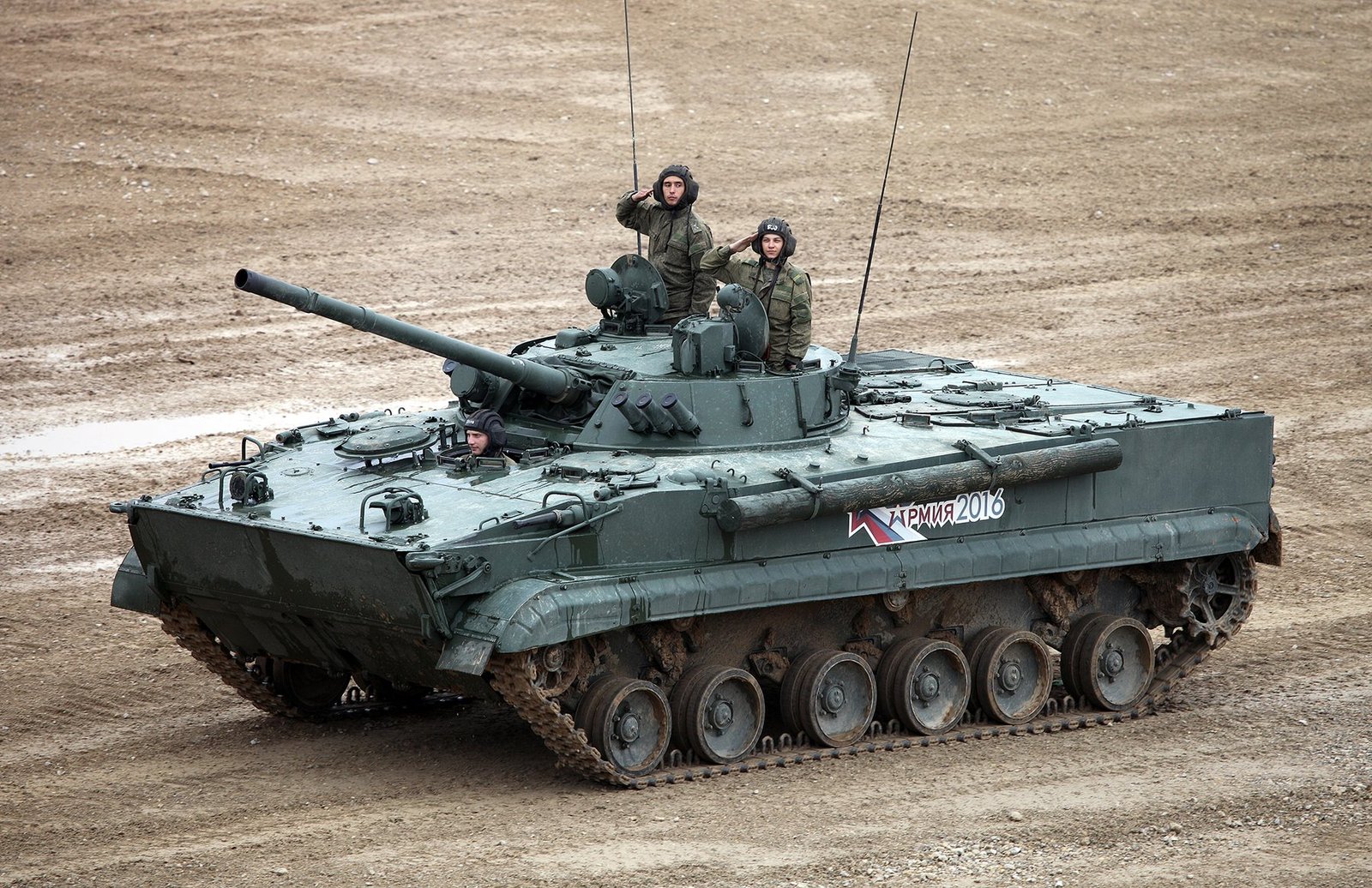
Development of the BMP-3 moved beyond incremental modification of the BMP-1/2 layout. Soviet designers adopted a new chassis and power-pack arrangement while seeking a vehicle that could deliver heavier fire support, remain amphibious, and transport infantry with armored formations. The result entered service near the end of the Cold War and paired troop transport with a weapons suite closer to a light fire-support vehicle than to most contemporary IFVs. 1, 2
Design and fighting role
The BMP-3 turret combines a 100 mm low-velocity gun capable of firing guided missiles with a 30 mm autocannon and coaxial machine gun. This offers high explosive effect, rapid-fire capability, and antitank reach in a single mount. The rear engine complicates infantry access compared with front-engined Western IFVs, while the vehicle’s amphibious design and light construction continue the Soviet priority on mobility and water crossing. 1, 2
Service and evolution
The BMP-3 has been fielded by Russia and exported to several countries, with later versions incorporating improved engines, sights, fire control, and protection. BMP-3M and associated turret developments demonstrate how the family has been modernized without abandoning the central 100/30 mm armament concept. The vehicle also became a basis for command and specialized platforms. 1, 2
Archive boundaries
The BMP-3 is a distinct generation rather than a simple BMP-2 upgrade. Related chassis-based vehicles and command variants stay linked to this family, while role-changing derivatives should appear elsewhere in the archive under their actual mission. 1
Sources and further reading
Representative source set used for this profile. Primary image source and reuse terms are listed with the image.
- U.S. Army TRADOC ODIN Worldwide Equipment Guide — BMP-3 search
- U.S. Army TRADOC ODIN Worldwide Equipment Guide — BMP-2 search