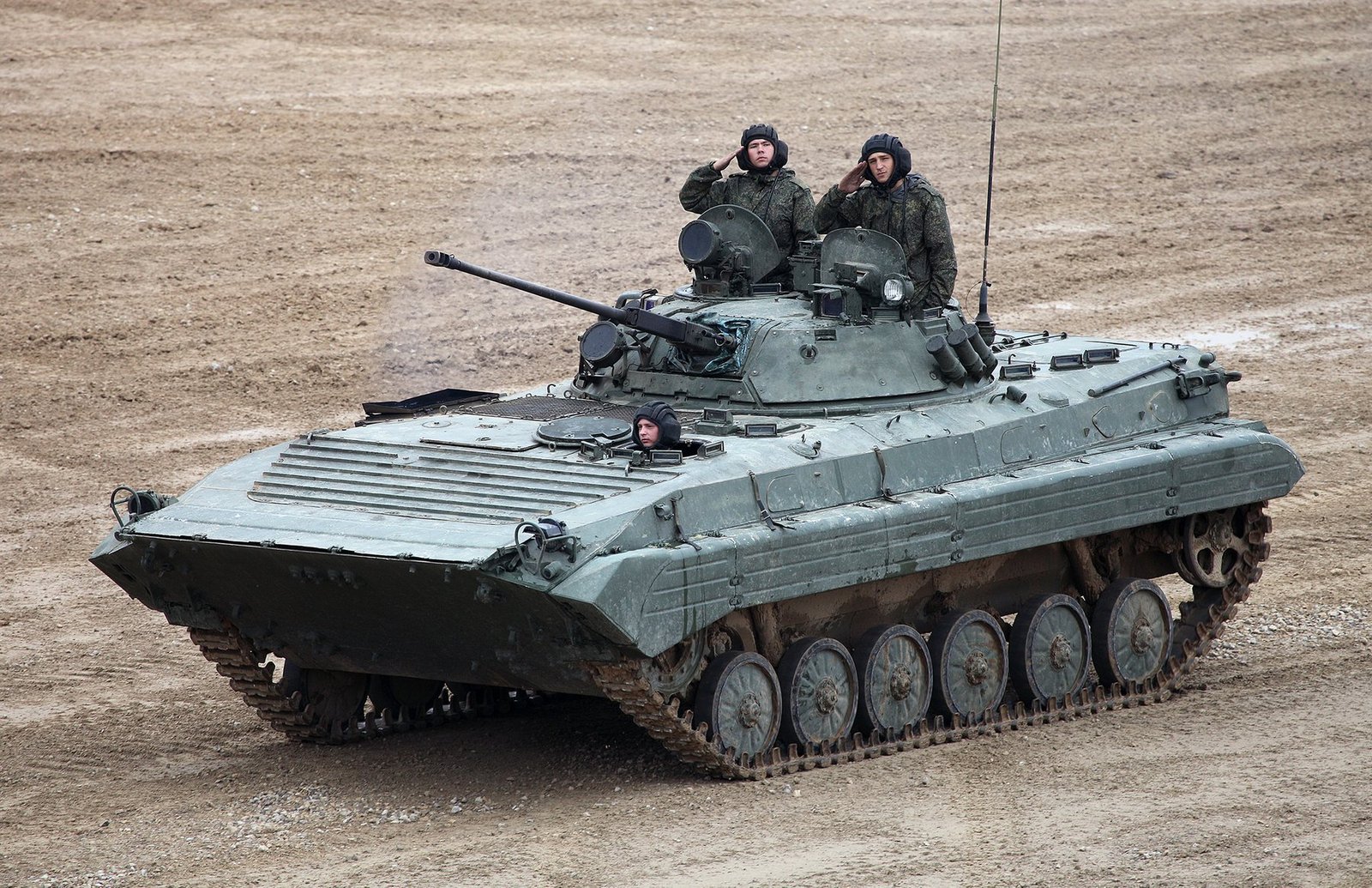

Development and requirement
Experience with the BMP-1 highlighted the need for better gun elevation, faster engagement of infantry and light armor, and a more useful weapon in Afghanistan-like terrain. The resulting BMP-2 retained much of the earlier chassis concept but introduced a larger two-man turret and the 30 mm 2A42 cannon. This evolutionary approach allowed Soviet motor-rifle units to gain a substantial increase in firepower without abandoning the logistics and mobility philosophy established by the BMP-1. 1, 2
Design and fighting role
The 2A42 autocannon became the defining feature of the BMP-2. Its high elevation supported engagement of targets on slopes and low-flying aircraft, while the turret-mounted antitank missile launcher preserved the ability to threaten tanks at range. The vehicle remained amphibious and relatively light, with a rear troop compartment and firing ports, but the larger turret reduced troop capacity and kept the protection compromises of the Soviet lightweight IFV tradition. 1, 2
Service and evolution
BMP-2s spread across Soviet and allied formations during the late Cold War and later served in numerous post-Soviet conflicts. Afghanistan prompted the BMP-2D protection package, while later modernization packages such as Berezhok added improved sights, missiles, and fire-control components. The vehicle remains widely encountered because of the enormous installed fleet and the practicality of upgrading its weapons and sensors. 1, 2
Archive boundaries
Although BMP-1 and BMP-2 share an obvious lineage, the turret and armament change fundamentally altered how the vehicle fought, so the archive treats them as separate generations. BMP-2M modernization stays within this profile because the core hull and role remain those of the BMP-2 family. 1
Sources and further reading
Representative source set used for this profile. Primary image source and reuse terms are listed with the image.
- U.S. Army TRADOC ODIN Worldwide Equipment Guide — BMP-2 search
- U.S. Army TRADOC ODIN Worldwide Equipment Guide — BMP-1