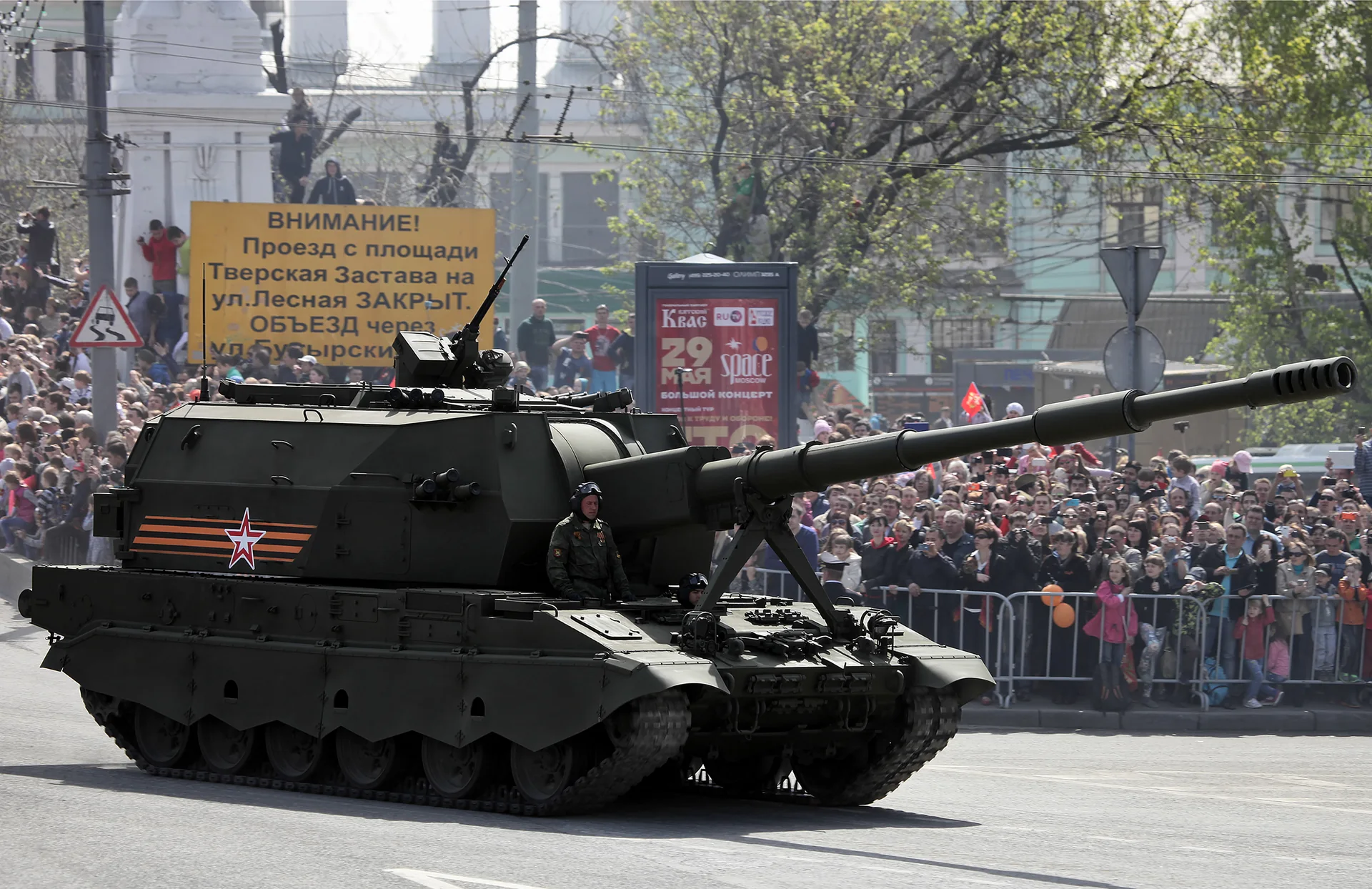
Development and design
Koalitsiya-SV had an unusually visible false start. Early development used a modified Msta-S chassis and a turret carrying two 152 mm barrels arranged one above the other. The concept sought extremely high fire output through paired guns and automated loading, but the twin-barrel approach was abandoned. The program retained the Koalitsiya name while moving toward a completely different single-barrel system with a new turret and much greater emphasis on isolating the crew from the ammunition-handling machinery. This history is important because photographs of the early demonstrator and the later production-direction vehicle depict fundamentally different designs. 1, 2
Crew forward, automated turret above
The single-barrel 2S35 uses a six-road-wheel tracked chassis with the crew concentrated forward in the hull. Its large turret is arranged around the gun and ammunition-handling machinery rather than occupied in the same way as Msta's crewed turret. The external resemblance to Russian tank automotive components does not establish that every element is interchangeable. The architectural change is the separation of the crew's working compartment from much of the gun machinery. 1, 2, 3
The 152 mm 2A88 and ammunition-dependent range
The single-barrel 2S35 is associated with the 152 mm 2A88 howitzer and a highly automated ammunition-handling system. Public descriptions emphasize a higher firing rate and increased reach compared with earlier Msta versions. Exact range depends on the projectile and charge, while promotional maximums are not universal performance figures. No single long-range number is used here as a specification for every round or as proof of demonstrated battlefield performance. 1, 2, 3
Automation is the defining feature
Rostec's description of the system emphasizes that shot preparation, projectile selection, fuze setting, and gun laying are highly automated. The crew controls the weapon from the protected hull compartment rather than manually working through each stage in the turret. This arrangement can reduce reaction time and crew fatigue while improving consistency between rounds. It also makes the vehicle more dependent on software, sensors, electrical actuators, and mechanical conveyors. A failure in one of those systems may have a larger effect than on a manually loaded howitzer whose crew can bypass some functions by hand. 3
Automatic handling moves the bottleneck outward
A highly automated loader can move projectiles and charges faster than a human team for short bursts, but it does not create ammunition. Koalitsiya therefore shifts some of the bottleneck from the breech to the resupply chain. Ammunition vehicles must deliver the correct projectiles and modular charges, and the battery must replenish the onboard system without exposing the gun for long periods. The faster the vehicle can fire, the faster it can empty its ready supply. This is a general paradox of modern artillery automation: mechanical rate improves, but logistics must accelerate with it. 1, 2, 3
Tracked mobility remains conventional even as the turret changes
For all its turret automation, the tracked 2S35 retains a conventional operational logic below the turret ring. A diesel-powered armored chassis gives it cross-country mobility with mechanized forces, the ability to use prepared or unprepared firing positions, and enough road speed to relocate between missions. Published figures commonly place road speed around sixty kilometers per hour. The tracked configuration sacrifices some road economy and strategic mobility compared with a truck-mounted gun but provides lower ground pressure and better performance over soft or broken terrain. 1, 2
Crew isolation changes, but does not solve, survivability
Concentrating the crew in the forward hull separates their working positions from much of the turret machinery. That is an important layout distinction from earlier crewed-turret Soviet howitzers. It should not be converted into a quantified survival advantage without testing evidence. Armor, internal separation and automated handling address different hazards, and none makes an ammunition-carrying artillery vehicle immune to attack or mechanical failure. 1, 3
Dated evidence matters more than a claimed inventory
Public presentation, testing and service introduction are separate milestones in the Koalitsiya program. The single-barrel vehicle appeared publicly in 2015, while published accounts cite a Rostec announcement of completed state trials in October 2023. That is a dated manufacturer claim about a development milestone, not a verified total of operational guns. It does not establish when a particular formation received a complete battery or how many vehicles were available at a later date. 1, 2, 3
An indexed secondary profile characterizes Koalitsiya-SV in prototype or pre-full-service terms, while other public statements discuss state testing and production. That conflict is itself relevant evidence. It supports recording each dated milestone separately rather than converting announcements about trials or manufacturing into proof of routine unit fielding. 4
Complexity is the price of reducing crew workload
Koalitsiya-SV attempts to solve many artillery problems through automation, which creates a new class of maintenance problem in return. Sensors must remain calibrated, conveyors must handle heavy projectiles reliably, software must coordinate the firing cycle, and electrical and hydraulic systems must work under shock, vibration, dust, cold, and heat. A manually loaded gun may be slower but can sometimes tolerate partial equipment failure through crew improvisation. A highly automated turret offers far less value if its handling system cannot complete the cycle. Reliability and maintainability are therefore as important as peak firing performance. 1, 2, 3
Service history
The 2015 public appearance of the single-barrel vehicle followed the earlier twin-barrel development effort. The cited 2023 Rostec announcement places completion of state trials years after that display. Together, those milestones outline a prolonged development history, but they do not establish a complete operational service record. Prototype visibility, testing, manufacturing announcements and delivery to a formation answer different historical questions. 2, 3
Historical place
Koalitsiya-SV requires unusually careful milestone language. Accessible public sources use different labels for prototype status, testing, production and service, and those terms are not interchangeable. This archive therefore treats the single-barrel 2S35 shown publicly as a distinct later system from the earlier twin-barrel demonstrator and avoids assigning a precise operational-service date unless a dated acceptance or fielding record supports it. 4
Sources and further reading
References and further reading are listed below. Image identification, credit and reuse terms remain with each photograph.
- U.S. Army ODIN — 2S35 Koalitsiya-SV Russian 152mm Self-Propelled Howitzer
- Weaponsystems.net — 2S35 Koalitsiya-SV
- Rostec — State trials of Koalitsiya-SV completed, October 2023
- Weaponsystems.net, 2S35 Koalitsiya-SV
Visit an Armor Museum
Explore the worldwide museum directory to find armored vehicles, collections, and visitor-planning information.
Browse armor museums