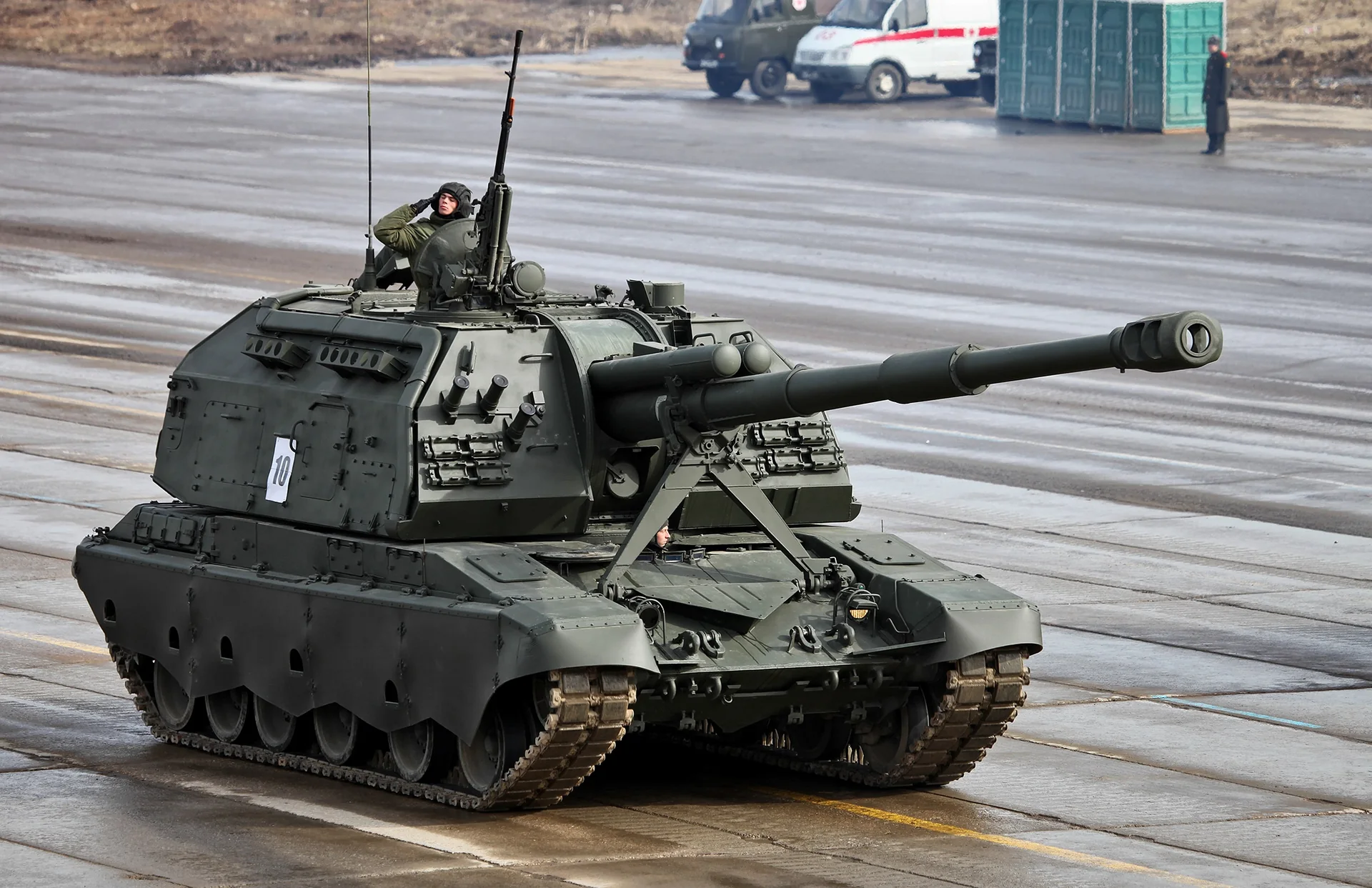
Development and design
By the late 1970s the Soviet Army's 2S3 Akatsiya remained useful, but its gun, fire-control arrangements, and overall architecture belonged to an earlier generation. Soviet requirements therefore called for a new 152 mm self-propelled howitzer with greater range, a faster ammunition-handling cycle, and better integration with the evolving artillery command system. Development that became the 2S19 Msta-S began around 1980 under the Ferma program. The weapon entered service in 1989, just as the Soviet Union approached its final years, making it both a culmination of Soviet armored artillery design and the starting point for decades of Russian modernization. 1, 2
ODIN labels the development effort Ferma and the vehicle Object 316. Those designations belong to the development history, whereas 2S19 is the service-family designation. Keeping them separate helps prevent prototype and program names from being treated as additional operational variants. 4
A hybrid chassis and a very large artillery turret
Msta-S is often described as tank-derived, but its automotive lineage is more accurately a hybrid. ODIN states that the vehicle uses a T-80-based hull while being powered by a diesel engine associated with the T-72 family. The driver sits forward in the hull, the engine and automotive components occupy the lower chassis, and the large turret dominates the rear portion of the vehicle. Six road wheels on each side and the broad tracked footprint give it the mobility expected of a system intended to accompany armored and mechanized formations. 1, 2
The 152 mm 2A64 and a broader ammunition family
The 2A64 152 mm howitzer gave Msta-S substantially greater reach than the older weapons it was intended to supplement or replace. ODIN lists conventional high-explosive ranges in the mid-twenties of kilometers, greater reach with base-bleed or rocket-assisted ammunition, and compatibility with specialized projectiles including the Krasnopol guided family. Exact maximum range depends on the projectile, propelling charge, and variant, so a single headline number obscures the way artillery performance actually works. The important change was the ability to exploit a modern 152 mm ammunition family from a protected, mobile platform. 1, 2
Automation grew more important with every upgrade
The baseline 2S19 already represented a major step beyond the manual procedures of earlier Soviet self-propelled guns. Its equipment included laying aids, intercoms, communications, a generator, and systems that allowed a battery to prepare and execute fire missions more efficiently. Yet the vehicle entered service before modern satellite navigation and networked digital fire control became routine. Its original architecture therefore still depended heavily on battery command posts, observers, survey data, and radio procedures outside the vehicle. 1, 2
Mechanized handling and the logistics behind the turret
Msta-S carries a substantial onboard ammunition load, but those rounds are only the first layer of a much larger supply system. Separate-loading 152 mm ammunition requires projectiles and propelling charges to be managed together, and high rates of fire can exhaust the turret's ready supply quickly. The automatic loader reduces the physical burden of repeated loading, yet it cannot eliminate the need for resupply vehicles, ammunition points, and crews to replenish the system. As with every modern self-propelled howitzer, the gun vehicle's advertised rate is meaningful only if the battery's logistics can sustain it. 1, 2
Tracked mobility for armored formations
The Msta-S chassis was designed to keep pace with Soviet armored formations rather than optimize strategic road movement. Tracks, tank-derived suspension, and a powerful diesel provide cross-country capability and allow the vehicle to use the same general maneuver corridors as tanks and infantry fighting vehicles. Published road speeds are around sixty kilometers per hour, but tactical usefulness depends more on the ability to leave roads, cross soft ground, and reposition between prepared or hasty artillery positions. 1, 2
Crew protection without pretending to be a tank
Msta-S is armored so that the crew can move and conduct many firing tasks while protected from small arms, fragments, weather, and battlefield contamination. That is a significant improvement over open gun carriages, especially during sustained operations. Smoke grenade launchers, NBC protection, and an enclosed fighting compartment are part of the system's survival package. Nevertheless, the vehicle is not built to exchange direct fire with tanks. Large turret sides and roof surfaces remain vulnerable to modern top-attack weapons and loitering munitions, while the ammunition carried inside makes any penetration potentially serious. 1, 2
M1, M2, and the long modernization path
The Msta family includes domestic 152 mm modernizations and a distinct 155 mm export offering. The 2S19M1 and M2 introduced changes to fire control and other systems, while the M2 is associated with a higher firing rate. Those changes did not make all earlier vehicles identical. In particular, a manufacturer specification for a 155 mm export version should not be used to describe the ammunition or gun of the original 152 mm Msta-S. 1, 3
Service history
Msta-S entered service in 1989 and survived the Soviet collapse to become one of the Russian Army's principal tracked artillery systems. Production continued under Russian industry, and the system appeared in post-Soviet conflicts and modernization programs rather than being displaced quickly by a new design. Its longevity reflects a combination of adequate gun performance, a large installed base, and the ability to update fire-control systems without discarding the entire platform. The older 2S3 also persisted, but Msta-S became the more capable reference point for modern Russian 152 mm tracked artillery. 1, 2
A capable design increasingly constrained by its generation
Msta-S's limitations are largely those of a large tracked howitzer designed in the 1980s. Its basic gun and turret remain heavy, its crew and maintenance burden are substantial, and its original electronics predate the networked fire-control environment of the twenty-first century. Modernization can add navigation, communications, and automated laying, but it cannot easily redesign the entire crew compartment or create the isolation between crew and ammunition found in newer highly automated concepts. Each additional upgrade must work around the space, power, and mechanical assumptions built into the original vehicle. 1, 2, 3
Historical place
Msta-S replaced Akatsiya at the newer end of Soviet 152 mm tracked artillery, but it was a separate vehicle program rather than a deep 2S3 rebuild. U.S. Army ODIN's indexed record traces the project from about 1980 and identifies service entry in 1989, with T-80-family running gear and a T-72-derived diesel. That mixed automotive lineage is a useful reminder that shorthand descriptions such as 'T-80 chassis' can oversimplify the actual design. 4
Sources and further reading
References and further reading are listed below. Image identification, credit and reuse terms remain with each photograph.
- U.S. Army ODIN — 2S19 Msta-S Russian 152mm Self-Propelled Howitzer
- Weaponsystems.net — 2S19 Msta
- U.S. Army ODIN — 2S19M2 Msta-SM2
- U.S. Army ODIN, 2S19 Msta-S (indexed asset-page evidence only)
Visit an Armor Museum
Explore the worldwide museum directory to find armored vehicles, collections, and visitor-planning information.
Browse armor museums