Development and design
The 2S3 was developed after Soviet planners renewed emphasis on armored self-propelled artillery for mechanized warfare. Its program began in the late 1960s and produced a vehicle accepted for service in 1971. Western observers later applied the reporting name M1973 after the type became known publicly. The design answered a different requirement from the lighter 2S1: 152 mm artillery delivered a heavier projectile and served at a higher fire-support echelon, making the new vehicle a medium rather than light self-propelled howitzer. 1, 2
A protected turreted medium howitzer
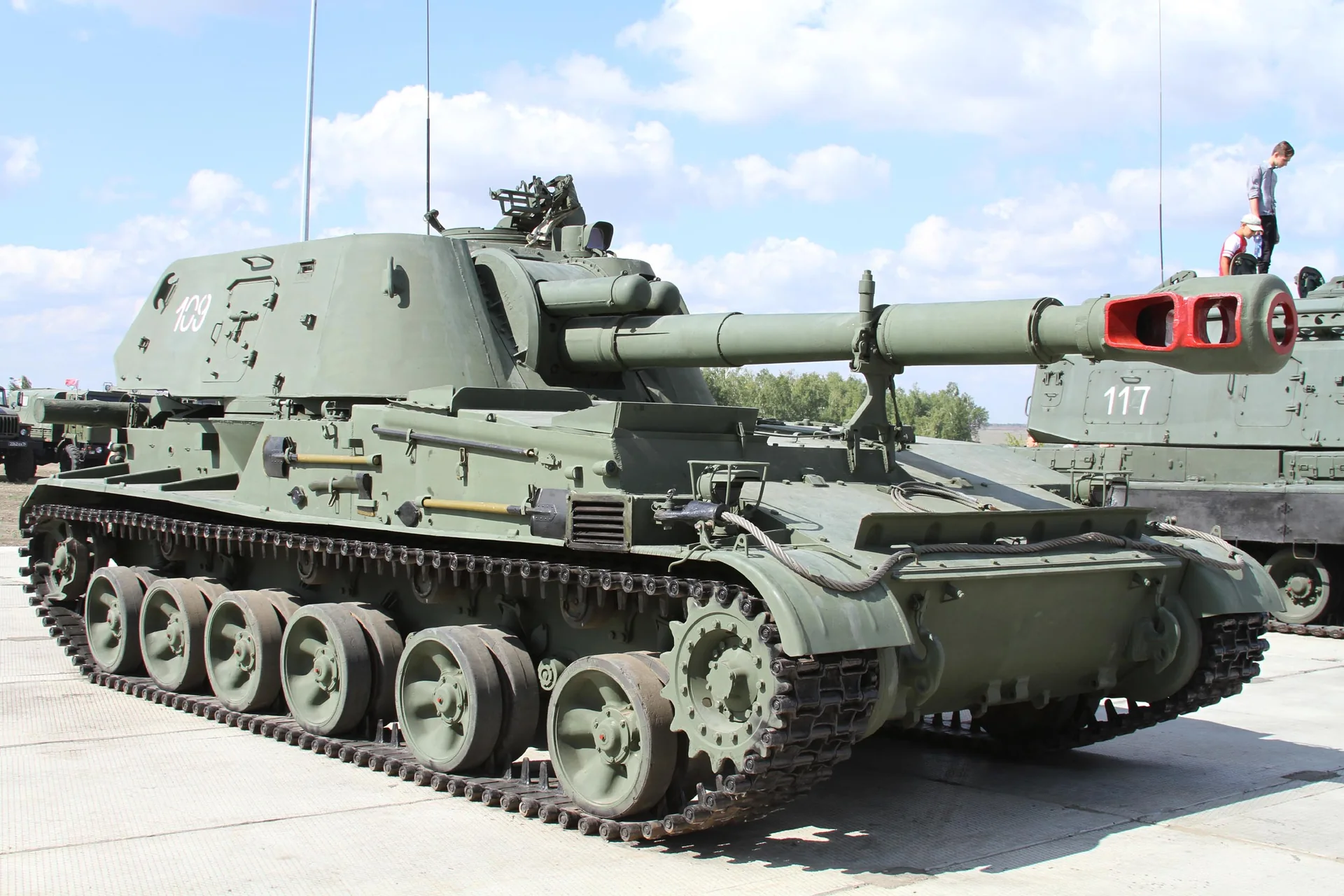
The 2S3 places the driver and engine toward the front and the large turret toward the rear. Steel armor is relatively thin but encloses the crew against small-arms fire and artillery fragments. The turret can traverse fully, allowing the gun to engage across a wide arc without moving the hull. This protected arrangement was a major improvement over open self-propelled guns for crews expected to operate close enough to the front to face counterbattery fragments, air attack, and small-unit threats. 1, 2
The 152 mm divisional gun-howitzer role
The 2S3's 152 mm weapon delivered a heavier projectile than the lighter Gvozdika's 122 mm gun. Published accounts place the reach of early conventional ammunition in the high teens of kilometers, with assisted projectiles extending it. Onboard capacity varies with configuration, and a short maximum firing rate is different from sustained output. Mechanical loading assistance reduces effort, but ammunition supply, crew fatigue and barrel heating remain practical limits. 1
Keeping medium artillery with mechanized formations
A roughly 520-horsepower diesel gives the 28-tonne 2S3 road mobility around sixty kilometers per hour and a road range near 500 kilometers in published specifications. Those figures placed it in the same general mobility environment as other Soviet tracked combat vehicles. The objective was not to match a tank in every maneuver but to let artillery batteries reposition without waiting for separate gun tractors and to keep them from becoming road-bound during fast mechanized operations. 1, 2
The medium tier above Gvozdika
Within Soviet artillery structures, the 2S3 complemented the lighter 2S1. A 152 mm howitzer offered greater shell effect and served divisional or higher requirements, while 122 mm vehicles could support lower-level formations in larger numbers. This layered approach gave commanders several calibers and weapon types rather than one universal artillery piece. The 2S3's place in that hierarchy helps explain both its heavy production and why even larger specialized weapons such as 2S4, 2S5, and 2S7 were still developed. 1, 2
Service history
The 2S3 acquired a long operational history because it was fielded widely across Soviet and allied forces. It saw combat in Afghanistan and later appeared in the Iran-Iraq War, the Gulf War, Chechen campaigns, conflicts in the Caucasus, and wars involving successor states of the Soviet Union. This record demonstrates the durability of the basic design but also means that vehicles encountered in different conflicts can represent different production standards, maintenance conditions, and modernization levels. 2
2S3M and 2S3M1 keep the family relevant
The 2S3 family evolved through changes to ammunition stowage, communications and fire-control equipment. The 2S3M and M1 designations belong to that development history; they should not automatically be read as a complete modern digital system. Later national upgrades added further equipment. A photograph showing the familiar Akatsiya silhouette therefore does not establish the vehicle's electronics, internal ammunition arrangement or precise upgrade standard. 1, 2
Variant details make that evolution concrete. Weaponsystems.net attributes increased ammunition stowage and an external-feed conveyor to the 2S3M, additional command and communications equipment to the M1, and more automated fire-control functions to later M2 development. These changes improved operation of the family without turning every surviving 2S3 into the same configuration. 1
A robust design overtaken by range and automation
The basic Akatsiya was designed before satellite navigation and integrated digital fire control became routine. Its original equipment and shorter-reaching gun impose limits when compared with later long-barreled howitzers. Modernization can improve position finding, communications and response times, but it does not by itself change the gun's ballistics or the available space inside the turret. The relative importance of these limits depends on ammunition, unit support and the period being discussed. 1, 2
Crew endurance and the 152 mm ammunition burden
The Akatsiya's four-person crew works with much heavier ammunition than the crew of a 122 mm Gvozdika. Loading aids reduce some effort, but sustained 152 mm fire still depends on physical handling, internal stowage, and a reliable flow of rounds from ammunition vehicles. The difference matters when comparing theoretical rates of fire. A short maximum rate can be achieved for a limited period, while a battery firing for hours is constrained by crew fatigue, barrel temperature, and the speed with which supply vehicles can replenish the gun line. 1, 2
Historical place
Akatsiya paired a 152 mm gun-howitzer with an enclosed tracked turret at the heavier end of the early-1970s Soviet self-propelled-artillery family. Weaponsystems.net traces development from the late 1960s to 1971 service entry and identifies the 2A33 weapon as derived from the D-20. Later M, M1 and M2 changes affected ammunition handling, communications and fire control, so an external photograph does not establish a vehicle's internal upgrade state. 1
Sources and further reading
References and further reading are listed below. Image identification, credit and reuse terms remain with each photograph.
- Weaponsystems.net, 2S3 Akatsiya (secondary source; not primary certification)
- 2S3 Akatsiya — operational history overview
- U.S. Army ODIN, 2S19 Msta-S successor context
See Armor in Person
This vehicle family is connected to 1 verified museum through 1 documented display record.