Development and design
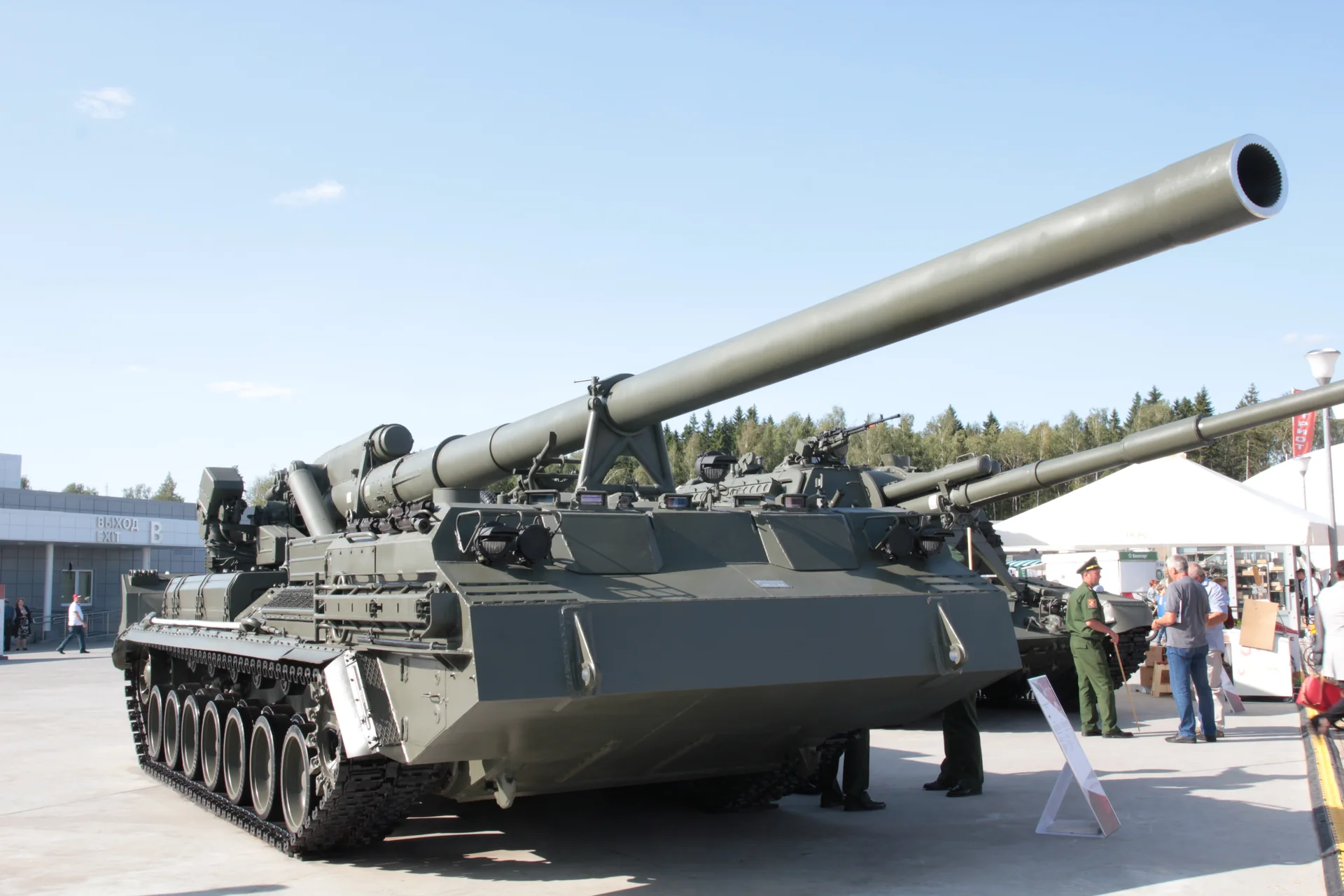
The Soviet Union issued a late-1960s requirement for a very large-caliber long-range self-propelled gun able to serve high-level artillery formations. The result was the 2S7, known as Pion, built around the 203 mm 2A44 weapon. ODIN identifies it as the largest tracked self-propelled gun in the Russian inventory, while Weaponsystems.net places service entry in the mid-1970s. The project represented a deliberate choice to preserve very heavy tube artillery even as most armies standardized medium self-propelled howitzers around 152 or 155 mm. 1, 2
A long chassis wrapped around an enormous rear gun
The 2S7's hull is stretched and heavily specialized. Crew members travel in protected compartments toward the front and rear while the engine sits between sections of the crew. The 203 mm gun dominates the back of the vehicle. A large spade is lowered during firing, and the running gear helps absorb recoil. This arrangement keeps the gun outside the hull and avoids an impossibly large turret, but it means the firing detachment must work in the open around the breech and ammunition. 1, 2
203 mm projectiles at operational ranges
The 2A44 gun fires very heavy 203 mm projectiles. Weaponsystems.net gives a conventional range in the upper thirties of kilometers and longer reach with rocket-assisted ammunition, while the original Pion's maximum rate is roughly one and a half rounds per minute. These figures illustrate the basic trade: each projectile offers very large effect and long reach, but ammunition handling is slow and sustained fire volume is far lower than that of medium-caliber howitzers. 1, 2
Making very heavy artillery operationally mobile
The 2S7 is massive but still capable of road speeds around fifty kilometers per hour and a long road range in published specifications. Its tracked chassis allows the gun to move with operational formations rather than rely on a separate heavy tractor. That mobility was the system's fundamental advantage over static or towed very-heavy artillery. A commander could shift long-range fire support between sectors and preserve the gun by moving it after missions. 2
An operational-level weapon with a large support tail
Pion belonged in high-level artillery organizations rather than ordinary divisional batteries. Its range and projectile weight made it suitable for deep or especially demanding targets, while its slow rate and limited onboard ammunition made it inefficient for routine close-support missions that could be handled by 152 mm systems. This specialization paralleled the Soviet use of 2S5 for long-range 152 mm fire and 2S4 for very heavy mortar effects. 1, 2
Service history
The 2S7 served in Soviet high-level artillery and remained in several post-Soviet inventories after 1991. Unlike the more widely exported 2S1 and 2S3, it was never a common general-purpose system. Its heavy logistics, unusual ammunition, and specialized doctrine limited the number of armies able or willing to support it. Where the infrastructure survived, however, the long-range gun remained a useful reserve or active capability. 1, 2
The 2S7M Malka modernization
The 2S7M Malka was a later modernization of the original Pion rather than a new caliber or a fully enclosed gun vehicle. Published accounts associate it with increased onboard ammunition, a faster firing cycle and automotive or control-system improvements. The original Pion's small ready supply and later Malka figures should remain separate. Exact formal acceptance dates vary among the retained descriptions, so the transition is best placed broadly in the mid-1980s rather than assigned an unsupported single day or year. 1, 2
ODIN identifies the Malka's onboard ammunition increase to eight rounds as one of the practical changes. That number is still small for sustained heavy-artillery fire, so an ammunition supply chain remains essential. The modernization improved what the vehicle could carry and how quickly it could respond, but it did not remove the basic logistical burden of 203 mm ammunition. 3
Exceptional effect at exceptional logistical cost
The 2S7's limitations are the mirror image of its strengths. A 203 mm projectile provides enormous effect and long range, but the gun fires slowly, carries very little ammunition, and exposes much of the crew during firing. The large vehicle is harder to conceal than a medium howitzer and requires a strong maintenance and transport system. In an environment saturated by aerial reconnaissance and counterbattery sensors, a firing position can become dangerous quickly. 1, 2
A gun whose logistics are as heavy as its projectile
The Pion's small onboard ammunition supply made external resupply fundamental to the battery. A large 203 mm projectile occupies far more space and requires more handling than the rounds carried by medium howitzers. The number of soldiers traveling on the firing vehicle is consequently not the same as the full detachment needed to sustain it. Ammunition transport, mechanical handling and maintenance remained part of the system, even though the gun itself was self-propelled. 1, 2
Historical place
Pion and Malka share the 203 mm artillery mission but should not be collapsed into one fixed configuration. U.S. Army ODIN's indexed record describes 2S7M Malka as a later modernization that entered service in 1983, with improved fire-control arrangements, a higher rate of fire and increased onboard ammunition. Those changes are substantial enough that specifications for Malka should not be projected backward onto an early Pion. 3
Sources and further reading
References and further reading are listed below. Image identification, credit and reuse terms remain with each photograph.
- U.S. Army ODIN — 2S7 Pion / Malka Russian 203mm Self-Propelled Gun
- Weaponsystems.net — 2S7 Pion
- U.S. Army ODIN, 2S7 Pion / Malka (indexed asset-page evidence only)
Visit an Armor Museum
Explore the worldwide museum directory to find armored vehicles, collections, and visitor-planning information.
Browse armor museums