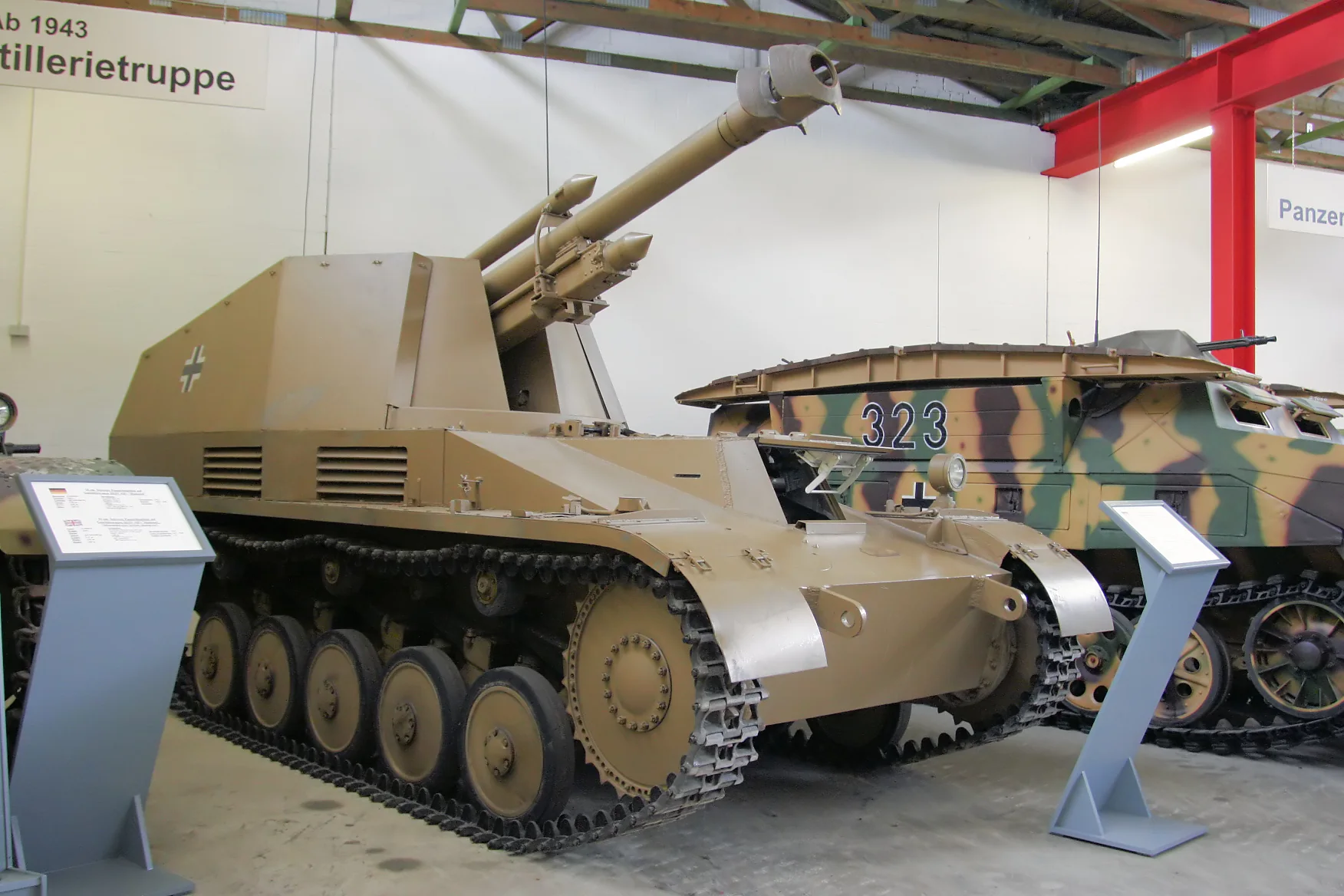
Development
By 1942 the German Army had a persistent mismatch between the mobility of its armored formations and much of their supporting artillery. Towed guns could provide the required firepower, but moving, emplacing, and displacing them during fast operations consumed time and exposed gun detachments to counterbattery fire. Rather than wait for a wholly new chassis, German planners chose the Panzer II as an expedient foundation. The tank was no longer satisfactory as a front-line gun tank, yet its automotive system was mature and production experience already existed. That made it a practical candidate for conversion into a purpose-oriented artillery carrier rather than continued use in an increasingly unsuitable combat role. 1
A chassis rearranged around the gun crew
The Wespe retained the basic mechanical ancestry of the Panzer II but reorganized the vehicle around artillery work. The driver and transmission remained forward, the relocated engine occupied the center, and the gun crew worked in a tall open-topped compartment at the rear. Thin armor provided protection from small-arms fire and shell fragments rather than tank-level protection. This arrangement gave the detachment room to handle the 105 mm ammunition and operate the howitzer, but it also left the crew exposed to weather, air attack, and bursts landing nearby. The vehicle's form therefore reflected the priorities of self-propelled field artillery: mobility and immediate availability of the gun mattered more than heavy armor. 1
The March 1945 American handbook identified Wespe as the 10.5 cm le.F.H. 18/2 on a modified Panzer II chassis, with the carriage designation Gw. II and Sd.Kfz. 124. It distinguished that installation from other German mounts carrying related 105 mm weapons on French chassis. The common gun caliber therefore did not imply common hull ancestry or an identical self-propelled artillery vehicle. 3
The same wartime handbook lists ten degrees of traverse to either side and a maximum range of 13,500 yards for the mounted 10.5 cm weapon. Those figures describe the installation as U.S. intelligence understood it in 1945, not as a German factory acceptance sheet. They nevertheless reinforce the basic operating picture: normal field-artillery reach combined with limited on-mount traverse, making vehicle orientation part of efficient gun laying. 3
Mobility and support
Wespe's Maybach engine and Panzer II-derived suspension gave a field howitzer tracked cross-country mobility without the weight of a medium-tank chassis. The gun moved as part of the vehicle rather than as a load behind a separate tractor. This reduced the equipment involved in changing positions, although mechanical faults could now immobilize the gun and its prime mover together. Mobility was therefore an advantage of the complete artillery system, not merely a high road-speed figure. 1
The ammunition carrier was part of the system
The gunless ammunition version used the Wespe's basic chassis but devoted the fighting-compartment area to rounds rather than a howitzer. This supplied the batteries with tracked transport that could follow the firing vehicles. The gun vehicle's limited stowage made that relationship essential to sustained work. Production totals for the ammunition carrier should remain separate from gun-vehicle totals, and neither should be mistaken for the number actually available in a particular unit. 1
Service history
The Wespe entered combat in 1943 and was issued principally to panzer and panzergrenadier divisions. German artillery organizations commonly grouped batteries of Wespes with the heavier Hummel, creating a tracked artillery element that offered both 105 mm and 150 mm fire. The type appeared on the Eastern Front during the Kursk period and later served in Italy, France, and Germany. Its presence across multiple theaters reflected both the usefulness of the concept and the German Army's need to keep armored formations supplied with artillery that could move repeatedly during retreat as well as advance. 1, 2
A lighter half of Germany’s tracked artillery pairing
Wespe batteries were generally the lighter component of self-propelled artillery battalions in armored divisions. Published organizational examples show batteries of six Wespes, with ammunition vehicles supporting them, and heavier Hummels providing 150 mm fire in the same battalion structure. This gave commanders different projectile weights and ranges without sacrificing the mobility advantages of tracked carriage. In practice, establishment strength and actual strength could differ sharply because combat losses, maintenance, and shortages reduced the number of operational vehicles available at any moment. 1
Effective precisely because its compromises were understood
The Wespe's limitations were obvious. Armor was thin, the fighting compartment was open, ammunition capacity was small, and a light-tank chassis placed limits on growth. The crew also worked in a restricted space crowded by the gun and ammunition. None of these features would have been acceptable in a vehicle expected to fight in the direct-fire zone as a tank. For artillery operating behind the immediate front, however, those compromises were tolerable when weighed against the gain in mobility and the speed with which an existing chassis could be adapted for production. 1
Crew work and battery life
The Wespe's usefulness depended on a crew that could combine vehicle duties with artillery drill inside a very confined compartment. Driver and radio tasks remained essential during movement, while the gun detachment handled separate projectile and charge components once the vehicle occupied a position. The open compartment made communication among crewmen straightforward but offered little relief from weather or nearby shell bursts. This human factor helps explain why the vehicle cannot be understood only through speed, armor, and gun caliber: sustained artillery work was physically demanding even when the weapon itself was mechanized. 1
Design legacy
The U.S. War Department's March 1945 handbook identifies Wespe as the 10.5 cm leFH 18/2 on a modified Panzer II chassis with a five-man crew. That period description captures the vehicle's practical importance: a light-tank foundation that was no longer competitive in its original role could still provide a mobile artillery chassis for armored formations. Wespe was therefore less a technological leap than a production-minded way to put a standard field howitzer on tracks. 3
Sources and further reading
References and further reading are listed below. Image identification, credit and reuse terms remain with each photograph.
- Tank Encyclopedia — 10.5 cm leFH 18/2 auf Fahrgestell Panzerkampfwagen II 'Wespe'
- Deutsches Panzermuseum — large exhibits collection
- U.S. War Department TM-E 30-451, Handbook on German Military Forces, self-propelled artillery section
Visit an Armor Museum
Explore the worldwide museum directory to find armored vehicles, collections, and visitor-planning information.
Browse armor museums