Development and design
The March 1945 U.S. Army handbook identified Hummel as the 15 cm sFH 18/1 carried on the Geschuetzwagen III/IV, designated Sd.Kfz.165. It described a hybrid of Panzer III and IV components, with a centrally placed engine and the heavy howitzer behind it. This contemporary identification confirms the vehicle's role as a mobile installation of field artillery rather than an infantry gun or tank destroyer. The handbook was wartime intelligence, so its estimates should not replace later production records. 3
The Geschützwagen III/IV and an open rear compartment
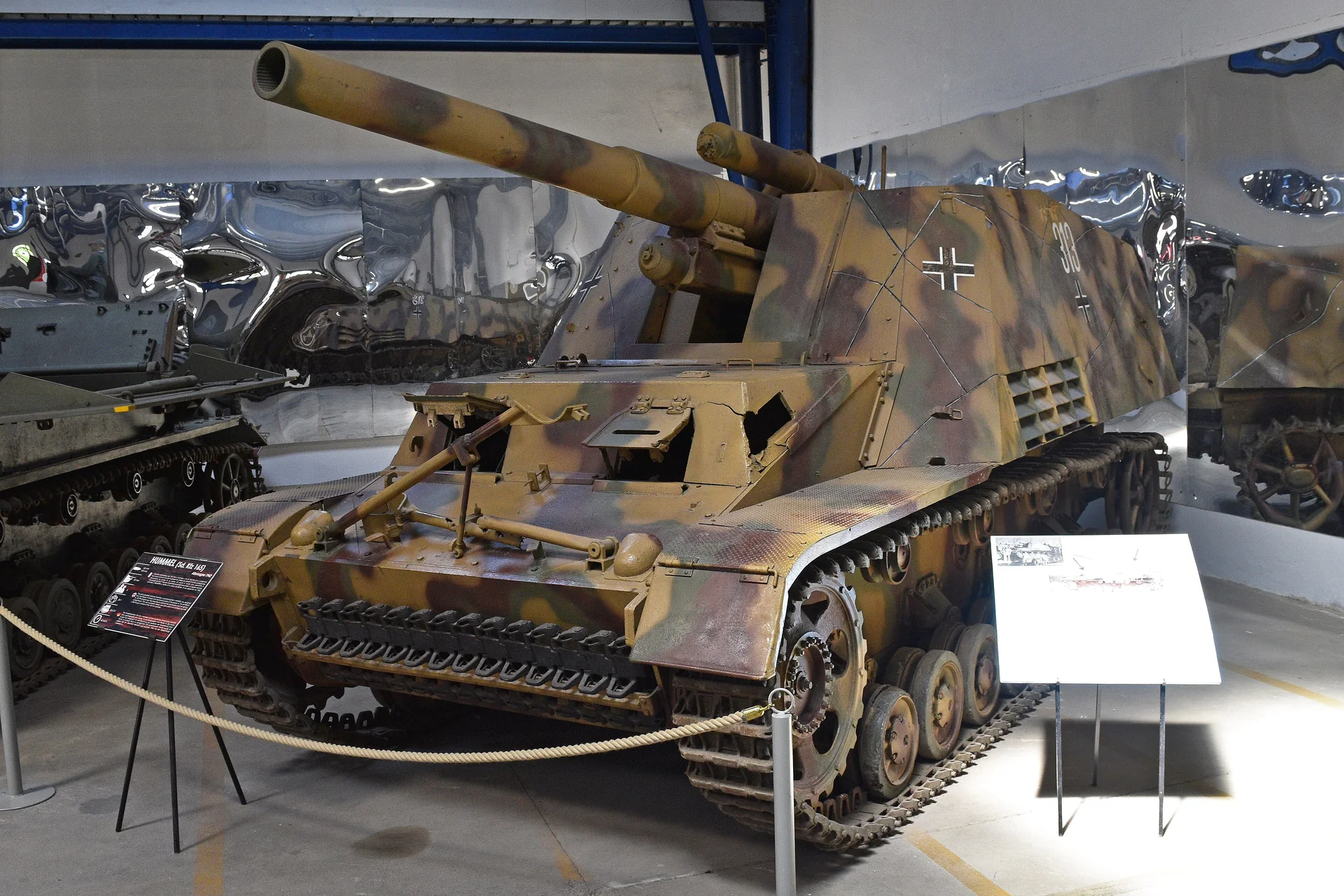
The Hummel placed its driver and transmission at the front, engine in the middle, and gun crew at the rear. Thin armored plates enclosed the sides and front of the fighting compartment but left the top open. This reduced weight, simplified the installation of a very large weapon, and gave the detachment the vertical space needed to handle separate-loading 150 mm ammunition. The price was exposure to shell fragments arriving from above, aircraft attack, weather, and small-arms fire from elevated positions. Like the Wespe, the vehicle was protected as artillery rather than armored as a front-line direct-fire fighting vehicle. 1
Heavy artillery with tracked operational mobility
The Hummel was substantially heavier than the Wespe but still gave a 150 mm howitzer the ability to move under its own power with the armored formation it supported. The Panzer III/IV-derived running gear and Maybach engine provided road and cross-country mobility appropriate for a large tracked support vehicle, not the agility of a tank. The key advantage was organizational speed: the gun, crew, and immediate equipment moved as one vehicle. A battery could change position without first coupling separate tractors and carriages, a meaningful advantage when front lines shifted rapidly or hostile counterbattery fire threatened a known firing point. 1
Munitionsträger Hummel and the resupply problem
The Hummel carried only a small immediate supply of heavy 15 cm ammunition. Its battery therefore depended on ammunition carriers and trucks rather than treating each gun vehicle as an independent fighting unit. Unarmed ammunition-carrying versions of the Geschuetzwagen III/IV helped support the guns, but the number of these carriers should not be confused with gun-vehicle production. The open rear compartment provided working room; it did not provide the storage capacity needed for prolonged firing without replenishment. 1
TM-E 30-451 credited the mounted 15 cm weapon with a maximum range of about 14,570 yards and recorded a small onboard ammunition supply. That limited carried load helps explain the importance of ammunition resupply vehicles in Hummel batteries. The numbers are retained as 1945 U.S. intelligence estimates, which can differ from later technical references and should not be treated as German factory specifications. 3
Service history
Hummels entered service in 1943 and fought on the Eastern Front, in Italy, in France, and during the defense of Germany. Their first large-scale employment coincided with the broader German effort to increase the self-propelled artillery component of panzer divisions. Units valued the ability to move a heavy howitzer with armored formations, while the weapon's projectile gave divisional artillery a destructive effect beyond that of the lighter Wespe. As the war turned increasingly defensive, mobility remained useful because gun batteries were repeatedly forced to withdraw, reoccupy positions, and support formations fighting on shrinking fronts. 1, 2
The heavy battery beside the Wespe
German armored artillery organization commonly paired Hummel and Wespe batteries. Published examples show a battalion with lighter 105 mm Wespe batteries and a smaller heavy component of 150 mm Hummels. This structure gave the divisional artillery commander two useful calibers on tracked carriers: the Wespe for the more numerous light field-howitzer missions and the Hummel for heavier targets or missions requiring a larger projectile. The pairing was doctrinally more important than viewing either vehicle alone, because it created a mobile artillery group rather than a collection of isolated self-propelled guns. 1
Weight, exposure, and ammunition consumption
The Hummel solved the mobility problem better than it solved protection or endurance. Its crew remained exposed from above, the fighting compartment armor was designed mainly against fragments and small arms, and only a small number of 150 mm rounds could be carried internally. The vehicle was also mechanically more complex and resource-intensive than a towed howitzer. These were serious limitations, but they were accepted because the alternative, keeping heavy divisional artillery entirely dependent on towing, reduced the ability of panzer formations to shift fire support as quickly as the tactical situation demanded. 1
Crew work and the heavy-gun battery
The Hummel's large projectile and separate propellant made crew work central to practical rate of fire. The open compartment provided the space needed to pass ammunition and work around the breech, but the same openness exposed the detachment to weather and fragments. Heavy shells also meant that fatigue mattered during prolonged missions. The vehicle's technical ability to move a 150 mm howitzer did not reduce the physical demands of loading it; mechanization primarily changed mobility and protection, not the basic human effort required to sustain heavy artillery fire. 1
Historical place
U.S. wartime intelligence described Hummel as a hybrid Panzer III/IV chassis carrying the 15 cm sFH 18/1. The same handbook lists a six-man crew and places the engine near the center of the chassis, leaving the rear fighting compartment for the large howitzer and its detachment. The vehicle's importance lies in that purpose-built artillery arrangement, not simply in carrying a larger gun than Wespe. 3
Sources and further reading
References and further reading are listed below. Image identification, credit and reuse terms remain with each photograph.
- Tank Encyclopedia — Hummel (Sd.Kfz.165)
- Deutsches Panzermuseum — large exhibits collection
- U.S. War Department TM-E 30-451, Handbook on German Military Forces, self-propelled artillery section
Visit an Armor Museum
Explore the worldwide museum directory to find armored vehicles, collections, and visitor-planning information.
Browse armor museums