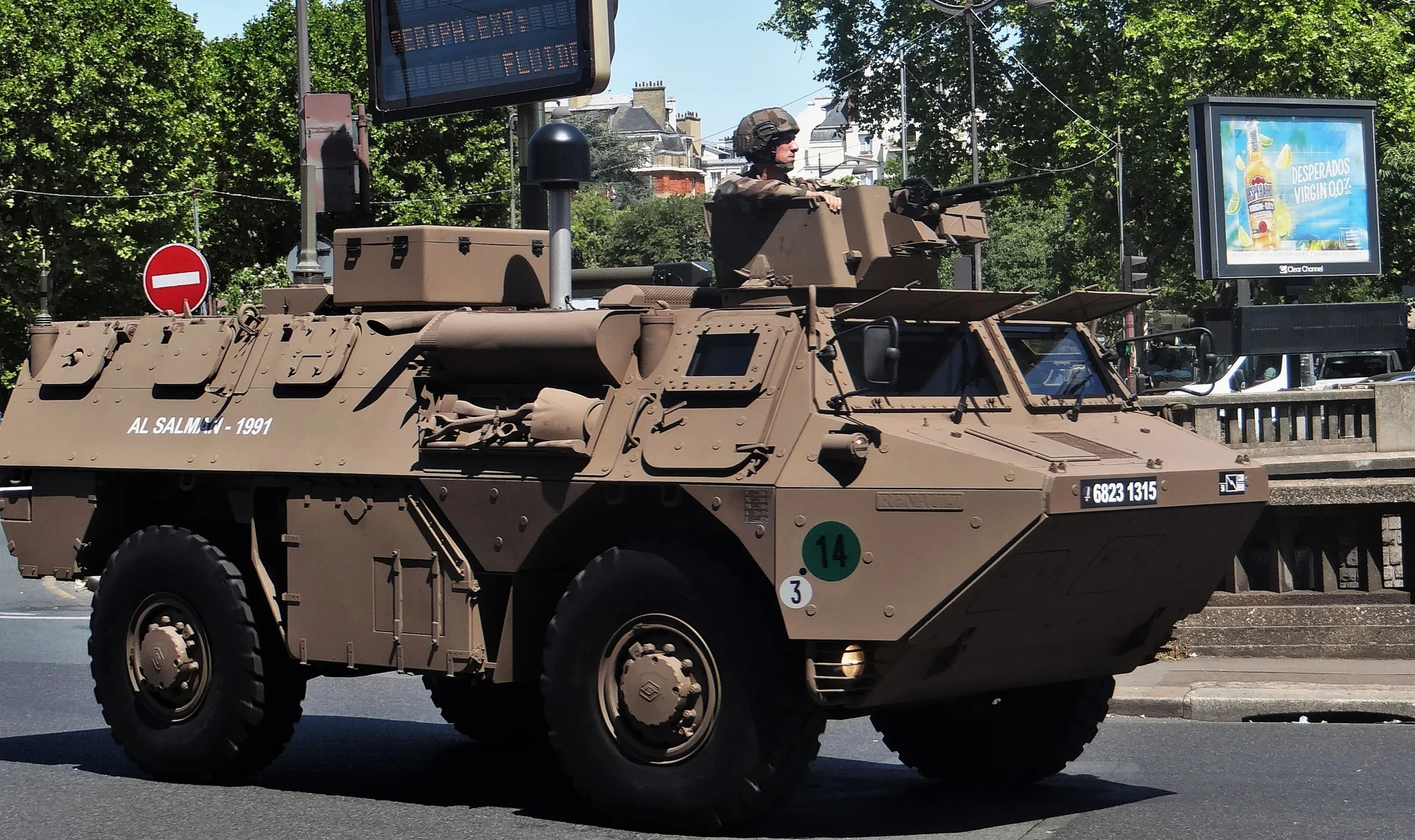
Development and requirement
France developed the VAB during the 1970s as a wheeled armored carrier for rapid troop movement and support missions. It entered service in 1976 and was produced in large numbers for France and export customers. The design’s broad family potential became at least as important as the basic troop-carrier role. 1, 2
The original VAB combined an armored passenger or equipment compartment with a wheeled automotive layout that could support several missions. France’s four-wheeled version and export six-wheeled versions should not be treated as one fixed configuration. Their shared family name is a starting point for comparison, not permission to combine dimensions, payloads and equipment from different models. The original troop carrier also needs to be distinguished from later vehicles marketed under updated VAB designations. A long-lived name does not mean that every hull and mission installation remained unchanged. 1, 2
Design, protection, and mobility
The VAB uses a box-like armored hull with all-wheel drive and amphibious capability on many versions. The French 4x4 configuration became standard domestically, while 6x6 versions were also produced. Armament varies from machine guns to heavier weapon stations depending on mission. The internal volume and straightforward automotive layout supported many conversions. 1, 2
The wheeled character of the VAB Family is central to how it was intended to be used. Wheeled armored vehicles generally trade some soft-ground and obstacle performance for road speed, range, reduced automotive complexity, and easier long-distance movement without heavy transporters. That trade is especially valuable to reconnaissance, security, and rapidly moving infantry formations, where arriving first, screening a broad frontage, or shifting quickly between sectors can matter as much as maximum armor thickness. Tires, driveline arrangement, suspension travel, and vehicle weight therefore become tactical questions rather than engineering trivia: damage that slows the vehicle can also reduce the unit's ability to observe, disengage, reinforce, or deliver troops on time. 1, 2
As a personnel carrier, the VAB Family is fundamentally organized around protected movement rather than tank-style direct combat. The troop space, embarkation route, seating, communications, and ability to load equipment are central to the vehicle's usefulness. Armor on an APC is intended to reduce vulnerability to common battlefield threats and allow soldiers to move through areas that would be far more dangerous in trucks, but the carrier still depends on tactics, terrain, supporting fires, and dismounting at the right point. A carrier that is treated as a tank simply because it is armored is likely to be exposed to threats its design never intended to absorb. 1, 2
Firepower and battlefield role
Firepower on the VAB Family has to be read through its mission rather than by caliber alone. Armored carriers and fighting vehicles use their weapons to protect movement, suppress opposition, cover dismounts, and create enough local advantage for the formation to continue its task. The usefulness of that weapon depends on sights, stabilization where fitted, ammunition, crew training, and the ability to detect a target before the vehicle is itself exposed. The vehicle's combat value therefore comes from the integration of mobility, protection, observation, communications, and weapon effect rather than from a single specification in isolation. 1, 2
Service, variants, and modernization
VABs served in French expeditionary operations across Africa, the Balkans, the Middle East, and elsewhere. Protection and weapon upgrades were added over time, but newer vehicles such as Griffon and VBCI increasingly took over roles once filled by the VAB family. 1, 2
The VAB’s replacement history is role-specific. A successor to a turreted infantry vehicle, a successor to a troop carrier and a replacement for a specialist command or medical vehicle need not follow the same schedule. Treating Griffon and VBCI as interchangeable one-for-one replacements obscures that distinction. Similarly, an operational protection package can describe selected vehicles for a particular deployment without documenting a universal fleet standard. The useful history is the sequence of missions and configurations, rather than an undated assertion that the entire VAB family has already been replaced. 1, 2
Arquus’s fortieth-anniversary announcement dates the first VAB delivery to the 1st Infantry Regiment in 1976. That gives the family a named unit milestone rather than only a decade-level introduction date. The cited evidence is limited to an official indexed excerpt of the announcement. It therefore supports that narrow delivery statement, not production totals, the chronology of every specialist version or the later status of all French VAB units. 3
How the vehicle fits the formation
In a formation, the VAB Family is a mobility system for people as much as it is an armored vehicle. Its value is measured by whether troops arrive together, with their weapons and communications intact, at the place and time the commander needs them. The carrier can provide local fire support and protection during movement, but the dismounted soldiers remain the element that clears buildings, occupies complex terrain, searches positions, and performs tasks that a vehicle cannot. That relationship is why APC tactics revolve around the choice of when to remain mounted, when to dismount, and how closely the carrier should follow the infantry once the fight becomes close. 1, 2
Strengths, limitations, and family boundaries
The VAB family remains classified as APC/support vehicle at its core. Antitank, mortar, command, and other specialized variants may appear in separate role categories while retaining the VAB chassis link. 1
The principal strength of the VAB Family is the mobility and flexibility that come from its wheeled architecture and mission fit. It can cover large road distances efficiently, shift between sectors without the same transporter dependence as many tracked vehicles, and support dispersed operations over a broad frontage. The tradeoff is that wheels, ground pressure, and suspension geometry impose different limits in deep mud, severe obstacles, and some forms of cross-country movement, while protection and turret weight can erode the original mobility margin. The design is strongest when commanders exploit its speed and reach instead of forcing it to imitate a heavier tracked vehicle. 1, 2
Family names can also obscure important differences. The recorded lineage relationship is Numerous troop, command, medical, missile, and support variants. A common hull or manufacturer does not mean every derivative belongs in the same operational category. Command posts, mortar carriers, antitank vehicles, recovery vehicles, reconnaissance versions, air-defense systems, and direct-fire variants may share engines and running gear while performing fundamentally different tasks. For that reason the Armor Archive keeps the VAB Family tied to its lineage but classifies individual branches by what they actually do on the battlefield. That approach preserves engineering relationships without turning one successful chassis into an all-purpose label that hides the history of the specialized vehicles built from it. 1, 2
Sources and further reading
References and further reading are listed below. Image identification, credit and reuse terms remain with each photograph.
- U.S. Army TRADOC ODIN Worldwide Equipment Guide — VAB
- French Ministry of the Armed Forces — VBCI
- Arquus: VAB fortieth-anniversary announcement, 19 October 2016 (indexed excerpt)
Visit an Armor Museum
Explore the worldwide museum directory to find armored vehicles, collections, and visitor-planning information.
Browse armor museums