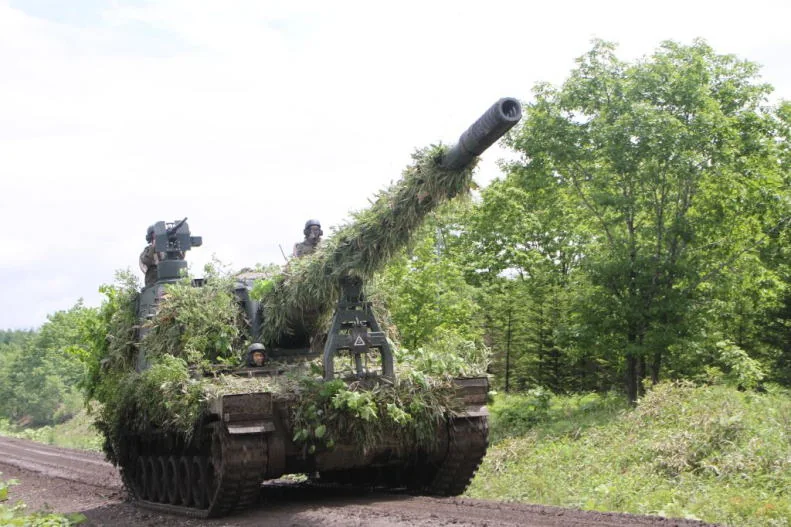
Development and design
The Type 99 was developed to replace the Type 75 in Japanese tracked artillery service. The JGSDF's equipment introduction describes improvements in range, rate of fire and accuracy while requiring fewer personnel. Those are the service's stated design advantages, not comparative test results reproduced here. The new vehicle combined a longer 155 mm gun with mechanized handling and updated equipment rather than merely mounting a different barrel on an unchanged Type 75. 1
Weaponsystems.net traces development from 1985 into the late 1990s and lists a 1999 service milestone. That secondary chronology should be kept distinct from the later unit-by-unit conversion dates visible in JGSDF histories. A system can be accepted and entering production before every formation has replaced its predecessor. 3
Vehicle configuration
Official data gives the vehicle a length of 11.3 meters, width of 3.2 meters, and weight of about 40 tonnes. The turret and gun are associated with Japan Steel Works and the body with Mitsubishi Heavy Industries. The large rear turret and forward automotive layout were arranged specifically around a long 155 mm weapon and mechanized ammunition handling. 2
Gun and ballistic performance
The Ministry of Defense lists high-explosive, smoke, illumination, and long-range projectiles for the Type 99. Secondary technical sources identify the weapon as a 52-caliber-class 155 mm howitzer, a major increase in barrel length over the Type 75 and a clear move into the long-range artillery generation that spread internationally during the 1990s. 2, 3
Ammunition handling and sustained fire
A central modernization feature is the extensive mechanical assistance inside the turret. The Type 99 uses automation to reduce the crew to four, compared with six on the older Type 75. Public descriptions of the loading system differ in fine detail, but they agree that the vehicle was designed to reduce repetitive projectile handling and support a high short-term firing rate. 1, 3
Fire control and artillery networking
JGSDF descriptions place the Type 99 in a newer fire-control environment than its predecessor, with better accuracy and responsiveness rather than merely a larger gun. The vehicle appeared as Japanese ground forces were increasing the use of digital communications, navigation, and networked command, making rapid position determination and exchange of fire data increasingly important to artillery effectiveness. 1, 3
Tracked mobility
Official Japanese indexed data lists Type 99 at about forty tonnes with a road speed around 50 km/h. Those figures show a substantial tracked artillery vehicle built for protected tactical movement, but they do not by themselves prove that bridge, tunnel or urban constraints dictated a specific design compromise. This profile therefore keeps the mobility description to documented dimensions, weight, speed and tracked configuration. 2
Crew protection and survivability
The crew works inside an enclosed armored hull and turret, which protects personnel and loading machinery from fragments, small arms, weather, and some contaminated-environment hazards. The vehicle is not intended for tank-like direct combat; its survivability depends primarily on operating at artillery distances, dispersing, and changing position after firing rather than relying on heavy passive armor. 1, 3
Support vehicles and logistics
The Type 99 belongs to a larger Japanese artillery system that includes dedicated ammunition support. Automation solves only the final movement of rounds inside the vehicle; 155 mm projectiles and charges still have to be moved from depots to gun units in large quantities. Sustained fire therefore depends on supply vehicles, maintenance, communications, and command arrangements around the howitzer. 1, 3
Service history
The JGSDF's 7th Artillery Regiment records Type 99 battalion conversions during 2004-2007, with the regiment completing conversion in September 2007. The 11th Artillery Unit also identifies Type 99 among its major equipment. These official unit descriptions establish particular service contexts, not a nationwide procurement total. They support a history centered on Japanese unit modernization and training without implying an export or combat record that the sources do not establish. 4
Variants and modernization
The Type 99 has not generated a large public family of export subvariants. Its most important distinction in Japanese artillery is instead functional: it is the heavy tracked successor to the Type 75, while a separate wheeled 155 mm system was later developed for different strategic-mobility requirements. These systems should not be conflated simply because they share caliber. 1, 2
Industrial context
The program shows the maturity of Japan’s postwar defense industry. Japan Steel Works and Mitsubishi Heavy Industries divided responsibility for major portions of the weapon and chassis, preserving national expertise in large-caliber guns, turrets, armored vehicles, and systems integration. Small domestic production runs can be expensive, but they maintain engineering knowledge that would otherwise disappear. 2
Historical place
Type 99 carried Japanese tracked artillery into the longer-barreled 155 mm generation while reducing crew workload through newer equipment. Unit histories provide a useful view of its introduction, one battalion and regiment at a time. Its relationship to Type 75 is direct, whereas later wheeled artillery represents a separate mobility choice rather than an interchangeable Type 99 variant. 1, 2, 3
Sources and further reading
References and further reading are listed below. Image identification, credit and reuse terms remain with each photograph.
- Japan Ground Self-Defense Force, 11th Artillery Unit, major equipment introduction
- Japan Ministry of Defense, Type 99 cost/equipment data (indexed asset-page evidence only)
- Weaponsystems.net, Type 99 (secondary source; not primary certification)
- Japan Ground Self-Defense Force 7th Artillery Regiment, unit history
Visit an Armor Museum
Explore the worldwide museum directory to find armored vehicles, collections, and visitor-planning information.
Browse armor museums