Development and design
Japan developed the Type 75 during the late 1960s and early 1970s as part of the Japan Ground Self-Defense Force’s effort to field a modern mobile 155 mm artillery system. Weaponsystems.net dates development from 1969 to 1975 and notes that prototype work preceded formal adoption in 1975. U.S. Army ODIN likewise identifies the system as entering service in 1975. The project emerged during a period when Japan’s postwar defense industry was steadily rebuilding the capacity to design specialized armored vehicles for national requirements. 1, 2
A compact tracked howitzer with a rear turret
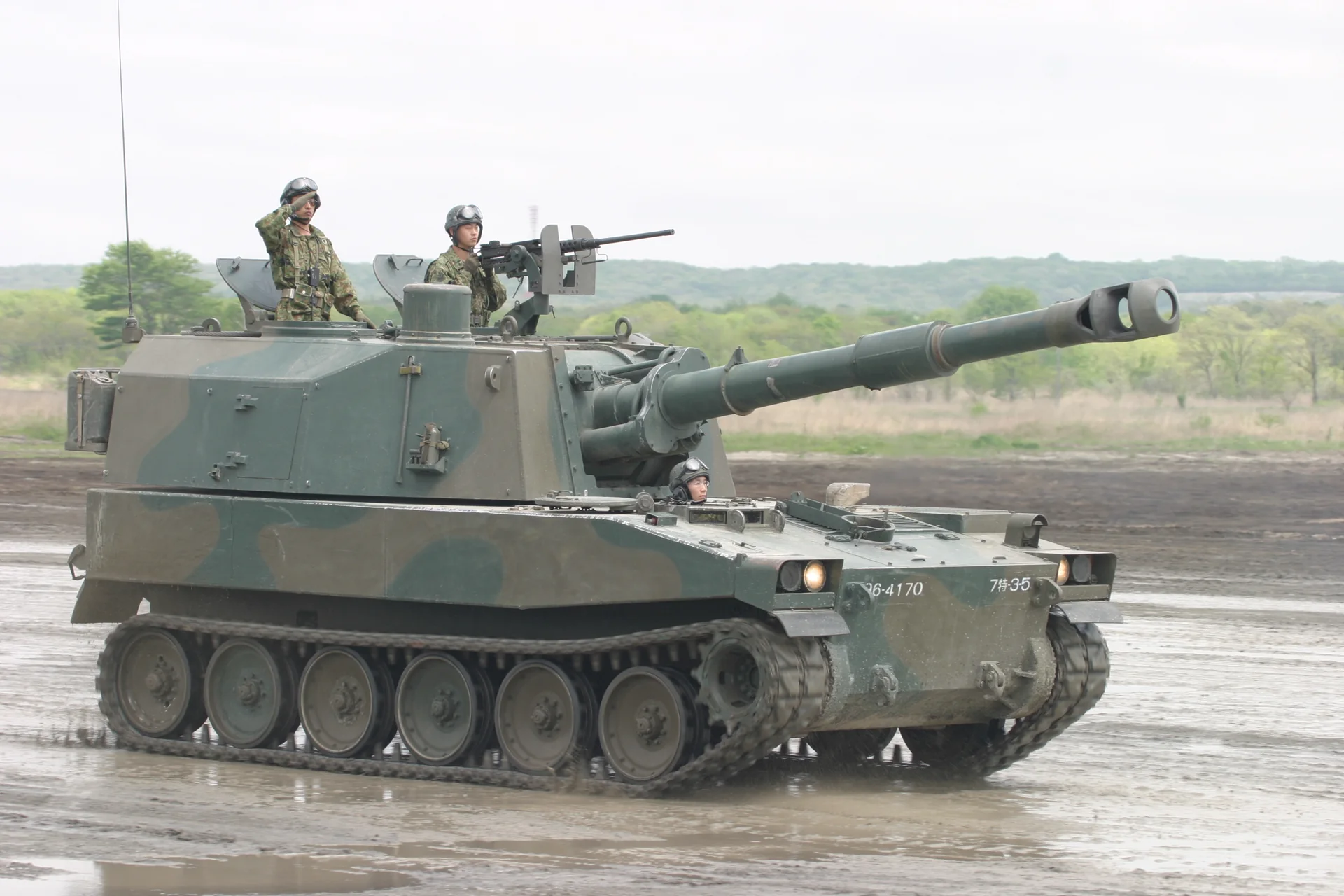
The Type 75 followed a conventional self-propelled-howitzer layout with the engine and drivetrain forward and a fully rotating turret toward the rear. Weaponsystems.net describes six road wheels per side and a relatively compact vehicle compared with some later 155 mm systems. The crew worked under armor, and the gun could traverse through a full circle rather than being restricted to a narrow arc over the rear of the hull. 2
A 155 mm/30 weapon and mechanized loading
Weaponsystems.net identifies the main armament as a 155 mm 30-caliber howitzer using NATO-standard caliber ammunition. The shorter barrel reflects the period in which the Type 75 was designed; later self-propelled artillery increasingly moved to longer 39-, 45-, and 52-caliber guns to obtain greater range. Weaponsystems.net gives a maximum range around 19 kilometers with Japanese ammunition and describes a six-round-per-minute maximum rate under favorable conditions. 2
Weaponsystems.net describes the loading system as two nine-round drums feeding a tray and rammer, one reason short bursts could be fired faster than sustained manual handling alone would allow. The same source gives different ranges depending on ammunition, including about 15 kilometers with the U.S. M107 projectile and roughly 19 kilometers with Japanese ammunition. That ammunition dependence is more informative than quoting one universal maximum range. 2
Service history
The Type 75's history is primarily one of JGSDF training, readiness and modernization rather than a documented export combat career. The 7th Artillery Regiment's own timeline records receiving Type 75 equipment in March 1981. That is a date for the regiment, not for Japan's first national adoption of the vehicle. The same unit history later records conversion to the Type 99, providing a concrete example of how replacement occurred within one formation. 3
Tracked mobility for Japan’s terrain
Type 75 used a tracked chassis with an enclosed turret and a relatively compact 155 mm installation for JGSDF artillery units. Weaponsystems.net describes a road speed of roughly 47 km/h and the conventional tracked layout. Those documented characteristics establish tactical mobility without requiring broader claims that Japanese geography dictated every design choice. 2
An enclosed working environment
The Type 75 carried a six-person crew according to the cited open references. Its aluminum armor protected against small-arms fire and shell fragments rather than heavy anti-armor weapons. Weaponsystems.net also notes NBC protection, consistent with Cold War expectations that artillery might need to remain functional in a contaminated environment. The enclosed turret represented a substantial improvement in crew protection over open gun mounts and towed artillery positions during movement and immediate firing operations. 1, 2
Japan’s maturing postwar defense industry
The Type 75 appeared during a period of rapid maturation in Japan’s postwar defense industry. By the 1970s, Japanese firms were producing increasingly sophisticated tanks, armored vehicles, aircraft, and naval systems for the Self-Defense Forces. Weaponsystems.net credits Mitsubishi Heavy Industries with the Type 75’s development, placing the howitzer within the same broad national effort to rebuild complex systems engineering after the restrictions and disruption of the immediate postwar period. 2
The transition to the Type 99
The Type 99 succeeded the Type 75 with a longer gun and newer crew and fire-control arrangements. The 7th Artillery Regiment records successive battalion conversions from 2004 through 2007 and completion of its transition in September 2007. Those entries describe that regiment alone. They should not be used to declare that every Type 75 across the JGSDF had retired by the same date. 3
A bridge between postwar rebuilding and modern Japanese artillery
The Type 75 occupies an important position in the history of the JGSDF because it was a genuinely domestic solution to a major artillery requirement. Earlier postwar Japanese forces depended heavily on American equipment and designs, while later systems reflected a mature national industrial base. The Type 75 sits between those phases, demonstrating that by the 1970s Japan could design and manufacture a specialized armored artillery vehicle around its own requirements. 1, 2
Historical place
Type 75 gave the JGSDF a domestically developed enclosed 155 mm tracked howitzer during Japan's postwar rebuilding of specialized armored-vehicle production. Its later replacement can be traced through individual unit histories rather than treated as an instantaneous fleet-wide event. The transition to Type 99 links two generations of Japanese artillery while preserving the separate requirements and limitations of each. 1, 2
Sources and further reading
References and further reading are listed below. Image identification, credit and reuse terms remain with each photograph.
- U.S. Army ODIN — Type 75 Self-Propelled Howitzer
- Weaponsystems.net, Type 75 (secondary source; not primary certification)
- Japan Ground Self-Defense Force 7th Artillery Regiment, unit history
Visit an Armor Museum
Explore the worldwide museum directory to find armored vehicles, collections, and visitor-planning information.
Browse armor museums