Development and requirement
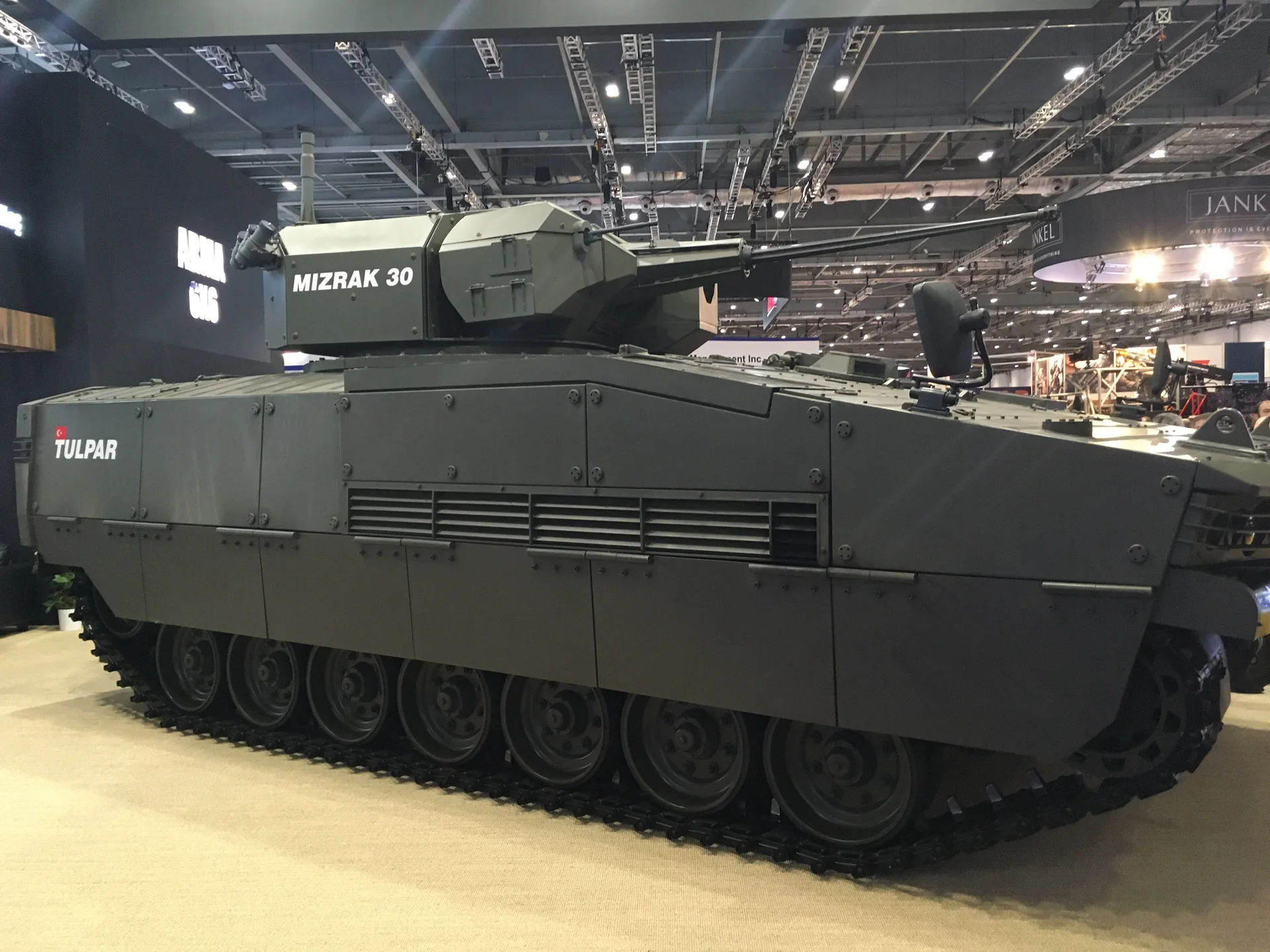
Otokar developed TULPAR as a next-generation tracked platform able to operate with main battle tanks while retaining modularity for different national requirements.
TULPAR is presented here as a modular tracked infantry-fighting-vehicle project, not as proof of an accepted national fleet. The cited material describes room for different turret and mission arrangements. That makes configuration identity central: a displayed troop carrier, a cannon-armed infantry vehicle and a gun-support proposal should not be collapsed into one equipment standard. Nor can the service history of another Otokar product supply a missing TULPAR record. Manufacturer identity establishes who is associated with a project, not when a particular vehicle was accepted or fielded.
Design, protection, and mobility
The platform emphasizes modular armor, high payload, modern suspension, and the ability to accept different turrets and mission equipment. IFV demonstrations commonly use medium-caliber cannon turrets.
The tracked layout of the TULPAR Infantry Fighting Vehicle emphasizes cross-country mobility and the ability to remain with armored formations away from improved roads. Tracks spread vehicle weight over a larger contact area and help negotiate soft ground, broken surfaces, and obstacles, but they bring higher maintenance demand and more mechanical wear than an equivalent wheeled carrier. For crews and infantry, this means mobility is inseparable from sustainment: track condition, suspension components, fuel, recovery support, and route selection all affect whether the vehicle can deliver its combat function when required. The design is therefore a compromise between tactical mobility and the logistical cost of preserving that mobility over time.
Protection and internal volume are especially difficult problems in an infantry fighting vehicle because the hull must serve both a vehicle crew and a dismounted fighting element. The troop compartment needs usable space, access routes, ammunition stowage, communications, and enough separation from fuel and mechanical systems to make the vehicle practical in repeated operations. Adding armor improves resistance to fragments and direct fire, but it also increases weight and can reduce mobility, amphibious margin, payload, or growth capacity. As threats change, many IFV modernization programs therefore become exercises in managing accumulated weight and electrical demand as much as in fitting a new gun or sight.
Firepower and battlefield role
Firepower on the TULPAR Infantry Fighting Vehicle has to be read through its mission rather than by caliber alone. Armored carriers and fighting vehicles use their weapons to protect movement, suppress opposition, cover dismounts, and create enough local advantage for the formation to continue its task. The usefulness of that weapon depends on sights, stabilization where fitted, ammunition, crew training, and the ability to detect a target before the vehicle is itself exposed. The vehicle's combat value therefore comes from the integration of mobility, protection, observation, communications, and weapon effect rather than from a single specification in isolation.
Service, variants, and modernization
TULPAR has been marketed and tested in multiple configurations rather than being confined to a single turret or troop layout. That modularity is central to the family’s identity.
The 2013 date in the inherited facts panel is labeled public debut. It must not be restated as a production or operational-service date. A vehicle’s first public appearance can precede trials, customer selection and delivery by years, and those later events require their own records. One previously listed reference concerned a Romanian-built COBRA II announcement rather than TULPAR and is not used here. That reference is now identified as unrelated and is not used to support the TULPAR narrative.
Otokar’s indexed tracked-vehicle listing names TULPAR and TULPAR S separately. That is a narrow manufacturer-catalog observation, not a recovered technical description of either vehicle. Only the indexed manufacturer listing is cited here. The listing therefore cannot establish that the two have identical chassis, payload or customer acceptance histories. Those questions remain open rather than being filled from a different Otokar vehicle’s announcement. 2
How the vehicle fits the formation
In combined-arms employment, the TULPAR Infantry Fighting Vehicle is not an independent substitute for tanks, infantry, artillery, engineers, or air defense. Its purpose is to connect protected mobility with the infantry's ability to seize and hold ground. The mounted crew can observe and engage while the dismounted element deals with terrain and threats that cannot be solved from inside the hull. Effective use therefore depends on coordination: tanks provide heavier direct fire and protection, artillery and mortars suppress or isolate, engineers open routes, and the infantry fighting vehicle moves soldiers while contributing its own sensors and weapons. The platform is most effective when those capabilities overlap rather than when it is sent forward alone.
Strengths, limitations, and family boundaries
The archive classifies the troop-carrying cannon version as an IFV. Light-tank and fire-support versions should be cataloged separately if fielded or historically significant.
A modular project’s significance cannot be established simply by listing every turret that could be fitted. The historical questions are which configurations were actually built, what was demonstrated, which customer selected them and whether acceptance followed. For TULPAR, the inherited description remains a project-level account until those steps are documented. The distinction also protects the infantry-fighting profile from absorbing unrelated light-tank or fire-support claims. A shared platform name is useful for tracing proposals, but it is not a substitute for a configuration and service history.
Otokar defines TULPAR as a modular tracked family spanning roughly 28 to 45 tonnes, with a front-mounted powerpack, automatic transmission, and common-platform approach supporting infantry fighting, recovery, mortar, air-defense, fire-support, and other variants. The current manufacturer brochure therefore supplies a usable technical baseline that the inherited COBRA II citation could not provide. 3 4
Otokar was still presenting TULPAR in multiple mission configurations in 2025, including a vehicle carrying Leonardo’s 120 mm HITFACT MkII turret. That demonstrates continuing configuration development and marketing; it does not by itself prove fleet acceptance by a specific operator. The archive keeps demonstrator status separate from documented service entry. 5
Sources and further reading
References and further reading are listed below. Image identification, credit and reuse terms remain with each photograph.
- Unrelated inherited citation: Otokar COBRA II Romanian-build announcement, not TULPAR evidence (unrelated; not cited as narrative evidence)
- Otokar: tracked armored vehicle product listing (indexed only) (indexed excerpt)
- Otokar Defence, TULPAR modular armored tracked vehicle brochure
- Otokar Defence, TULPAR tracked armored vehicle overview
- Otokar Defence, TULPAR at LAAD 2025, 1 April 2025
Visit an Armor Museum
Explore the worldwide museum directory to find armored vehicles, collections, and visitor-planning information.
Browse armor museums