Requirement and development
The SU-100 grew from the search for a stronger successor to the SU-85. Designers considered different routes to greater performance rather than simply enlarging the existing gun. The 100 mm solution also depended on having suitable ammunition available, not merely on completing an armored vehicle. 1
Layout and engineering
The vehicle retained the medium casemate layout while incorporating a stronger frontal arrangement and improved commander’s observation. The larger weapon consumed working space, and its forward weight altered the load carried by the running gear. 1, 2
SU-100 development in early 1944 built directly on the SU-85/T-34 automotive and casemate line while integrating the larger 100 mm D-10S. The Padikovo museum describes a four-man crew and a combat weight of about 31.6 tonnes. The apparently familiar hull therefore concealed meaningful changes in gun size, frontal arrangement, observation, and weight distribution. Those changes are better understood as an integrated vehicle redesign than as a simple gun swap inside an unchanged SU-85 compartment. 4
The larger gun also changed the balance of the vehicle. Retained wartime reports connect the heavier forward installation with greater load on the front road wheels and note the practical hazard of the long barrel when crossing obstacles. Shared T-34 components simplified parts commonality, but common components did not erase the new stresses introduced by a heavier weapon and altered center of gravity. 1, 3, 4
Armament and direct-fire role
The D-10S provided the 100 mm armament that defined the SU-100. Its development belonged to a broader search for sufficient performance against heavy German armor, but field evidence still shows the importance of ammunition handling and crew practice. 1, 2
A March 1945 report from the 1st Guards Tank Corps recorded a practical combat rate of four to five rounds per minute and complained that ammunition beneath the gun obstructed the loader. This was a unit’s reported experience, not a fixed rate for every crew and firing situation. 3
Protection and survivability
Heavier frontal armor was a genuine improvement, but wartime reports did not describe an invulnerable vehicle. Some distinguished acceptable armor plate from less satisfactory welded joints. Protection therefore depended on construction quality as well as the thickness and angle of individual plates. 1, 3
Protection improvements did not remove manufacturing and assembly limits. Wartime field reports cited in the retained research distinguish stronger frontal armor from weaknesses in some welded joints and other details. That distinction matters: nominal plate thickness describes one part of survivability, while joint quality, observation, positioning, and crew exposure to other threats determine how the whole vehicle performs. The evidence supports a stronger frontal design, not a claim of immunity from heavy antitank fire. 1, 3
Mobility, reliability, and logistics
Field reports linked the long, heavy gun and added forward armor to increased loading of the front road wheels. Crews also reported difficulties connected with the barrel’s projection beyond the hull and with limited internal space. These were consequences of integrating greater firepower into an established chassis. 2, 3
The same report linked front road-wheel failures to increased weight and a forward shift in balance. It also warned that the long barrel could strike the ground while crossing obstacles. Shared T-34 components did not eliminate the handling consequences of the heavier forward installation. 3
Variants, production, and naming
The transitional SU-85M combined the later hull development with an 85 mm weapon; the SU-100 designation identifies the 100 mm-armed production solution. Treating both as interchangeable obscures the relationship between vehicle manufacture and gun availability. 1
Operational service
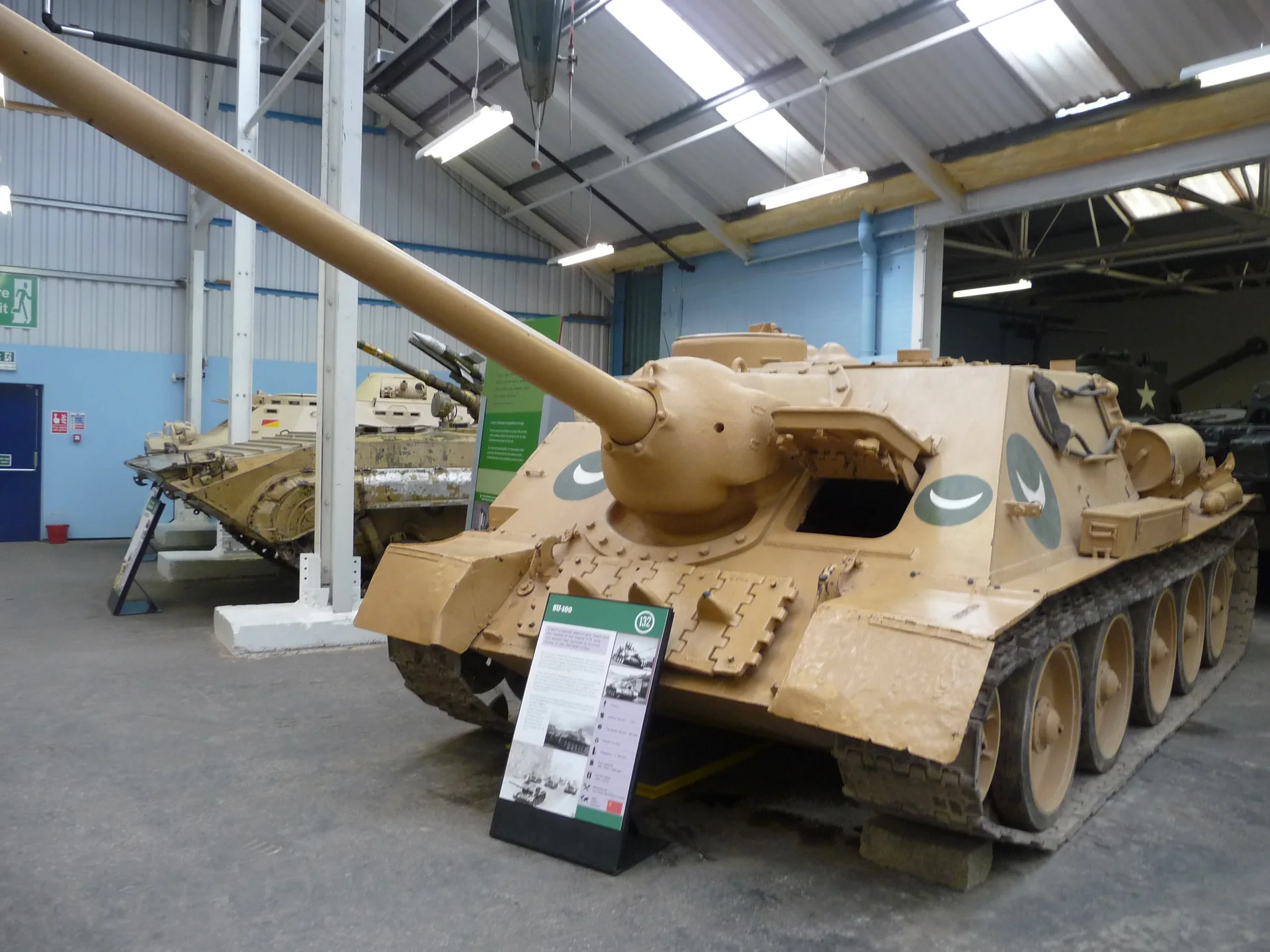
The SU-100's important wartime employment came during the closing campaigns, including fighting in Hungary in March 1945. Its 100 mm D-10S and four-man crew belonged to a vehicle developed from the T-34/SU-85 line, not to a heavier IS-based assault gun. The Padikovo exhibit wears markings representing a vehicle of the 1st Ukrainian Front in April 1945. Such display markings illustrate a historical configuration; they do not, by themselves, establish that the surviving museum chassis served with that formation. 4
Limitations and tradeoffs
The 1st Guards Tank Corps had used SU-100s as tank substitutes during operations from January to March 1945. Its report criticized the narrow traverse, cramped loading space and lack of a machine gun for close infantry threats. The staff recommended using the vehicles to accompany tanks rather than replacing the tanks themselves. 3
Assessment and related development
SU-100 extended the medium casemate tank-destroyer line with a 100 mm gun. It was not an ISU in a smaller hull, and its wartime configuration must be distinguished from later production and foreign service. A museum vehicle wearing 1945-style markings is useful as an exhibit, but those markings alone are not its service record. 1, 2, 3, 4
Sources and further reading
References and further reading are listed below. Image identification, credit and reuse terms remain with each photograph.
- Tank Archives — Optimal Modernization
- Tank Archives — 100 Stings
- Tank Archives — SU-100 Review
- Museum of National Military History, Padikovo: SU-100
See Armor in Person
This vehicle family is connected to 4 verified museums through 4 documented display records.