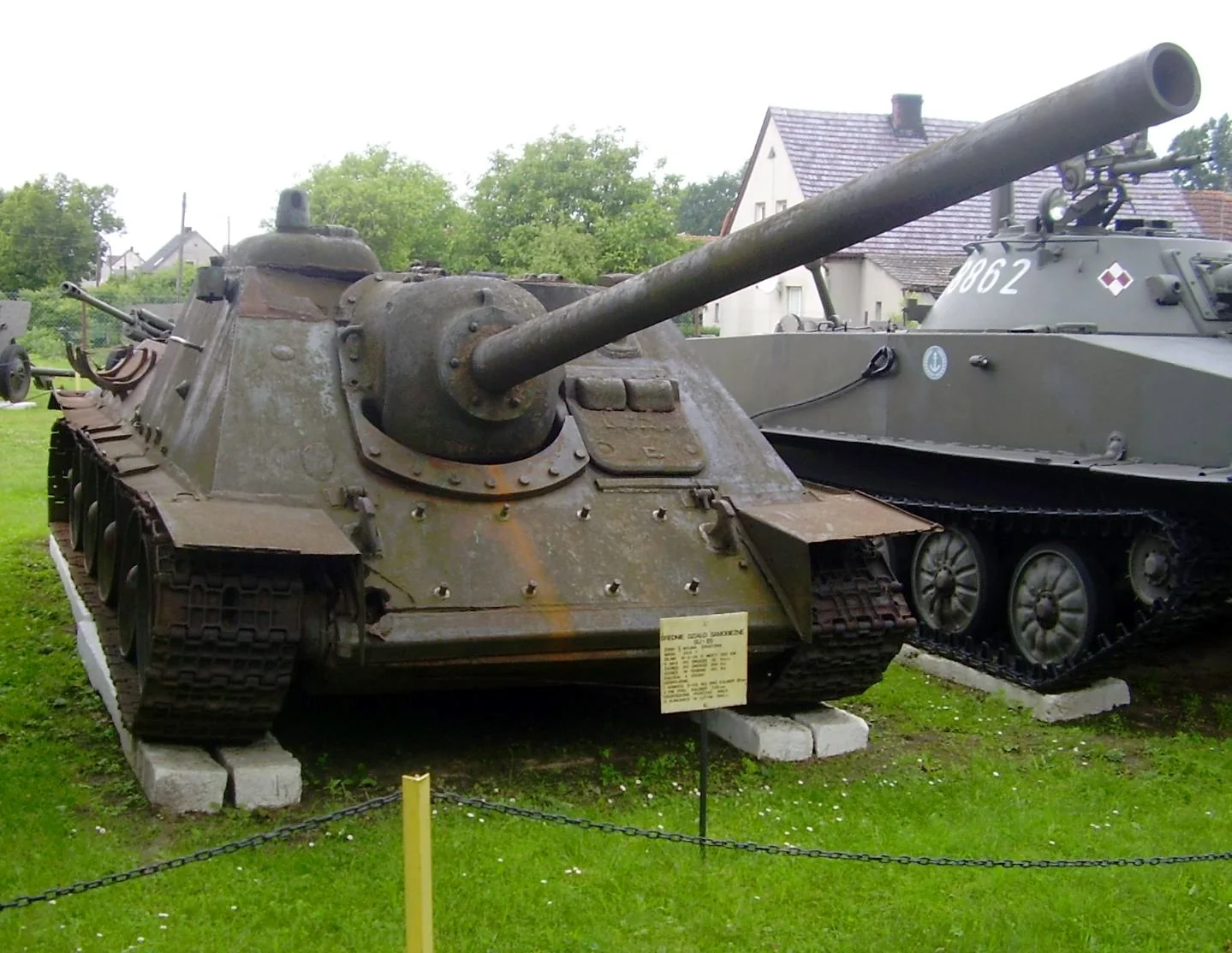
Requirement and development
The SU-85 was developed at UZTM in 1943 using the automotive base of the T-34 and experience from the SU-122. Its 85 mm D-5S changed the emphasis from the earlier vehicle's howitzer support role toward antitank work. Padikovo's account places acceptance in August 1943. The resulting vehicle retained a fixed fighting compartment rather than a turret, so installing the larger gun did not reproduce the crew layout or target-switching freedom of a T-34-85. 4
The published Factory No. 9 record gives a less tidy picture of selection than a simple list of successful prototypes. Its commission found that all four vehicles passed mobility trials but not gunnery trials. Urgency nevertheless favored the D-5S-85 installation, with Factory No. 9 instructed to correct defects in the gun and mechanisms. Selection was therefore conditional on further work, rather than evidence that the winning design had completed every test without difficulty. 5
Layout and engineering
The production SU-85 retained much of the existing medium self-propelled-gun arrangement. Its fixed fighting compartment housed four men, with a limited-traverse gun rather than a tank turret. Proposals for more extensive enlargement of the fighting compartment did not define the standard vehicle that first reached production. 2
The D-5S installation combined a vertically sliding semiautomatic breech with recoil equipment above the barrel. The hydraulic brake and hydropneumatic recuperator occupied the same upper plane, while a spherical armored cover protected the mounting. The gun and its mechanisms had to fit the existing medium chassis without a rotating turret. 3
The same record describes the recoil brake and recuperator arranged above the barrel, with a special frame allowing the gun to move within the fixed fighting compartment. The mounting and recoil components were protected by a spherical armored cover. The D-5S-85 retained the ballistics, barrel and chamber lineage of the 1939 antiaircraft gun, but its mounting was designed for an enclosed self-propelled vehicle. Shared ballistic ancestry did not mean that a complete towed gun had simply been placed inside a hull. 5
Armament and direct-fire role
The selected D-5S was an 85 mm self-propelled-gun weapon associated with the ballistics of the Soviet 85 mm antiaircraft-gun family. The adoption material distinguishes it from the rival installations tested in the same program. 3
The long 85 mm weapon shifted the emphasis from the SU-122’s short howitzer toward antitank fire. High-explosive ammunition still allowed the crew to engage other targets, but the mounting and ammunition were different from the earlier 122 mm installation. 1
Protection and survivability
The SU-85 retained an enclosed, sloped fighting compartment based on the medium-vehicle layout. Development and production changes included the gun shield, mantlet arrangement, and commander’s observation provisions. These details affected both protection and practical use. 1, 2
The closed casemate sheltered the crew from above, unlike an open-topped gun carrier. Observation depended on the commander’s fittings and the gunner’s sight, and the driver had to turn the hull when a target moved beyond the gun’s limited traverse. 1, 2, 3
Mobility, reliability, and logistics
The SU-85 benefited from the T-34 automotive lineage, while trial and production records still identified faults, including road-wheel problems. Uralmash’s transition away from simultaneous tank manufacture helped it concentrate on self-propelled-gun output. 2
Trials from 25 July to 6 August 1943 compared four competing installations. The commission reported that all passed mobility trials but not the gunnery tests. It nevertheless favored the D-5S-armed vehicle for urgent adoption, subject to corrections to the weapon and mechanisms. 3
Variants, production, and naming
SU-85-I, SU-85-II, and related trial designations describe competing experimental configurations, not a simple sequence of mass-produced marks. The vehicle selected for manufacture was closest to the D-5S-armed SU-85-II, with necessary revisions. 1, 3
The later SU-85M combined an 85 mm gun with the developing SU-100 hull arrangement. It remained distinct from the 100 mm-armed production vehicle, despite the shared external form. 2
Operational service
The SU-85 was accepted in August 1943 and used a four-man crew with the 85 mm D-5S series gun. The Padikovo museum places production through September 1944 and gives 2,339 vehicles, a museum summary that is useful for scale but should not be elevated above factory records not included in the cited evidence. Its exhibit markings represent a wartime unit scheme rather than documented provenance for that exact surviving chassis, another reminder to separate display interpretation from vehicle history. 4
The adoption date is also a reminder that SU-85 service followed rather than preceded the main July 1943 fighting around Kursk. The vehicle answered the same growing antitank problem, but its acceptance in August places large-scale use in the subsequent campaigns. This chronology avoids the common shortcut of inserting any 1943 Soviet tank destroyer into the Kursk battle simply because development was already under way. 3, 4
Limitations and tradeoffs
The SU-85 exchanged turret flexibility for a rapidly obtainable gun installation on an existing chassis. Workspace, observation, and a restricted gun arc remained important constraints. Its stronger antitank armament did not transform it into a more adaptable version of every vehicle whose chassis it resembled. 1, 2
Assessment and related development
SU-85 adapted an existing medium automotive family to a more strongly antitank-oriented weapon. The fixed compartment distinguished it from the T-34-85 even though both used 85 mm guns. The following SU-100 again changed the weapon installation and vehicle details. These relationships are clearer when chassis ancestry and battlefield role are described separately. 1, 2, 3, 4
Sources and further reading
- Tank Archives — From Medium Assault Gun to Medium Tank Destroyer
- Tank Archives — Long Awaited Tank Destroyer
- Tank Archives — SU-85 Adoption
- Museum of National Military History, Padikovo: SU-85
- Factory No. 9 SU-85 project and trials record, CAMD RF 38-11369-107; Tank Archives translation
Visit an Armor Museum
Explore the worldwide museum directory to find armored vehicles, collections, and visitor-planning information.
Browse armor museums