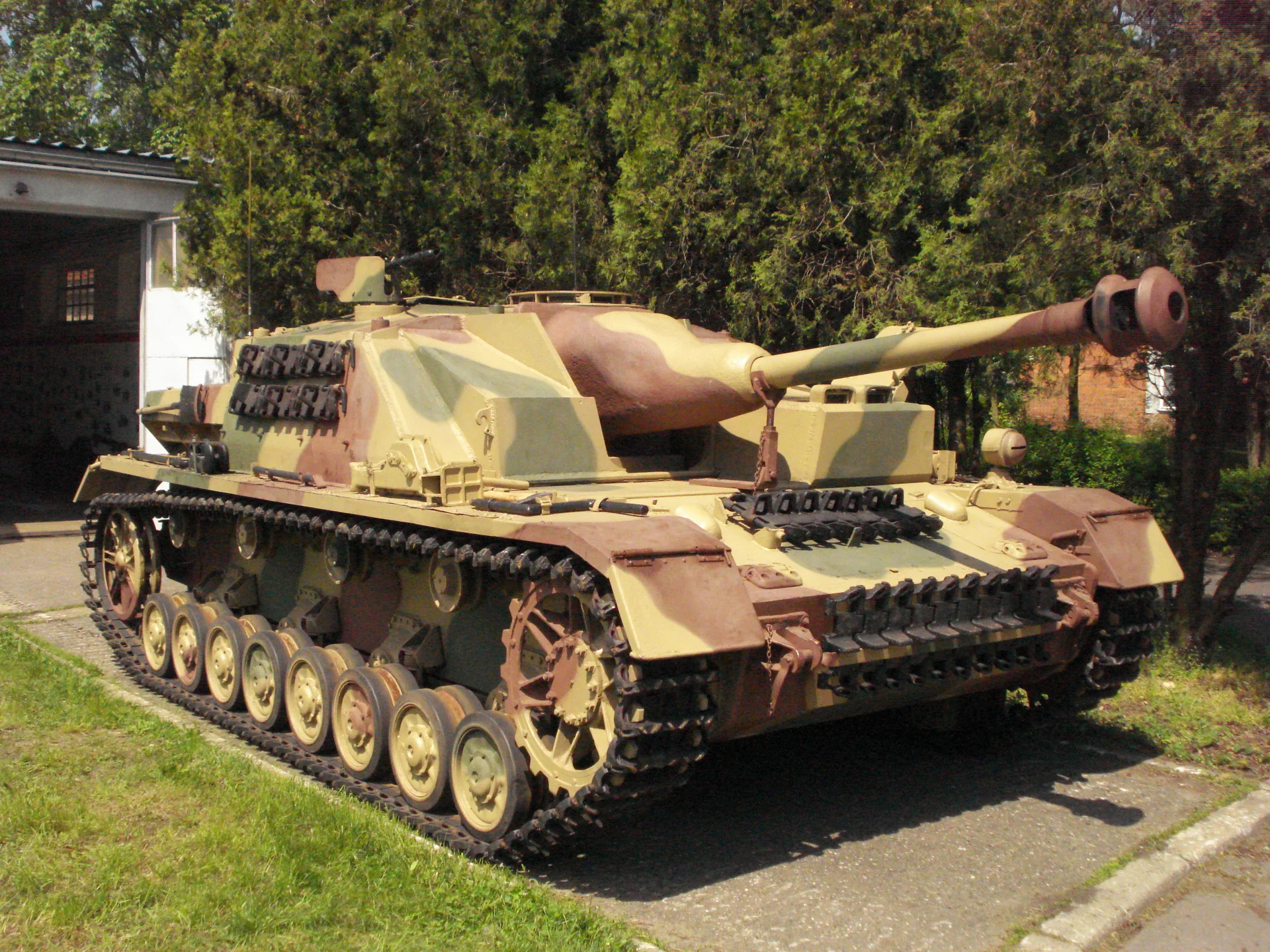
Requirement and development
StuG IV emerged from an urgent effort to preserve assault-gun output after the November 1943 bombing of Alkett disrupted StuG III production. Tank Encyclopedia describes the solution as adapting the StuG III fighting-compartment concept to the Panzer IV chassis, with the first small batch completed before the end of 1943. This was therefore not a clean-sheet successor to StuG III. It was a production response that combined available Panzer IV automotive components with an established assault-gun layout while German industry was under increasing pressure. 1
The production context also explains why StuG IV retained so much from existing systems. Reusing Panzer IV chassis production and the established StuG fighting-compartment concept reduced the amount of new design work required during a disruption. Secondary production summaries give differing totals and month-by-month figures, so no single aggregate number is treated as independently verified factory acceptance data. 1, 5
Layout and engineering
The StuG IV combined a Panzer IV chassis with an enclosed assault-gun fighting compartment. Its road-wheel arrangement and hull distinguished it from the Panzer III-based StuG III despite their related missions and armament. The March 1945 U.S. handbook explicitly lists the 7.5 cm StuK 40 L/48 on a Panzer IV chassis. That contemporary identification separates the vehicle from the longer-gunned Panzer IV/70 family. 5, 6
An Australian War Memorial catalog entry provides a dated factory context: photograph SUK14499 was made in July 1945 at Krupp Grusonwerk in Magdeburg, and its description identifies a late-model StuG IV in the assembly-shop background. The catalog establishes the location and identification of the photographed vehicle, not a production total or a complete history of that individual chassis. 5, 6
Armament and direct-fire role
The standard StuG IV carried the 7.5 cm StuK 40 L/48, the same general long-gun class that made late StuG IIIs effective against contemporary armor while retaining useful high-explosive capability. The gun sat in a limited-traverse mount within the casemate, so rapid shifts to widely separated targets required movement of the hull. Machine-gun arrangements varied over the production run and later vehicles incorporated improved provisions for close defense. 1, 2, 3
Protection and survivability
The enclosed casemate offered the StuG IV crew substantially more protection than open-topped Panzerjäger such as the Marder or Nashorn. Frontal armour was concentrated on a relatively small projected area, while the low silhouette helped reduce exposure. Side protection remained much lighter, and late-war vehicles could be fitted with skirts intended primarily to counter light anti-tank threats and fragments rather than transform the vehicle into a heavy assault tank. As with the StuG III, the gun’s limited traverse made flank security important because an unexpected threat could force the entire vehicle to turn. Armour therefore complemented, rather than replaced, concealment and combined-arms support. 1, 2, 3
Mobility, reliability, and logistics
The Panzer IV chassis gave the StuG IV well-understood mobility and maintenance characteristics but also carried the accumulated weight and development limits of a design that had been in service since before the war. The vehicle remained mobile enough for the assault-gun and anti-tank roles and benefited from an established spare-parts and training base. Because the superstructure avoided a turret, weight remained manageable compared with some later heavy tank destroyers. The chassis was nevertheless being asked to support numerous late-war variants, and German maintenance organizations faced increasing shortages of fuel, components, recovery vehicles, and trained mechanics regardless of the intrinsic soundness of the design. 1, 2, 3
Variants, production, and naming
StuG IV production was more standardized than the long StuG III series, but vehicles still differed by production date in fittings, armour details, machine-gun arrangements, exhaust systems, side skirts, and other changes. It should not be confused with the Jagdpanzer IV or Panzer IV/70, which used the same basic chassis but had a different sloped casemate and, in the latter case, a longer 7.5 cm gun. Nor should StuG IV figures be automatically substituted for a turreted Panzer IV. The family relationship is logistical and automotive, not evidence that all three vehicles shared the same silhouette, internal arrangement, combat weight, or tactical employment. 1, 2, 3
Operational service
StuG IVs served from 1944 through the final campaigns of the war in assault-gun and anti-tank formations. Like StuG IIIs, they were used in both offensive support and defensive direct-fire roles, and their long 75 mm guns were valuable against armored targets. Their appearance in units reflected practical wartime allocation rather than a perfectly clean doctrinal division between artillery and Panzer branches. By the late war, German formations often mixed equipment because losses, production shortages, and replacement flows made strict standardization impossible. The StuG IV’s utility therefore came partly from being familiar in concept and support requirements when armies were under severe operational and industrial strain. 1, 2, 3
Limitations and tradeoffs
The StuG IV inherited the basic fixed-gun limitations of the Sturmgeschütz idea. It could not swing its weapon rapidly across a wide arc without moving the hull, and immobilization or confined terrain reduced its ability to respond to threats outside the frontal sector. The Panzer IV chassis was dependable but no longer had large reserves for dramatic increases in armour or firepower. Its existence also added another armored-vehicle type to an already complicated German logistical system. The vehicle’s strengths were therefore pragmatic rather than transformational: it was a competent way to continue producing a familiar direct-fire capability, not a design that solved the deeper late-war problems of fuel, maintenance, training, and industrial fragmentation. 1, 2, 3
Assessment and related development
StuG IV was a Panzer IV-based means of fielding the established assault-gun system. It was neither a turreted Panzer IV nor merely another name for Jagdpanzer IV. Its gun, chassis and enclosed fighting compartment explain the relationship to both families. The Magdeburg photograph adds a dated industrial setting without providing a production census. 1, 2, 3, 4, 5, 6
Sources and further reading
References and further reading are listed below. Image identification, credit and reuse terms remain with each photograph.
- Tank Encyclopedia — Sturmgeschütz IV für 7.5 cm Sturmkanone 40 (Sd.Kfz.167) (secondary source; not primary certification)
- The Tank Museum — StuG III
- Tank Encyclopedia — Panzerkampfwagen IV Hub
- Military Trader — “Pulled from a river in Poland”
- Australian War Memorial, SUK14499 — Krupp Grusonwerk assembly shop, July 1945
- U.S. War Department, TM-E 30-451 VII.V.6: self-propelled artillery list (March 1945), transcription
Visit an Armor Museum
Explore the worldwide museum directory to find armored vehicles, collections, and visitor-planning information.
Browse armor museums