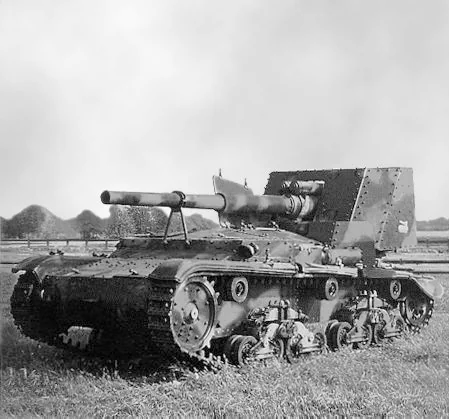
Development
The program sought a mobile installation for a weapon considerably larger than those carried by ordinary Italian medium tanks. Ansaldo developed the mount around a modified M14/41-derived chassis. The resulting vehicle represented a choice to prioritize the gun rather than wait for an entirely new heavy tank platform. 1
Layout and crew
The June 1943 U.S. intelligence report described the 90/53 as a rear-mounted gun on a turretless M14/41-derived chassis and inferred that the engine had been moved forward to make room. Its wording matters: the report presents parts of the layout as observation and other parts as wartime inference. The archive therefore uses it to establish the unusual rear-gun arrangement while keeping estimated mechanical details explicitly qualified. 2
The report was an intelligence assessment written while the war continued, not a factory handbook. Its suggestion that two men occupied the front of the vehicle was qualified in the same way as its account of the relocated engine. Consequently, it helps reconstruct what American readers understood about the mounting in June 1943 without establishing a complete crew roster. The front occupants, the men serving the exposed gun and the personnel moving ammunition should not be collapsed into a single crew figure on the strength of that passage. 2
Armament
The 90/53 weapon gave the vehicle a substantial direct-fire capability. Gun caliber alone, however, says little about how long a unit could sustain firing. The mount, available ammunition, crew access, and accompanying transport formed a larger working system around the gun. 1
Crew protection
The shield did not enclose the working area like a tank turret or a roofed casemate. Protection was therefore uneven: parts of the vehicle were armored, while the gun detachment remained exposed. It is misleading to apply a single hull-armor figure to the survivability of everyone operating the weapon. 1, 2
Mobility and support
The onboard ammunition provision was very small, commonly recorded as eight rounds, so accompanying ammunition transport was integral to the design. The gun vehicle needed a supply chain able to follow the same movement as the firing section. This was a substantial limit on independent action, not a minor specification. A large weapon could exhaust the rounds on its own chassis long before a sustained artillery task was complete. 1
Versions and conversions
The M41M designation belongs to this modified installation. It should not be confused with an ordinary M41 75/18 or with the various truck mounts using the same gun family. Production totals also need to remain separate from the number actually assigned to a campaign or formation. 1
Service history
Sicily in 1943 provides the established combat setting for the type. The fact that the vehicle was developed while fighting continued in North Africa does not by itself establish North African combat service. Nor does an intended deployment prove that vehicles actually reached the intended theater. 1
A surviving vehicle provides a much more specific Sicilian connection. In a January 2013 U.S. Army account, Fort Sill's artillery museum curator identified its gun with the 163rd artillery group and described its capture in Sicily in 1943, followed by shipment to Aberdeen for evaluation. The vehicle subsequently moved to Fort Sill during the redistribution of the Aberdeen collection. This is the custodian's provenance account for one gun, not a claim that every surviving component or marking has an uninterrupted wartime history. 3
Operating constraints
The contemporary American report repeatedly qualified its estimates of power and speed. Those estimates are useful evidence of Allied knowledge at the time, not a reason to override later identification work. More generally, the design’s limited protection and ammunition capacity constrained what its substantial armament could accomplish as a complete vehicle. 1, 2
The Fort Sill restoration also illustrates the difference between a preserved gun and a functioning self-propelled vehicle. Workers replaced rusted fenders with newly fabricated sheet metal, while the immobile tracks forced them to move the exhibit with a large forklift. The museum used photographs taken after capture to reconstruct the camouflage and unit markings. Those finishes were researched replacements: the photographs supplied evidence for the appearance, while the surviving chassis supplied the object being restored. 3
Design legacy
The 90/53 is an especially clear example of a gun-centered tank-destroyer design. Its story separates three questions that are often conflated: whether a weapon was effective, whether it could be installed on a chassis, and whether the resulting formation could protect and sustain that weapon in combat. 1, 2
Sources and further reading
- Arturo Giusti, “Semovente M41M da 90/53” (2023)
- U.S. War Department, Tactical and Technical Trends 26, 3 June 1943; transcription
- U.S. Army, Army FA museum adds WWII artillery pieces, 17 January 2013
Visit an Armor Museum
Explore the worldwide museum directory to find armored vehicles, collections, and visitor-planning information.
Browse armor museums