Development
The Saumur museum describes the Semovente 75/18 M40 as a casemate vehicle built on the M13/40 chassis and records the first deliveries in May 1941. Its initial purpose was mobile support for armored formations, while combat experience also brought antitank employment. That sequence is more precise than treating the short 75 mm weapon as evidence that the vehicle began as a dedicated tank destroyer. 2
Saumur's account also records a change in the Italian high command's priorities in July 1942: the Semovente had become attractive enough for commanders to favor producing more self-propelled guns than tanks. This was a wartime judgment about the usefulness of the low, gun-armed vehicle, not proof that a corresponding production ratio was actually achieved. Production orders, completed vehicles and front-line strength remain different measures of that preference. 2
Layout and crew
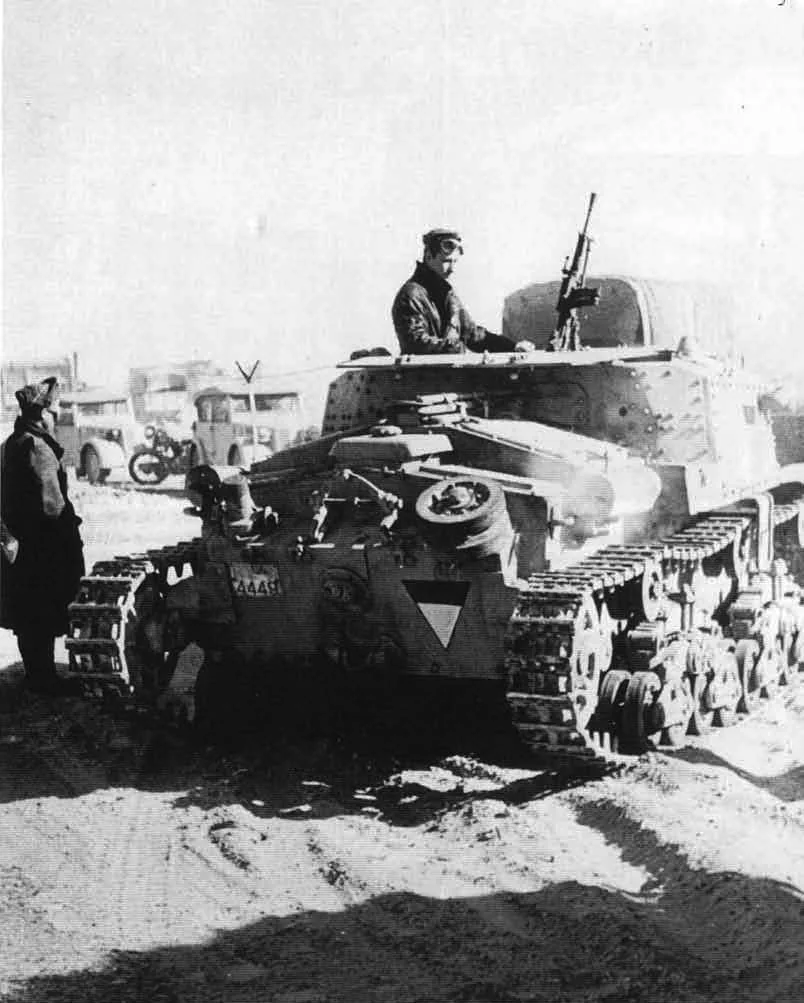
Removing the turret made room for a fixed fighting compartment. The gun occupied its front, with only a limited arc of traverse. The arrangement reduced height and concentrated the weapon, sights, ammunition, and crew in a compact space; its practical cost was that the hull sometimes had to turn when the gun could not follow a target. 1
Armament
The howitzer’s high-explosive ammunition suited support fire. Shaped-charge rounds supplied a different means of attacking armor: their effect did not depend on turning the short gun into a high-velocity weapon. That distinction explains how an artillery vehicle could also perform antitank tasks without having been designed exclusively for them. 1
A distinctive detail was the perforated conical fitting at the muzzle. The museum describes it as serving both muzzle-braking and flash-suppression functions. The short barrel left a conspicuous flash, which could interfere with the gunner's vision and reveal the vehicle's location. The fitting therefore addressed the crew's working conditions as well as the mechanical effects of firing. A small feature in photographs can preserve evidence of a practical difficulty that the gun's caliber and barrel-length designation do not convey. 2
Crew protection
The enclosed casemate offered more shelter than an open gun platform, but neither a low silhouette nor frontal armor made the vehicle equally protected from every direction. As an engineering comparison, the roofed layout exchanged the openness of a field-gun position for a more confined workplace and restricted visibility. 1
Mobility and support
The chassis sequence followed the M13/40, M14/41, and M15/42 families. Early diesel-powered versions and the later petrol-powered M42 should not be assigned a single engine specification. Shared components could simplify support, but changing the automotive base also meant changing the relevant spare parts, fuel arrangements, and maintenance knowledge. 1
Versions and conversions
M40, M41, and M42 identify chassis developments within the 75/18 family; they are not three different gun calibers. Likewise, the broad Italian word semovente, meaning self-propelled, does not establish that another similarly named vehicle carried the same weapon or fulfilled exactly the same role. 1
Service history
The family’s combat history is closely associated with the North African campaign. After the September 1943 armistice, vehicles also continued in German use. A family-level service history must nevertheless distinguish the different chassis batches rather than place every version in every engagement attributed to Italian assault guns. 1, 2
American intelligence was still sorting out the installation in August 1942. A contemporary report described a turretless M13/40 mounting but questioned whether the less satisfactory M11/39 might instead have been converted. It also admitted that the report did not identify which 75/18 carriage model was involved. Its tabulated elevation and traverse figures belong to the field-gun discussion and cannot simply become limits for the cramped vehicle mounting. This source records an early stage of Allied identification; it is not evidence for assigning the 75/18 family to every theater in which other Italian self-propelled guns appeared. 3
Operating constraints
The design combined several useful functions without removing the compromises between them. Artillery support, direct fire against field positions, and antitank engagements imposed different demands on ammunition and observation. Its low outline was an advantage in some circumstances, not a basis for claiming universal superiority over turreted tanks. 1
Design legacy
The 75/18's artillery origins remained visible even when crews used it against armored targets. A short howitzer, low casemate and medium-tank automotive base produced a different balance from a turreted gun tank. Its history spans both Italian and German employment, with changes of chassis and operator occurring independently. The family therefore belongs in the history of mobile support artillery as well as tank-destroyer development. 1
Sources and further reading
- Arturo Giusti, “Semovente M40 da 75/18” (2023)
- Musée des Blindés, Semovente exhibit
- U.S. War Department, Tactical and Technical Trends 6, 27 August 1942; transcription
Visit an Armor Museum
Explore the worldwide museum directory to find armored vehicles, collections, and visitor-planning information.
Browse armor museums