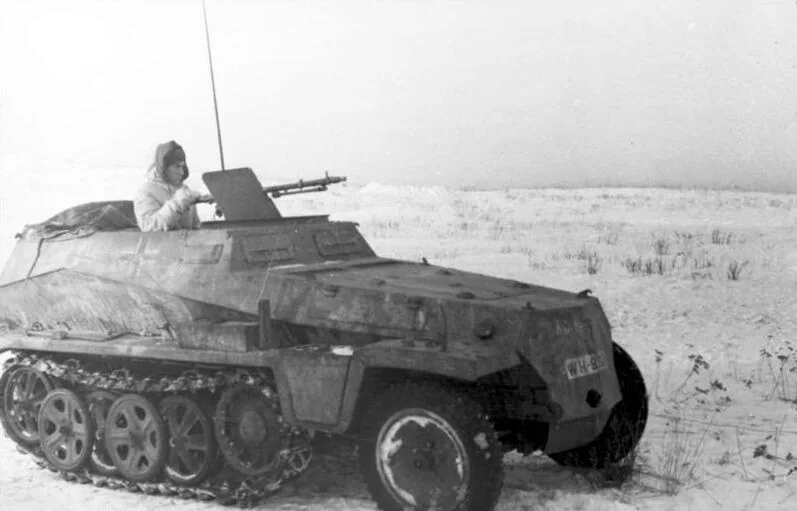
Development and requirement
Germany developed the Sd.Kfz. 250 to provide light armored mobility for reconnaissance and specialist elements that did not require the larger Sd.Kfz. 251. 1
The Sd.Kfz. 250 was a light armored half-track used to give small reconnaissance and specialist teams protected mobility. Its role sat below the larger Sd.Kfz. 251 troop carrier in capacity, and the 250 family was adapted into several command, observation and weapons configurations. The Weald Foundation's surviving Ausf. A material also ties one vehicle to an armored reconnaissance battalion, reinforcing the family context without turning a single preserved hull into evidence for every wartime variant. 1, 2
Design, protection, and mobility
Its half-track running gear combined front-wheel steering with tracked rear propulsion. The open-topped armored body protected a small crew and mission team from small-arms fire and fragments while retaining good cross-country mobility for the period. 1
The 250 was not a wheeled armored car. Front wheels provided steering while the rear half of the vehicle used tracks for propulsion and cross-country movement. The open-topped armored body traded complete overhead protection for low weight, access and usable space for a small crew or specialist detachment. Its automotive and tactical compromises therefore belong to the half-track category, not to the tire, road-range and suspension tradeoffs associated with the earlier wheeled-template wording. 1, 2
Reconnaissance places unusual pressure on internal layout and protection. The vehicle must carry radios, observation equipment, ammunition, and scouts while remaining mobile enough to avoid decisive engagement. Protection is valuable because reconnaissance units operate forward and can be discovered unexpectedly, but excessive weight can undermine the very mobility that lets them break contact. The practical design goal is therefore not invulnerability; it is enough protection and firepower to survive contact, report, maneuver, and continue the reconnaissance mission. 1
Firepower and battlefield role
Weapons varied with the sub-variant. A basic carrier or command vehicle cannot be described with the armament of a cannon or mortar version merely because both carried the Sd.Kfz. 250 designation. The family needs variant-specific treatment: weapon installation, radio fit, crew size and internal stowage changed as the chassis was assigned to reconnaissance, command, observation and support tasks. 1
Service, variants, and modernization
A wide range of sub-variants carried radios, observation equipment, antitank weapons, and other specialized systems. That diversity made the 250 family especially prominent in armored reconnaissance units. 1
The Weald Foundation's research illustrates the value of chassis-level provenance. Its Ausf. A project used surviving camouflage, tactical markings, unit-strength documents and recovered components to associate a specific vehicle with SS-Panzeraufklärungs-Abteilung 10 in Normandy. That is evidence for one vehicle and formation, not a license to generalize its markings, equipment or service history across the entire Sd.Kfz. 250 family. 2
The Weald Foundation's reconstruction of a Normandy vehicle shows how a particular half-track can acquire a documented history. In 2005 it received incomplete armor carrying camouflage and tactical number 317. That number suggested a position within a company and platoon but did not initially establish the division. Comparison with organizational records and photographs narrowed the investigation. The later recovery of the matching rear door, carrying both the number and divisional insignia, supplied an additional physical connection to the 10th SS Panzer Division's reconnaissance battalion. 2
How the vehicle fits the formation
In reconnaissance formations the light half-track carried people, radios or specialist equipment while remaining mobile enough to accompany other armored vehicles. The useful historical distinction is not a generic statement that every armored carrier supports infantry. It is that the 250 filled smaller reconnaissance and command requirements for which the larger Sd.Kfz. 251 was unnecessary or inefficient. 1, 2
Strengths, limitations, and family boundaries
The baseline family is treated as an APC/reconnaissance carrier. Heavily armed specialist variants can be cross-linked by role without changing the family’s primary transport identity. 1
The 250 combined steering wheels with tracked propulsion, so its mobility advantages and liabilities were those of a half-track. It offered better protected cross-country movement than ordinary light vehicles, but the running gear was mechanically more involved than a simple truck. The cited evidence does not support the earlier claim that the family derived its strength from a wheeled architecture. 1
Sub-variant numbers matter. Carrier, command, artillery-observation and weapons versions reused the same basic chassis but altered the interior, crew equipment and combat function. The Armor Archive keeps those variants together as an engineering family while avoiding a single specification block that would make every Sd.Kfz. 250 appear identically armed or equipped. 1
The Foundation faced a choice between that incomplete vehicle and an intact example whose earlier blasting and repainting had destroyed the original markings. Its account describes using the latter as a donor for the historically identifiable wreck. Completeness and evidential value were therefore not the same thing: surviving paint and associated fragments could preserve information that a visually cleaner vehicle had lost. The described reconstruction is a custodian's project account, not proof that all visible restored panels came from one wartime hull. 2
Sources and further reading
- Panzernet, Sd.Kfz. 250 history and variants
- Weald Foundation, Sd.Kfz.250 Ausf. A restoration and identification
Visit an Armor Museum
Explore the worldwide museum directory to find armored vehicles, collections, and visitor-planning information.
Browse armor museums