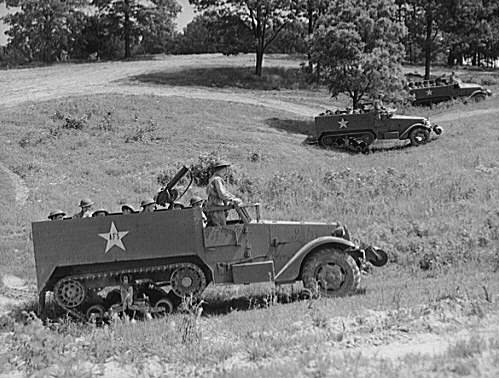

Development and requirement
The U.S. Army needed protected transport that could move infantry with armored formations without the cost and complexity of a fully tracked vehicle. The M3 half-track combined a wheeled front axle with tracked rear running gear and entered service in 1941. A closely related M5 family, built by International Harvester with different construction details, helped expand Allied supply through wartime production and Lend-Lease. 1, 2
Design and fighting role
Half-track construction offered better rough-ground traction than ordinary trucks while retaining familiar steering and automotive components. Armor protected against small arms and shell fragments rather than tank guns. Troops normally entered through the rear, and machine guns provided local fire support. The open top improved visibility and access but left occupants exposed to overhead fragments and airburst effects. 1, 2
Service and evolution
M3/M5 half-tracks served in enormous numbers across U.S. and Allied formations as troop carriers, command vehicles, ambulances, artillery movers, and weapons platforms. They were central to World War II mechanization even though postwar armies increasingly favored fully tracked or fully wheeled APCs. 1, 2
Archive boundaries
The archive keeps troop-carrier M3/M5 vehicles together because they filled the same core APC mission. Anti-aircraft, artillery, tank-destroyer, and other major weapons carriers based on half-track chassis are classified by battlefield role rather than automatically folded into this APC profile. 1
Sources and further reading
Representative source set used for this profile. Primary image source and reuse terms are listed with the image.
- National WWII Museum — White M3 Half-Track
- U.S. Army Infantry magazine, 1966 — postwar APC development