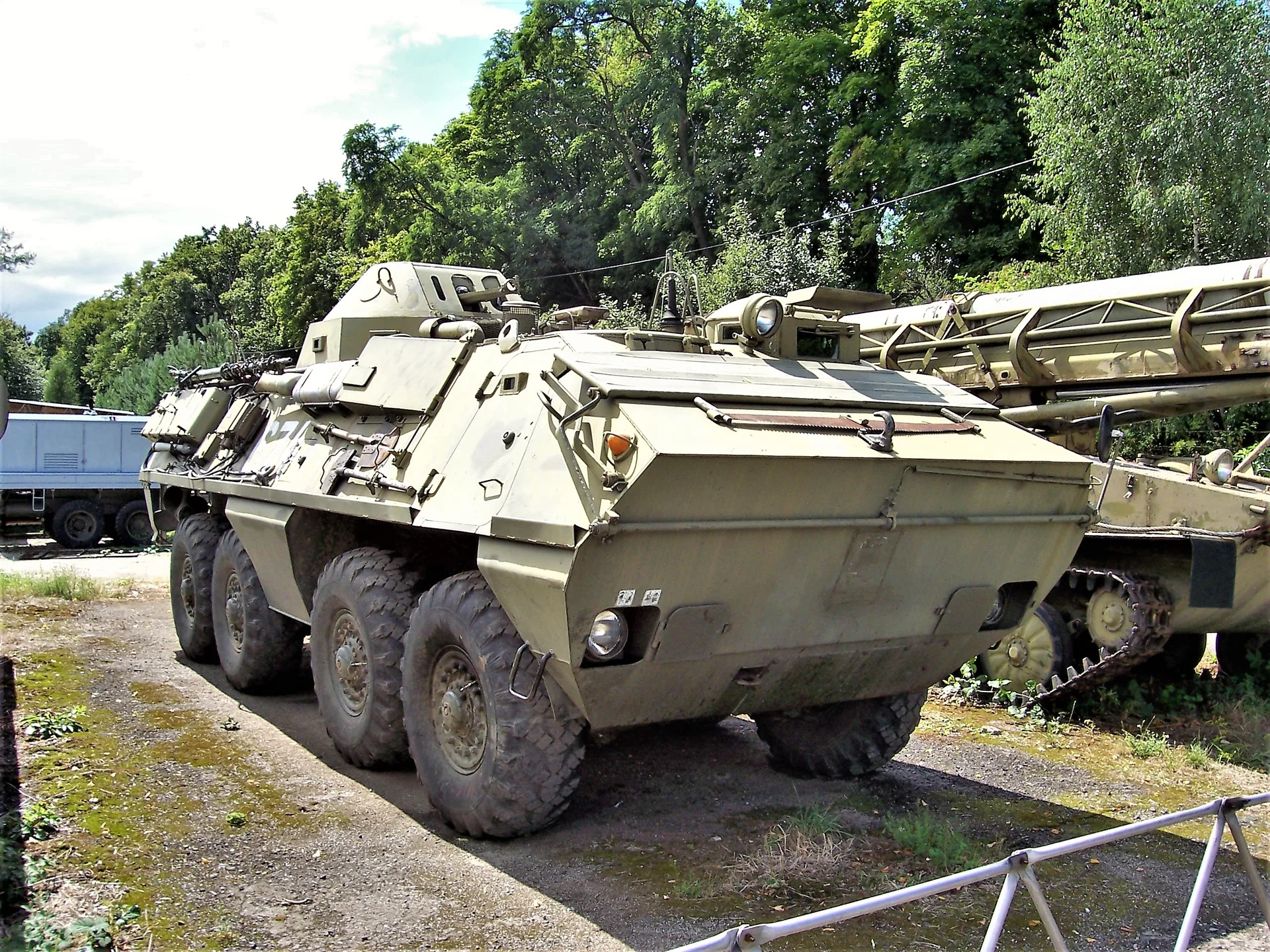
Development and requirement
Czechoslovakia and Poland jointly developed the OT-64 as a modern wheeled armored personnel carrier for motorized infantry. It entered service in the early 1960s. 1
OT-64 was a joint Czechoslovak-Polish amphibious armored personnel-carrier project. The Military History Institute in Prague dates the beginning of development work to 1959 and entry into the army to 1964. That record provides a firmer chronology than the previous generic Cold War framing and places the vehicle in a specific cooperative industrial program. 2
The Military History Institute traces the project to studies in Brno in 1956 and submission of the A105 project at the end of 1958. The first SKOT I prototype was completed in May 1960. Testing did not simply confirm the original design: armor trials that November led to a requirement for a revised hull, followed by changes to slopes and thickness before further trials in 1961. The prototype sequence therefore records a practical redesign process, not an uninterrupted march from drawing board to production. 3
Production became a shared Czechoslovak-Polish undertaking. The institute describes a 1962 agreement, preparation of series documentation in 1963 and manufacture at FSC Lublin using substantial Czechoslovak component supply. Deliveries began in 1964, while the proposal for formal Czechoslovak adoption was dated 3 May 1965; vehicles appeared in the public parade six days later. Delivery and adoption are different milestones. Treating either year as the single beginning of the entire program would lose part of the documented sequence. 3
Design, protection, and mobility
Compared with many contemporary Soviet wheeled carriers, the SKOT used a diesel engine and rear troop doors, improving troop access and reducing some of the compromises of side/top egress. 1
SKOT itself denotes a medium wheeled armored personnel carrier, and the vehicle used an eight-wheel layout rather than tracks. Its design combined road mobility with amphibious capability and a protected troop body. The relevant tradeoffs are therefore those of a large 8x8 carrier, not a generic statement that could apply equally to every wheeled reconnaissance vehicle. 1, 2
Troop-carrying versions were built around moving infantry under armor, while command and weapons variants rearranged internal space for radios, crews or combat systems. That distinction is important because an APC's usable troop volume cannot be inferred from a specialist SKOT fitted for another role. 1
The Ministry of Defence's historical reference distinguishes the unarmed transporter from the armed OT-64A. Its occupancy figures differ substantially: two crew and eighteen passengers for the described unarmed arrangement, against two crew and eight passengers for the armed vehicle. That is not a typographical discrepancy to be averaged away. It reflects the space and role changes associated with the particular configuration. A family page should therefore identify the vehicle attached to a seating figure rather than presenting the largest figure as a universal capacity. 4
Firepower and battlefield role
Armament varied across the family. Some troop carriers used machine-gun installations, while turreted and specialist versions carried different equipment. This profile therefore treats weapon fit as configuration-specific and does not transfer a turret specification from one national or mission variant to every OT-64/SKOT. 1
The same reference separates armed, command, medical and technical-support arrangements. It identifies the familiar heavy-machine-gun turret fit while also recording changes to the accompanying machine gun and other armament on specific versions. Command designations concern radio and staff functions, and the DTP vehicle concerns technical support. These variants show how the hull supported a formation beyond moving infantry. They do not establish that all occupants, radio sets and weapon fittings could be carried simultaneously on one standard transporter. 4
Service, variants, and modernization
Thousands were produced in multiple variants for domestic and export use, making OT-64 an important Warsaw Pact-era wheeled APC family outside direct Soviet production. 1
The Czech military-history record documents a long service span. It states that the last examples were removed from Czech Army equipment at the beginning of the twenty-first century and records OT-64 use by Czech troops in the former Yugoslavia, including the IFOR mission in 1996. Those dated points are stronger evidence than a generalized claim that the family was merely modernized over time. 2
A photograph in the Military History Institute's collection places an OT-64 at Brezičani during the 1996 IFOR deployment. The catalog associates it with the 3rd Company of the Czech mechanized contingent. That gives the type a specific post-Cold War episode: an older Warsaw Pact-era transporter appearing in a multinational peace-support mission. The object entered the museum collection much later, so the acquisition date must not replace the date of the scene. The photograph establishes that vehicle's presence and context, not a complete fleet count or a technical description of every modification made for the deployment. 2
How the vehicle fits the formation
During IFOR, Czech OT-64s were used by a mechanized contingent operating in Bosnia and Herzegovina. The museum caption establishes the vehicle's presence in that mission without proving that every SKOT configuration or operator used it in the same way. The example is therefore kept specific to the documented Czech contingent. 2
Strengths, limitations, and family boundaries
Standard troop carriers belong in the APC category. Antitank, air-defense, command, and other specialist SKOT variants should be cross-linked by function rather than counted as ordinary APCs. 1
The OT-64's historical interest lies in a large amphibious 8x8 carrier developed jointly by two Warsaw Pact states and kept in Czech service for decades. Its road mobility, troop capacity and specialist adaptability came with the usual need to distinguish weight, turret and internal-layout changes by variant. The earlier generic comparison with heavy tracked vehicles has been removed. 1, 2
SKOT variants included troop carriers and specialist command, weapons and support configurations. The archive keeps them connected by chassis lineage but separates battlefield roles where the installation materially changed crew, equipment or mission. That prevents one turret, passenger figure or radio fit from being presented as universal across the family. 1
Sources and further reading
- GlobalSecurity, OT-64 SKOT overview
- Vojenský historický ústav, OT-64 photograph from IFOR
- Vojenský historický ústav, OT-64 SKOT development history
- Czech Ministry of Defence, historical OT-64 vehicle reference
See Armor in Person
This vehicle family is connected to 1 verified museum through 1 documented display record.