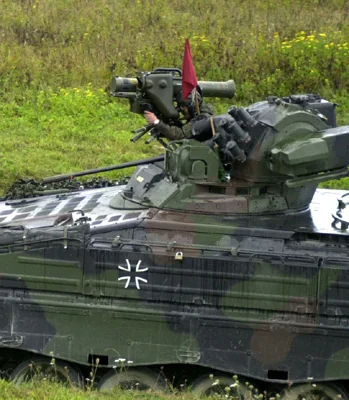
Development and requirement
The Marder emerged from West Germany’s requirement for an infantry vehicle able to accompany modern tanks and support Panzergrenadiers both mounted and dismounted. It entered service in the early 1970s and became one of the principal armored systems of the Bundeswehr. Unlike the earlier APC model of simply transporting troops, the Marder was expected to contribute directly to the fight with a turreted automatic cannon and antitank weapons. 1, 2
Marder belongs to the generation of West German vehicles intended to keep mechanized infantry with a tank formation while allowing them to contribute mounted fire. Its tracked hull, cannon turret and rear infantry compartment addressed that requirement together. The design did not treat the infantry as cargo unrelated to the crew. Observation, communication and the movement of soldiers between the vehicle and the ground were part of the same fighting system. That relationship helps explain why later modifications concerned the occupied compartment and protection as well as the turret weapon. 1, 2
Design, protection, and mobility
A front-mounted engine, rear troop compartment, and turreted 20 mm cannon gave the vehicle a conventional Western IFV arrangement. Later vehicles added or improved thermal sights, missile integration, mine protection, stowage, and survivability. The Marder’s armor and automotive upgrades increased weight over time, but the platform remained mobile enough to work with Leopard-equipped formations. 1, 2
The tracked layout of the Marder 1 emphasizes cross-country mobility and the ability to remain with armored formations away from improved roads. Tracks spread vehicle weight over a larger contact area and help negotiate soft ground, broken surfaces, and obstacles, but they bring higher maintenance demand and more mechanical wear than an equivalent wheeled carrier. For crews and infantry, this means mobility is inseparable from sustainment: track condition, suspension components, fuel, recovery support, and route selection all affect whether the vehicle can deliver its combat function when required. The design is therefore a compromise between tactical mobility and the logistical cost of preserving that mobility over time. 1, 2
Protection and internal volume are especially difficult problems in an infantry fighting vehicle because the hull must serve both a vehicle crew and a dismounted fighting element. The troop compartment needs usable space, access routes, ammunition stowage, communications, and enough separation from fuel and mechanical systems to make the vehicle practical in repeated operations. The published configuration summarized here lists 3 crew + 6 infantry. Adding armor improves resistance to fragments and direct fire, but it also increases weight and can reduce mobility, amphibious margin, payload, or growth capacity. As threats change, many IFV modernization programs therefore become exercises in managing accumulated weight and electrical demand as much as in fitting a new gun or sight. 1, 2
Firepower and battlefield role
The vehicle’s principal armament, 20 mm automatic cannon, defines much of how the Marder 1 can contribute after contact. Cannon and antitank weapons can allow an infantry or reconnaissance vehicle to suppress positions, engage light armor, and threaten heavier vehicles under favorable conditions without depending on a tank for every target. That firepower changes tactics because the carrier can support the infantry before and after dismount, cover movement, and respond quickly to targets that would otherwise require a separate support weapon. At the same time, mounted firepower does not erase the distinction between an IFV and a main battle tank: protection, ammunition, sensors, and survivability remain optimized around different missions. 1, 2
Service, variants, and modernization
Marder served throughout the Cold War and continued in German service during the long transition to Puma. Bundeswehr variants such as the 1A3, 1A5, and 1A5A1 reflect successive emphasis on protection, mine resistance, electronics, and crew environment. The type has also been transferred to other users, extending a family originally designed for Central European mechanized warfare into modern conflicts. 1, 2
The Marder name covers several distinguishable upgrade states. Changes in protection, communications and mine resistance should not be compressed into a claim that every surviving vehicle is equivalent to the latest described version. The A3, A4, A5 and A5A1 designations identify different configurations, and later antitank equipment should not be projected back onto the vehicle’s original service entry. The long service history also makes dates important: an equipment page describing a modern fitting is useful evidence for that fitting, but not proof of the configuration used in an earlier deployment. 1, 2
The Bundeswehr distinguishes the Marder 1 A3, A4, A5 and A5A1 rather than treating them as interchangeable names. Its equipment description associates A4 with command communications, A5 with mine-protection and stowage changes, and A5A1 with additional crew-support and observation equipment, including air conditioning. These changes concern different parts of the vehicle and should not be inferred from a turret photograph alone. The same page describes an external infantry telephone on a 4.5-metre cable, illustrating a less conspicuous part of the fighting system: soldiers outside the hull need a way to communicate with the crew inside. Such details connect the Marder’s vehicle systems to the infantry mission more directly than a list of armor and engine figures alone. They do not establish that every version carried every later fitting, or when each vehicle in a national fleet received an upgrade. 1
How the vehicle fits the formation
In combined-arms employment, the Marder 1 is not an independent substitute for tanks, infantry, artillery, engineers, or air defense. Its purpose is to connect protected mobility with the infantry's ability to seize and hold ground. The mounted crew can observe and engage while the dismounted element deals with terrain and threats that cannot be solved from inside the hull. Effective use therefore depends on coordination: tanks provide heavier direct fire and protection, artillery and mortars suppress or isolate, engineers open routes, and the infantry fighting vehicle moves soldiers while contributing its own sensors and weapons. The platform is most effective when those capabilities overlap rather than when it is sent forward alone. 1, 2
Strengths, limitations, and family boundaries
The archive treats Marder 1 as one family across its principal combat upgrades. The much newer Puma is a separate IFV generation. Specialist observation, command, and training Marders are linked as variants rather than presented as new basic vehicle families. 1
Marder’s layout makes the relationship between the vehicle crew and dismounted infantry especially important. The cannon and associated sights support the mounted part of the mission, while the rear compartment must permit soldiers to observe, communicate and leave the hull. Added protection may improve one aspect of survival while changing weight, access or stowage. The vehicle’s history is therefore not just a record of gun performance. The accumulated changes show how a relatively stable hull and turret concept can require extensive revisions to keep crew and infantry working together. 1, 2
Puma is a successor in the German infantry fighting vehicle role, not another Marder production suffix. Likewise, command and observation arrangements within the Marder family should be distinguished from the ordinary infantry vehicle rather than assumed to have identical radios and internal fittings. Family relationships are useful only when they retain those differences. A photograph captioned simply Marder may identify the broad type while leaving the protection standard, communications fit and date unresolved. Those details are necessary before assigning an exact specification to the pictured vehicle. 1, 2
Sources and further reading
References and further reading are listed below. Image identification, credit and reuse terms remain with each photograph.
See Armor in Person
This vehicle family is connected to 1 verified museum through 1 documented display record.