
Development and design
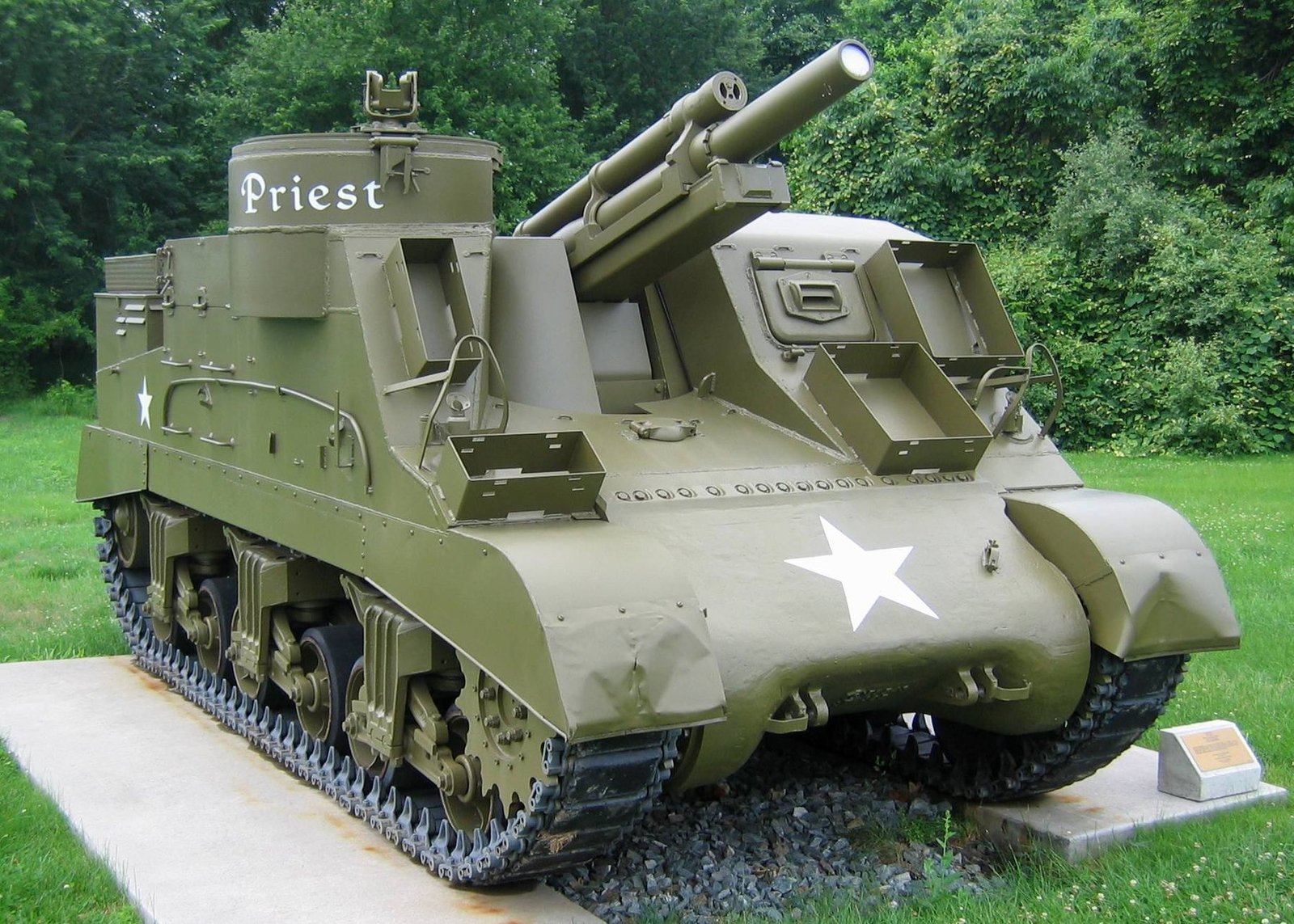
The Army developed the M7 to give armored formations artillery that could move cross-country with tanks. Early vehicles drew heavily on M3 medium-tank components, while later M7B1 production used M4 Sherman automotive features. 1, 2
Operational use
Priests entered service in 1942 and fought widely with U.S., British, and other Allied forces. The open fighting compartment carried both the gun crew and a substantial ammunition load, letting batteries displace faster than towed artillery. 1, 2
Role and significance
The M7 demonstrated that self-propelled field artillery could be a normal component of armored warfare rather than a specialized expedient. It also influenced Commonwealth requirements that produced the Sexton. 1, 2
Sources and further reading
Representative source set used for this profile. Primary image source and reuse terms are listed with the image.
- U.S. Army, “Great guns: M7 Priest backs WWII armor”
- U.S. Army Center of Military History, M7B1 context