_3.JPG)
Development and requirement
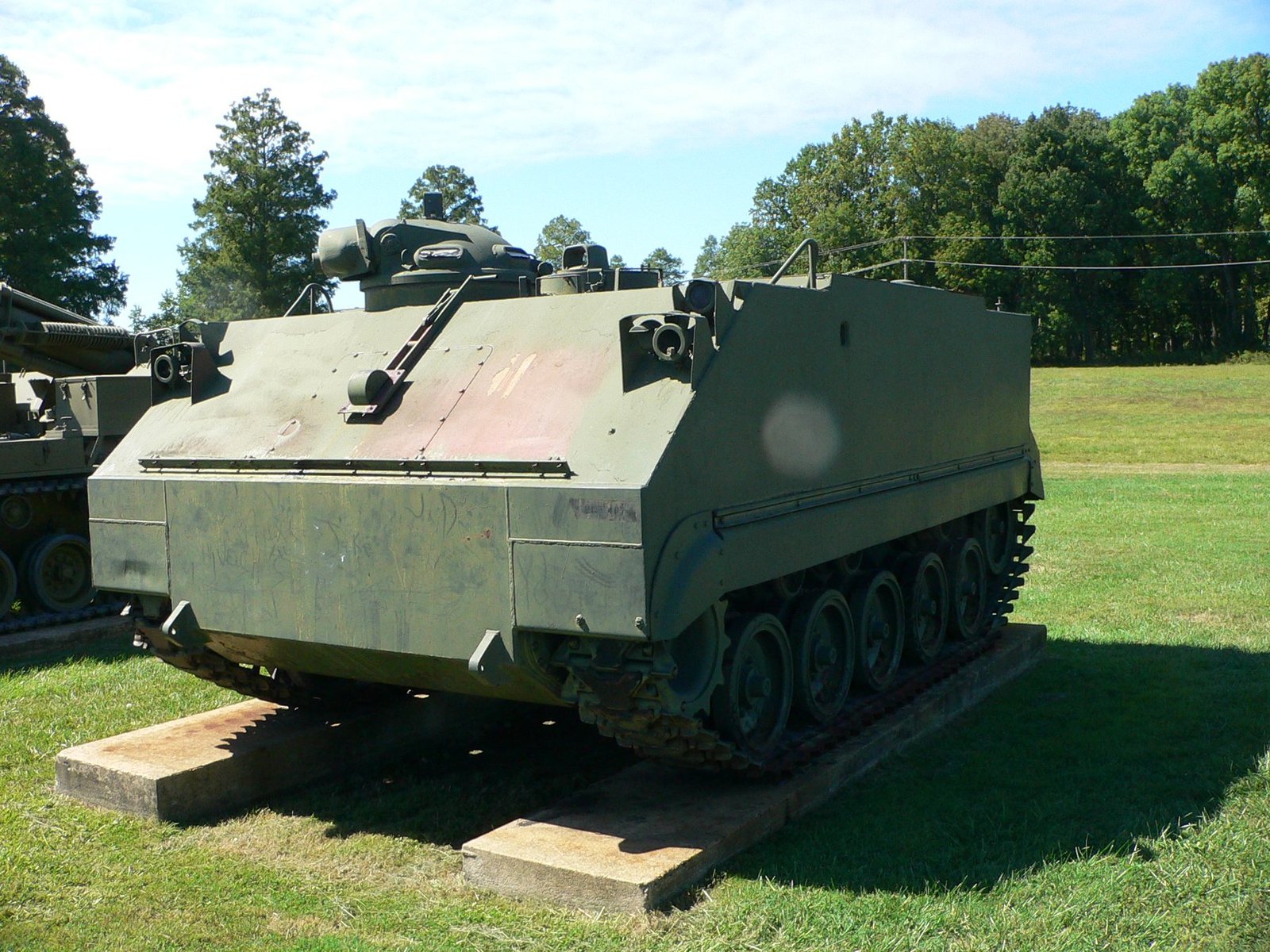
Korean War experience and dissatisfaction with the expensive M75 prompted the Army to pursue a new APC almost immediately. FMC prototypes led to the T59, standardized as M59. Entering service in 1954, the vehicle was lower, amphibious, and substantially cheaper to produce than its predecessor. 1, 2
Design and fighting role
The M59 used two commercial-style gasoline engines rather than one large specialized power plant, helping control cost but adding complexity. A rear ramp improved troop access, and the vehicle could swim without extensive preparation. Its armor protected against small arms and fragments, while a .50-caliber machine gun gave the commander a basic defensive weapon. 1, 2
Service and evolution
Thousands of M59s were produced and the vehicle served with U.S. and allied forces, including use in Vietnam-era operations. The M84 mortar carrier adapted the chassis for indirect fire. The M59 was eventually eclipsed by the M113, whose aluminum hull, automotive arrangement, and family growth proved far more enduring. 1, 2
Archive boundaries
M59 remains a separate APC generation between M75 and M113. The M84 mortar carrier should be linked to the M59 family but belongs under self-propelled mortar/artillery treatment if it receives a full profile. 1
Sources and further reading
Representative source set used for this profile. Primary image source and reuse terms are listed with the image.
- Tucson Military Vehicle Museum — M59 Armored Personnel Carrier
- U.S. Army Infantry magazine, 1966 — postwar APC development