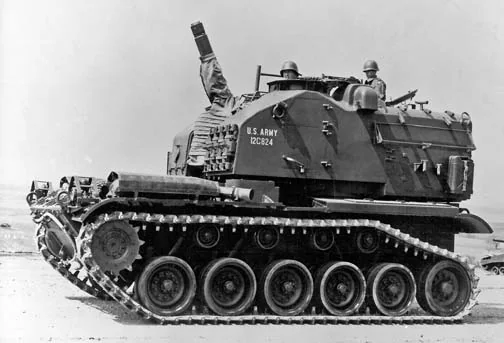
A protected 105 mm howitzer for mechanized formations
The M52 emerged from the Army's attempt to mechanize the 105 mm howitzer mission after the Second World War. Towed pieces remained useful, but armored and mechanized formations needed artillery that could keep pace across country, displace rapidly, and protect crews from weather, small-arms fire, and shell fragments. The new vehicle was developed alongside the 155 mm M44 and drew on the same broad automotive family as the M41 light tank. That commonality reflected a larger postwar effort to build families of armored vehicles rather than create every specialized chassis from scratch. 1, 2, 3
Development
AFV Database records first acceptance of the M52 in 1955 and a total production figure of 684 vehicles. Those dates place the system after the Korean War fighting that helped accelerate U.S. self-propelled-artillery development. The M52 should therefore be described as an early Cold War fielded design shaped by wartime lessons, not as a Korean War combat vehicle. 1
A reversed light-tank chassis and a large enclosed turret
The M52 used a chassis closely related to the M44 and ultimately to the M41 light-tank family, but the drivetrain was reversed. The engine and transmission were placed toward the front, and the drive sprockets were also forward. Above the hull sat a large asymmetric turret. The driver occupied the turret's left-front corner, the gunner sat at the right front, and the section chief was toward the right rear. This unusual arrangement put driving and artillery stations inside the same protected superstructure rather than separating a hull driver from a rear gun compartment. 1, 2
The driver's position belonged to the traversing compartment, an unusual arrangement compared with a tank whose driver remained fixed in the hull. That made the relationship between driving controls, turret position and the chassis part of the vehicle's design. The artillery turret still had limited traverse rather than a tank's unrestricted rotation, so enclosing the gun and crew did not remove every constraint on orienting the weapon. 1
The 105 mm M49 and its limited-traverse mount
The M52 mounted the 105 mm Howitzer M49 in the M85 mount. The standardized vehicle carried 102 rounds, including a ready supply inside the turret, and the howitzer could elevate from minus ten degrees to plus sixty-five degrees. Horizontal movement was limited to a total arc of 120 degrees, sixty degrees left or right. The howitzer's maximum range was approximately 12,150 yards, or about 11.1 kilometers. These figures placed the M52 in the divisional 105 mm support class rather than among the longer-ranged heavy guns. 1, 2
The same manual-derived compilation lists 102 rounds for the 105 mm M49 and a total traverse of 120 degrees, sixty degrees to either side. The enclosed turret can therefore be visually misleading: it was not a tank-style 360-degree gun installation. Chassis orientation still mattered when a target or firing direction lay outside that limited arc. 1
Mobility and support
At roughly 54,100 pounds, or 24.5 metric tonnes, the M52 was far lighter than the M53/M55 heavy artillery family. It used torsion-bar suspension with five road wheels per side, a front drive sprocket, and a trailing idler. AFV Database lists a maximum level-road speed of about 35 mph and a road cruising range of roughly 90 miles for the original configuration. Those figures suited a vehicle expected to accompany mechanized formations, though its large turret and specialized mission made its handling and silhouette different from the light tank that supplied much of its automotive ancestry. 1
Protection, visibility, and the realities of a crowded turret
Published crew figures require care because the vehicle crew and the complete artillery section were not always counted the same way. AFV Database lists five men carried in the vehicle, while period field-manual imagery shows additional cannoneers associated with the section, some of whom traveled separately. The distinction is important: a self-propelled howitzer was only one part of a larger firing organization that included ammunition handling, communications, maintenance, and command functions beyond the seats physically available in the vehicle. 1, 2
Service history
Contemporary Field Artillery Journal material shows the M52A1 operating as part of a six-howitzer firing battery supported by command, communications, ammunition, maintenance, and transport elements. That organizational context is essential to understanding the vehicle. The M52 carried a substantial ammunition load, but artillery effectiveness depended on survey, fire direction, resupply, radio links, and the ability of the battery to move as a coordinated unit. The self-propelled chassis changed how quickly the guns could move; it did not eliminate the wider artillery system around them. 4
Operating constraints
The M52 entered service at an awkward moment. It was more protected and integrated than wartime open gun carriages, but its limited traverse, manual weapon controls, gasoline-era automotive system, and 105 mm range reflected requirements that were already being reconsidered. Army branch history records that the service sought greater range, traverse, lethality, and mobility from the artillery systems that followed. The M52 was not a failure in the simple sense; rather, it became obsolete quickly because the desired battlefield changed around it. 3
Design legacy
The M52 occupies an important place in American self-propelled-artillery development because it shows the Army experimenting with crew enclosure, family-based chassis design, and mechanized 105 mm support before those ideas matured in the M108/M109 program. Its reversed drivetrain and large turret represented a substantial departure from the open rear decks of the M7, M12, and M40 families. Yet its manual controls and limited traverse preserved constraints that the next generation would remove. 1, 3, 6
Sources and further reading
References and further reading are listed below. Image identification, credit and reuse terms remain with each photograph.
- AFV Database — 105mm Self-Propelled Howitzer M52 (secondary source; not primary certification)
- AFV Database — M52 technical-manual image and layout archive
- U.S. Army / Center of Military History — King of Battle: A Branch History of the U.S. Army's Field Artillery
- U.S. Army Field Artillery Journal archive — March 1959
- U.S. Army Field Artillery Journal archive — December 1959
- AFV Database — A Brief History of American Armor
Visit an Armor Museum
Explore the worldwide museum directory to find armored vehicles, collections, and visitor-planning information.
Browse armor museums