Replacing the M19
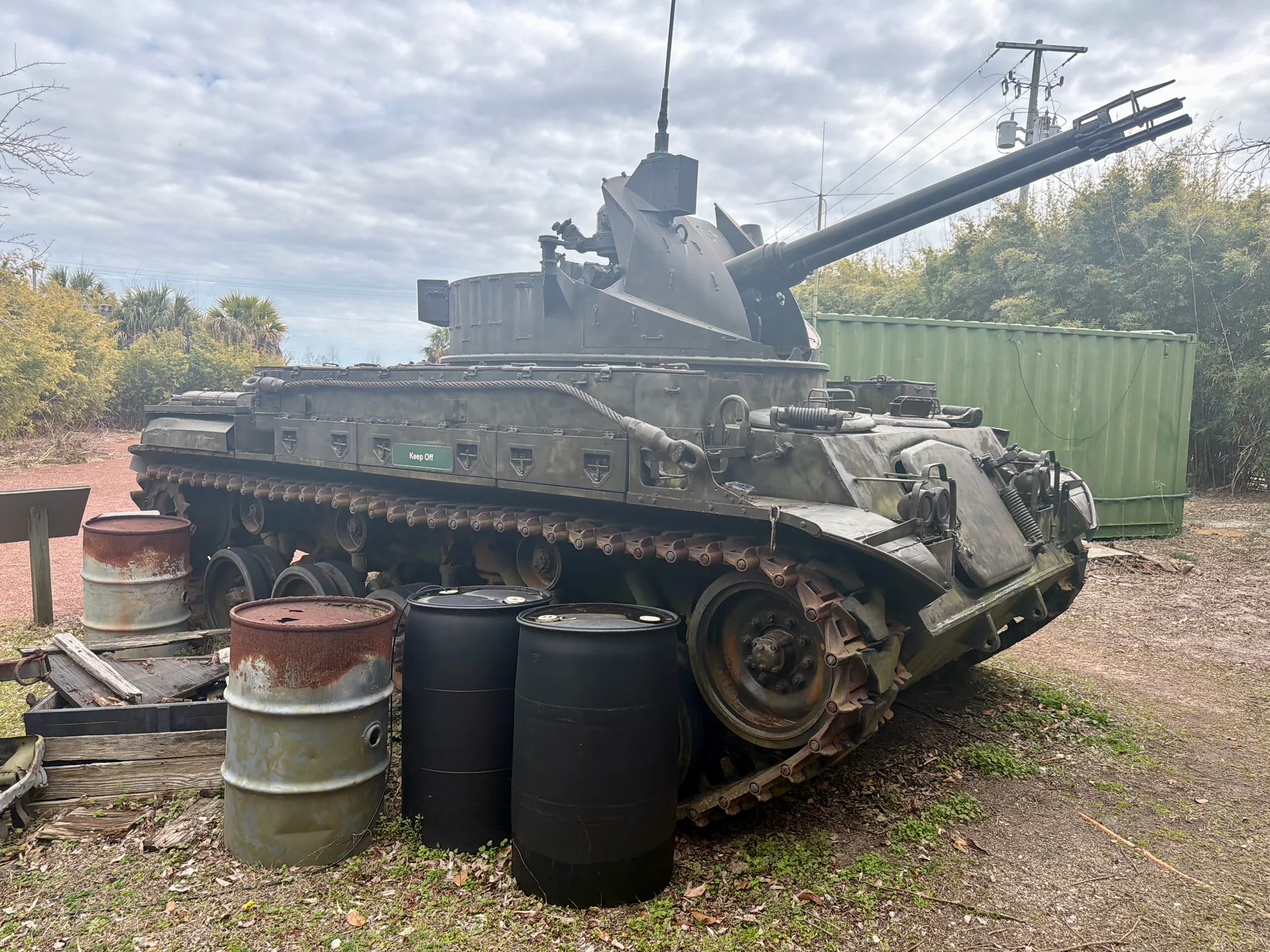
The U.S. Army Heritage Trail describes the M42 as an evolution of the M19's twin-40 mm installation on a newer M41-derived chassis, entering service in 1953. The same institutional account identifies convoy escort and point or perimeter security among its Vietnam roles. That dated service introduction does not establish participation in Korean War combat. 5
The M42 retained the broad twin-40 mm, open-mount arrangement associated with the M19 while using the newer automotive family. That design comparison does not itself measure improved reliability or reduced maintenance. Claims about those advantages need test or unit records, separately from evidence identifying the carrier and weapon installation. 1, 2, 3
M41-derived chassis and open gun mount
The M42 combined an M41-derived hull with a central open gun installation behind the driving compartment. It did not retain the M19's arrangement of engines moved into the middle of the hull to leave a rear gun platform. The resemblance of their twin 40 mm mounts can therefore conceal an important difference in automotive and fighting-compartment layout. 1, 2, 3
The open mount reflected continuity with the M19. It kept weight down and allowed the large cannon to elevate freely, but it also left the crew exposed to overhead fragments, small arms, weather, and the intense close-range fire encountered when Dusters were used against ground targets. 1, 2, 3
Twin 40 mm automatic cannon
Two Bofors-derived 40 mm automatic cannon remained the heart of the system. Army Air Defense Artillery historical material describes a combined high rate of fire and a projectile far more powerful than heavy-machine-gun ammunition, giving the vehicle substantial effect against both aerial and surface targets. 1, 2, 3
The guns were fed by clips handled by loaders in the open turret. Sustained fire therefore depended on crew drill and ready ammunition rather than a large enclosed magazine. This arrangement was simple and familiar, but it imposed a heavy workload during prolonged ground engagements. 1, 2, 3
A gun system without onboard radar
The M42 did not carry an integral search-and-track radar. Crews relied on optical sights, visual observation, and external warning, a serious limitation as jet aircraft became faster and attack windows shorter during the 1950s. 1, 2, 3
The absence of radar helped make the vehicle comparatively simple and mobile, but it was also why the Duster’s relevance as a front-line air-defense gun diminished. Later air-defense systems increasingly tied sensors and weapons together instead of expecting a crew to acquire fast targets with sighting equipment alone. 1, 2, 3
Protection in air-defense and ground roles
The light-tank-derived hull offered useful mobility and protection against fragments and small-arms fire from some directions, yet the open turret meant the gun crew never had tank-like survivability. That mattered less when firing from covered air-defense positions than when accompanying convoys or defending firebases from ground attack. 1, 2, 3
Vietnam service forced crews to use terrain, sandbags, prepared positions, and supporting weapons to compensate. Army historical photographs and accounts regularly show Dusters dug in or positioned as part of layered perimeter defense rather than operating as armored assault vehicles. 1, 2, 3
Mobility with maneuver forces
The M41-derived chassis gave the Duster the road speed and cross-country mobility expected of a Cold War light tracked vehicle. It could relocate with mechanized forces and was not dependent on a tractor, which preserved the central advantage of self-propelled antiaircraft artillery. 1, 2, 3
Tracks also proved valuable in Vietnam, where Dusters escorted convoys and moved between firebases over roads and terrain that could be difficult for ordinary gun trucks. Mobility let commanders concentrate the guns quickly when a route, base, or defensive sector required additional automatic fire. 1, 2, 3
Production and service life
M42 production belongs to the 1950s, with M42A1 changes forming part of the later family history. Published summaries differ in how they present the end of manufacture and subsequent modification work, so an exact final production date needs a clearly identified record. Continued National Guard or export use is a separate question from factory completion. 1, 2, 3
The Duster nevertheless remained useful enough to return prominently in Vietnam and to continue in reserve and National Guard service long after newer air-defense concepts appeared. Its longevity reflected the enduring value of a mobile twin-40 mm mount even when its original anti-aircraft mission had become less convincing. 1, 2, 3
Vietnam deployment
Vietnam gave the M42 its defining combat reputation. The theater presented little conventional enemy air threat, so Duster units used their twin 40 mm guns for convoy escort, base defense, direct fire, and support to infantry and artillery positions. 1, 2, 3
Army accounts describe Dusters reinforcing Khe Sanh, firebases, and road convoys, where their rapid explosive fire could break up attacks or suppress ambush positions. The vehicle’s ability to respond instantly with heavy automatic fire made it valuable even though those missions were far removed from the aircraft-defense role that justified its design. 1, 2, 3
Perimeter defense and direct fire
At defended bases, Dusters were often integrated with artillery, machine guns, searchlights, and other weapons. Their guns could cover likely avenues of approach and deliver direct high-explosive fire at close range, while the tracked chassis allowed the vehicles to shift between threatened sectors. 1, 2, 3
This ground role exposed the crews to risks an air-defense designer had not prioritized. Rocket-propelled grenades, mortars, and small arms could disable a Duster or hit the open turret, so battlefield effectiveness depended as much on position preparation and combined defense as on the power of the cannon. 1, 2, 3
Historical place
The M42 sits at the end of an American lineage that began with wartime half-tracks and the M19 twin-40 mm carrier. It retained mobility and heavy automatic fire but arrived just as radar-guided weapons and surface-to-air missiles began redefining short-range air defense. 1, 2, 3
Vietnam gave the Duster a substantial ground-support role, extending its use beyond its original air-defense mission. Later vehicles such as the M6 Linebacker and SGT STOUT again combined short-range air defense with an armored carrier, but used different weapons and sensor or command arrangements. They were not simply radar-equipped versions of the twin-40 mm Duster. 1, 2, 3
Sources and further reading
- U.S. Army Air Defense Artillery Journal — Air Defenders are Force Protectors
- U.S. Army Center of Military History — Vietnam Area
- U.S. Army History — Army History No. 107
- U.S. Army — Director models future of ADA history
- U.S. Army Heritage and Education Center, Army Heritage Trail, M42 Duster equipment entry
Visit an Armor Museum
Explore the worldwide museum directory to find armored vehicles, collections, and visitor-planning information.
Browse armor museums