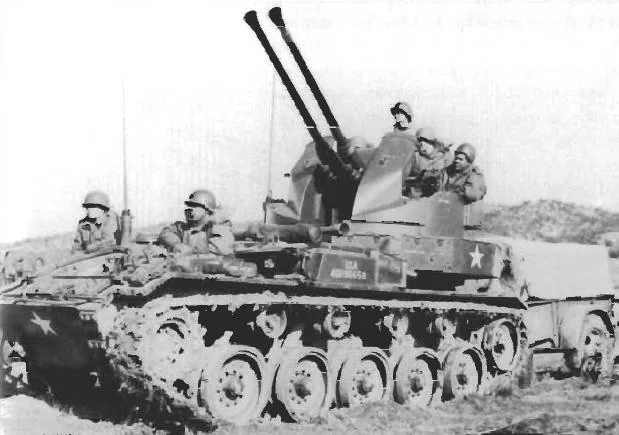
From the T65 to the M19
The Army wanted a fully tracked automatic-weapon carrier that could move with armored formations and carry heavier antiaircraft guns than the M16 half-track. An early twin-40 mm project used the M5 light-tank family, but that chassis was leaving production as the new T24/M24 Chaffee was adopted. 1, 2, 4
The concept was therefore reworked as the T65E1 on the newer chassis and standardized as the M19 in 1944. Army ordnance history identifies the twin-40 mm installation as the most satisfactory of several combinations tested on light-tank and related chassis. 1, 2, 4
Chaffee-family chassis arrangement
The M19 did not simply place a gun turret on an unchanged M24. Its twin Cadillac engines were moved toward the center of the hull, leaving the rear available for a large open fighting compartment and the twin 40 mm mount. 1, 2, 4
That layout balanced the weight of the gun system while creating working room for loaders and ammunition. It also made the M19 a distinct member of the Chaffee vehicle family, sharing major automotive elements without being a conventional tank hull with its turret swapped. 1, 2, 4
Twin 40 mm Bofors guns
The M19 mounted two Bofors-derived 40 mm automatic cannon in an open rear fighting compartment. A quoted combined cyclic rate is not the same as sustained fire, which depended on clip loading, ammunition handling and the gun crews. The heavier projectiles distinguish this installation from the quad-.50 M16 without requiring a single rate figure for every firing condition. 1, 2, 4
The 40 mm weapon was already a mature American antiaircraft standard by late World War II. Mounting two guns on a tracked chassis preserved the ballistic advantages of the towed weapon while removing the need to emplace a trailer and prime mover every time the defended formation displaced. 1, 2, 4
Optical fire control
The M19 remained an optically aimed system. Its crew used sights and manual observation rather than an onboard acquisition radar, which meant the vehicle could be ready to fire quickly but still needed timely warning and favorable visibility to exploit its guns against fast aircraft. 1, 2, 4
That distinction between mobility and fire control became increasingly important after 1945. Tracks solved the problem of keeping the weapon with tanks; they did not solve the harder postwar problem of detecting and tracking higher-speed aircraft under all-weather conditions. 1, 2, 4
Open turret and crew protection
The hull provided light armored protection for the driver and automotive components, while the gun crew worked in an open-topped rear mount. This gave excellent visibility and room to handle 40 mm ammunition but exposed the crew to fragments, small arms, and weather. 1, 2, 4
The protection level was appropriate to a support vehicle expected to operate behind the leading tanks rather than duel with enemy armor. In Korea, however, ground combat frequently brought M19s into direct-fire positions where the open mount became a more serious vulnerability. 1, 2, 4
Tracked mobility with armored formations
Twin Cadillac engines and the Chaffee-derived torsion-bar running gear gave the M19 road speed and cross-country mobility suitable for light armored formations. Full tracks were a major improvement over the half-track solution when terrain, snow, mud, or steep grades limited wheeled vehicles. 1, 2, 4
Family commonality also simplified parts supply and training. The M19 shared important automotive technology with the M24 even though its internal arrangement differed, allowing the Army to build a specialized air-defense vehicle without supporting an entirely unrelated chassis. 1, 2, 4
A large order cut short
Published histories commonly give 285 completed M19s from a larger wartime order. The distinction between ordered and completed vehicles is more secure than a simple total copied without its accounting basis. Production began late enough that the vehicle's substantial combat history belongs to Korea, rather than the European campaigns for which it had originally been developed. 1, 2, 4
The M19A1 added an auxiliary power arrangement and spare-barrel stowage, improvements that made prolonged operation of the gun system less dependent on running the main vehicle engines. The changes were evolutionary rather than a new air-defense concept. 1, 2, 4
Entry into service after World War II
Although conceived for the Second World War, the M19 did not reach combat in time to fight in Europe. Its first significant operational test came in Korea, where U.S. forces urgently needed mobile firepower and antiaircraft units were frequently employed against ground threats. 1, 2, 4
Army histories of the Korean War describe M19s serving alongside M16 quad-.50 half-tracks. The 40 mm guns were particularly valuable for direct fire because they combined automatic fire with a much heavier projectile than machine guns. 1, 2, 4
Korean War ground-fire role
In Korea, the M19’s original air-defense mission was often secondary to ground support. Twin 40 mm cannon could engage exposed troops, defensive positions, and approach routes with rapid high-explosive fire, making the vehicle useful during perimeter defense and fighting in difficult terrain. 1, 2, 4
That success should not obscure the doctrinal mismatch. Using scarce air-defense vehicles as assault guns placed open crews close to enemy weapons and did not improve the system’s ability to defeat modern aircraft. The experience instead demonstrated the versatility of automatic cannon mounted on a mobile armored chassis. 1, 2, 4
Historical place
The M19 established the basic U.S. pattern of a fully tracked light chassis carrying twin 40 mm guns in an open mount. When the M24 family left service, the same broad armament concept was transferred to the newer M41-based M42 Duster. 1, 2, 4
The M19 and the M42 belong to related but distinct vehicle families. Their twin-40 mm armament provides a useful comparison, while the change from the M24-derived carrier to the M41-derived vehicle remains an automotive and production distinction. Similar guns do not establish that the vehicles had identical service histories or that every later design decision followed directly from M19 experience. 1, 2, 4
Sources and further reading
- U.S. Army Center of Military History — The Ordnance Department: Planning Munitions for War
- U.S. Army — Director models future of ADA history
- U.S. Army Center of Military History — From San Juan to Pusan
- U.S. Army ARMOR — November–December 1990 Chaffee family history
Visit an Armor Museum
Explore the worldwide museum directory to find armored vehicles, collections, and visitor-planning information.
Browse armor museums