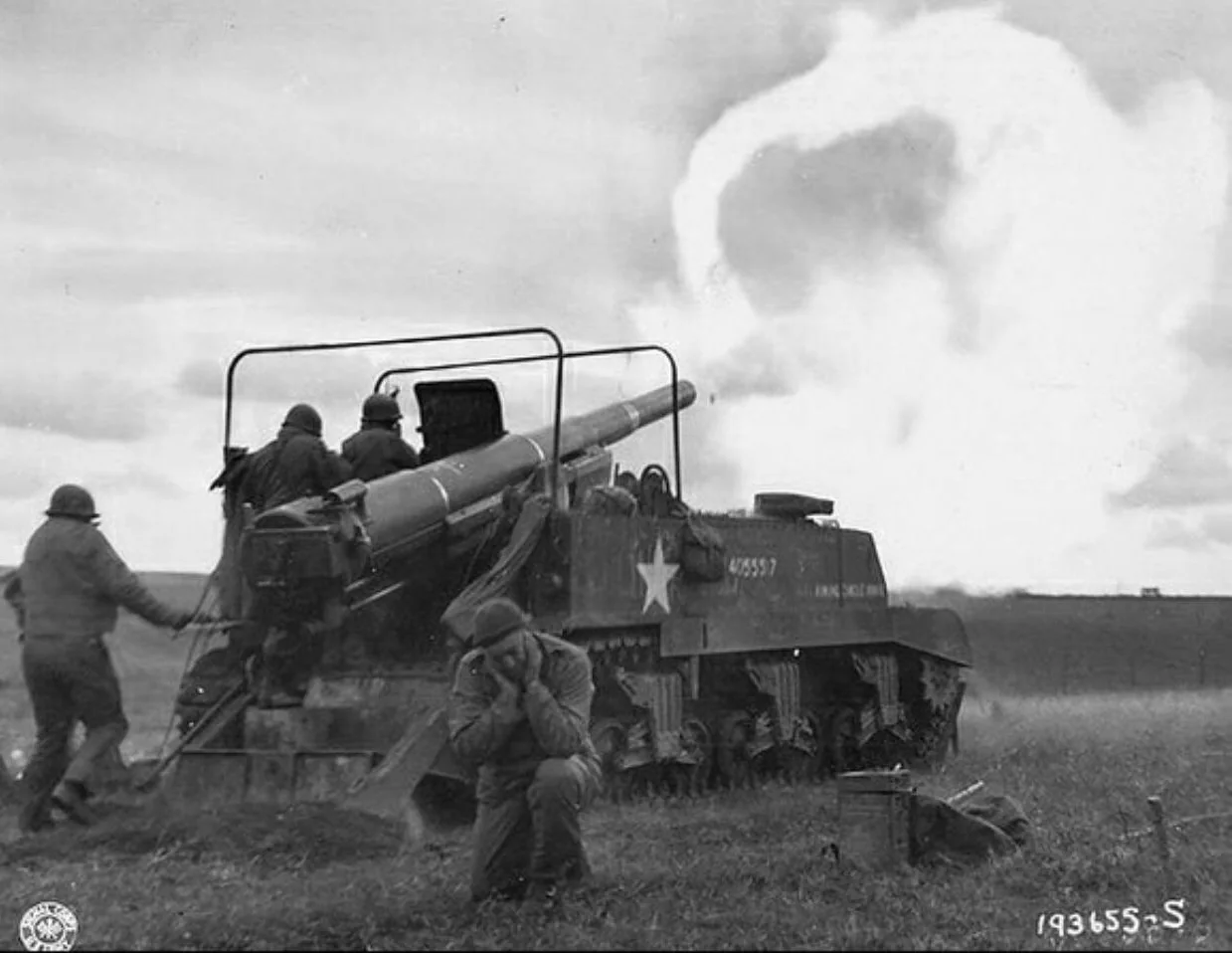
Development
The M12 grew from a 1941 Ordnance Department study of how to mechanize the Army’s 155 mm heavy gun. The solution used automotive components from the M3 medium tank and moved the engine forward so that the long artillery piece could sit on an open rear platform. Army Ground Forces initially showed little enthusiasm for the concept, but Ordnance and artillery advocates continued the work. The design was standardized and accepted in 1942, and Pressed Steel Car Company produced one hundred vehicles. The project therefore began as a contested answer to mobility rather than as the inevitable next step in American artillery development. 1, 2, 5
An M3-derived chassis reorganized around the gun
The M12 was based on the M3 medium-tank family, but it was not simply a tank with its turret removed. The engine was relocated from the rear to a position behind the drivers, leaving the back of the hull available for the gun mount and crew work space. Only the forward driving compartment was roofed; the gun and most of the detachment worked in the open. The main weapon could traverse fourteen degrees to either side and elevate from roughly minus five to plus thirty degrees, a restricted arc that reflected the need to package a very large field gun on a relatively compact tracked chassis. 1
Mobility and support
At about twenty-seven metric tonnes, the M12 retained the vertical-volute suspension and radial gasoline engine associated with its medium-tank ancestry. AFV Database’s manual-derived figures give a sustained road speed of about twenty-one miles per hour, with a higher short-duration dash speed, and a road cruising range of roughly 140 miles. Those numbers were not extraordinary for a tank, but they represented a major change for a 155 mm gun whose traditional movement required a separate tractor and a more involved displacement process. The M12 could accompany a moving operational front in a way towed heavy artillery often struggled to match. 1
Rebuilt for the invasion of Europe
The first production vehicles did not go directly into combat. They were used largely for training until the approach of the 1944 invasion revived interest in the type. Seventy-four M12s were rebuilt beginning in early 1944, with changes addressing engine vapor lock, exhaust arrangements, and internal stowage. That rebuild is an important part of the M12 story because it shows how a system that had been viewed skeptically was adapted when an operational requirement finally became urgent. The vehicle that entered France was therefore the product of a second decision to make the existing fleet combat-ready, not simply the untouched 1942 design. 1, 5
Service history
M12s saw their most important service in the campaign across Western Europe. U.S. Army accounts describe their use for conventional supporting fire, counterbattery work, interdiction, and long-range targets during the breakout and pursuit from Normandy. The same mobility that allowed the gun to follow armored forces also exposed the difficulty of keeping a heavy artillery battalion supplied while the front moved quickly. In open country the carriage could exploit movement; in the Norman bocage, sunken lanes and hedgerows often restricted it to the same narrow routes used by the rest of the Army’s heavy vehicles. 4, 5
A field gun pressed into direct-fire work
Although designed primarily for artillery missions, the M12 was also used in direct fire against concrete fortifications. This was not a transformation into a tank destroyer. The open fighting position, limited armor, long gun, and restricted traverse made it ill-suited to close armored combat. Instead, direct laying allowed the heavy 155 mm projectile to be applied against bunkers and walls when tactical conditions permitted the gun to be brought forward. The method exploited the destructive effect of the weapon while accepting significant exposure for the crew, a trade that made sense only for particular targets and circumstances. 5, 6
The M30 and the full gun section
Ammunition capacity was one of the clearest limits of the gun carriage. With only ten 155 mm rounds on the M12, a battalion could not sustain meaningful firing without the M30 Cargo Carrier and the broader artillery supply system. The M30 used the same basic chassis but devoted its rear area to ammunition and personnel. Pairing the vehicles reduced the need for an entirely different support platform and gave the gun section tracked resupply compatible with the M12’s movement. The arrangement anticipated later American efforts to match self-propelled howitzers with dedicated ammunition vehicles. 1
The Army Ordnance Corps credits Carl Hansen’s wartime team with developing the M12 and records production of 100 M30 Cargo Carriers alongside the gun carriages. That paired production underlines how deliberate the support relationship was. M30 was not an optional afterthought added because the M12 happened to carry few rounds; tracked ammunition support was part of making the heavy gun mobile as a practical firing system. 2
A successful expedient with built-in limits
The M12’s age and architecture imposed obvious constraints. Its main guns came from an earlier generation, the fighting compartment was exposed, traverse and elevation were limited, and onboard ammunition was small. The M3-derived chassis was also an interim automotive foundation at a time when the M4 Sherman had already become the Army’s standard medium tank. None of those shortcomings erased the system’s combat value, but together they made a long postwar future unlikely. The vehicle was best understood as a wartime bridge between towed heavy artillery and the more mature self-propelled systems already being developed behind it. 1, 2
Design legacy
The M12's production run was small, but it linked heavy artillery to tracked automotive equipment at an important wartime moment. Its gun platform, ammunition carrier and rebuilt fleet showed that useful mechanization depended on support arrangements as well as the weapon itself. The later M40 carried that work forward with newer ordnance and Sherman-derived components, while the M12 remained closely associated with the fighting in western Europe. 2, 3
Sources and further reading
References and further reading are listed below. Image identification, credit and reuse terms remain with each photograph.
- AFV Database — 155mm Gun Motor Carriage M12
- U.S. Army Ordnance Corps — Carl Hansen, M12 and M40/M43 development
- U.S. Army — Field Artillery Museum educates public, Soldiers
- U.S. Army — D-Day 75: Ohio National Guard Soldiers who were there
- AFV Database — A Brief History of American Armor
- U.S. Army Field Artillery Journal archive — September 1946
Visit an Armor Museum
Explore the worldwide museum directory to find armored vehicles, collections, and visitor-planning information.
Browse armor museums