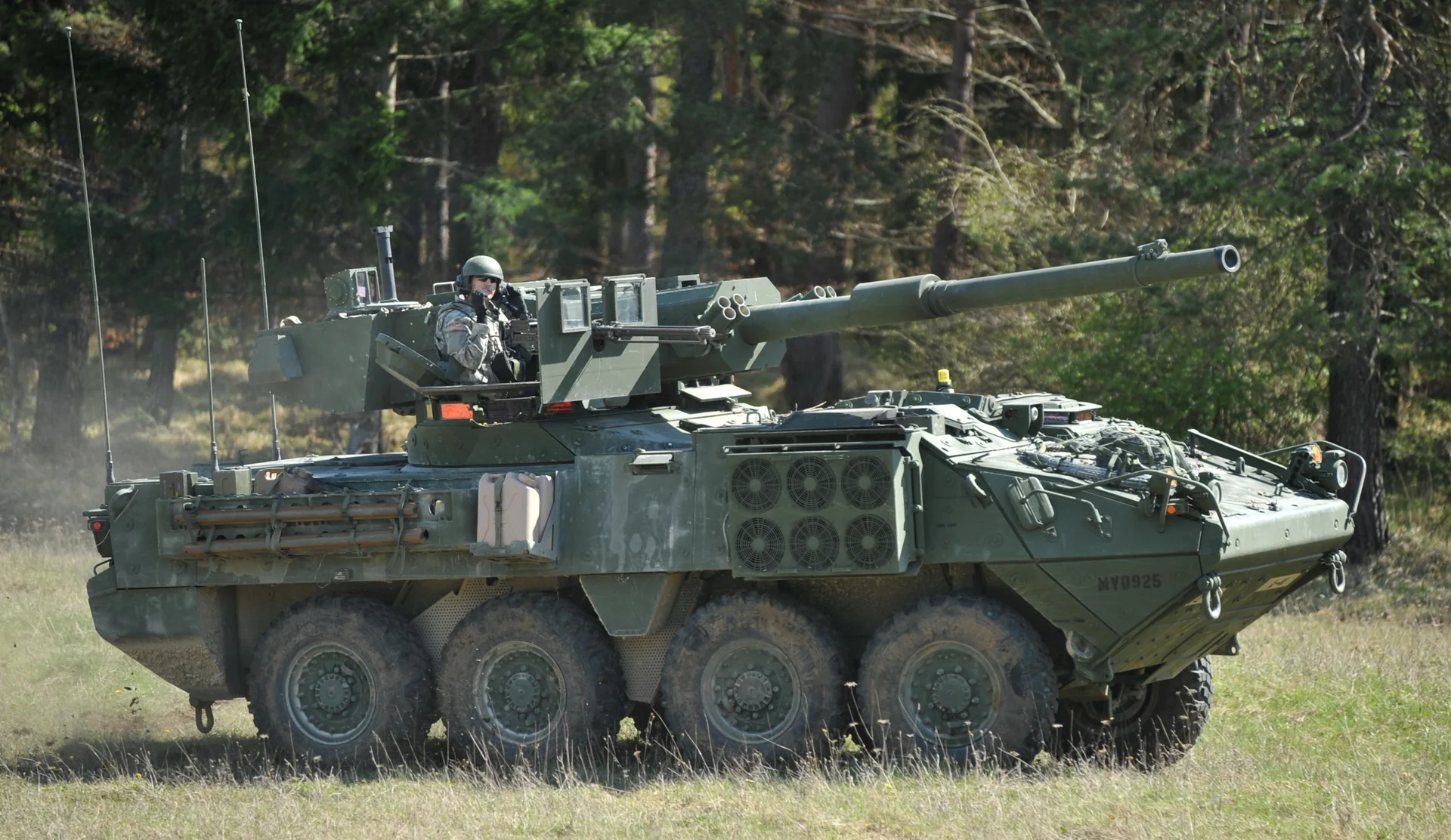
Development
The Mobile Gun System belonged to the effort to place more direct-fire capability inside a medium-weight formation. In a 2010 ARMOR article, Captain Timothy McDonald connected its development to the Army’s selection of the LAV III-derived Stryker family and the deployment constraints shaping that force. The resulting vehicle was a specialized member of a common family, not a simple turret substitution that left all carrier functions intact. 1
Layout and crew
The gun sat in a low-profile installation, with ammunition moved through an automatic loading and replenishment arrangement. That architecture reduced the need for a conventional four-person tank crew, but it also made mechanical ammunition handling central to the vehicle’s operation. In general engineering terms, automation relocates work into machinery, controls, and maintenance; it does not make that work disappear from the system. 1
Armament
The 105 mm cannon gave infantry a direct-fire tool different from a missile launcher or an autocannon. The original practitioner account describes an eighteen-round total divided between eight ready rounds and ten additional rounds in the replenishment system. Keeping those categories separate matters: total ammunition carried is not the same as ammunition immediately available in the ready mechanism, and neither number describes every other Stryker variant. 1
Crew protection
The Army’s 12 May 2021 release identified the MGS’s flat-bottom chassis and its lack of upgrades against newer mine and improvised-explosive-device threats as part of the divestment rationale. That finding applies to the MGS configuration, not automatically to every Stryker’s hull, protection package or modernization history. 4
Mobility and support
A common automotive family can simplify some training and support tasks while still producing variants with very different demands. The MGS added the mass, ammunition equipment, and maintenance needs of a gun vehicle. McDonald’s account also discussed movement difficulties in particular ground conditions. That practitioner evidence is useful context, but it is not a controlled comparison proving that every wheeled vehicle behaves alike across all terrain. 1
Versions and conversions
The M1128 designation identifies the gun-equipped vehicle. It should not be confused with the separately organized Stryker antitank guided-missile vehicle, or with later efforts to add 30 mm cannon and missile capability to other Strykers. Shared family membership does not imply shared internal layout, weapon effects, crew tasks, or ammunition supply. A retrospective account must distinguish the MGS program from the continuing evolution of the broader fleet. 1, 3
Service history
On 12 May 2021 the U.S. Army announced that it intended to divest all Stryker Mobile Gun Systems by the end of fiscal year 2022 after more than fifteen years of direct-fire support to infantry formations. The announcement is evidence of a formal retirement decision and target date, not by itself proof that every vehicle had physically left inventory by that date. 4
The Army's 2021 announcement did not describe a simple exchange of one 105 mm gun vehicle for another. It pointed instead to the Medium Caliber Weapons System, the remotely operated weapon station integrated with Javelin, and antitank guided-missile improvements as other ways to distribute firepower across the Stryker formation. These systems differed in weapon, ammunition and purpose. The decision therefore involved changing the formation's mix of capabilities, not preserving every MGS function in a single replacement turret. 4
Operating constraints
The system’s history shows why judging a combat vehicle only by its largest weapon can be misleading. A useful cannon still requires dependable ammunition handling, sustainable maintenance, and a chassis whose protection and mobility remain appropriate for the force using it. The 2021 decision addressed the combined support and modernization problem. It does not establish that all infantry direct-fire vehicles are unnecessary, or that replacing one gun system always means procuring an identical substitute. 3
The Army tied that decision to several system-level problems: an aging cannon, costly and difficult autoloader maintenance, and the flat-bottom MGS chassis, which had not received the double-V-hull protection upgrade applied elsewhere in the Stryker fleet. Those points show why retirement cannot be explained by the 105 mm gun alone; maintainability, survivability growth and fleet commonality all mattered. 4
The announcement also addressed the industrial consequences. MGS production had already stopped, and much of the support supply chain was shared with the wider Stryker fleet. The Army consequently presented the decision as having limited impact on that industrial base. Ending support for this specialized gun installation was not equivalent to ending the carrier family. The same statement acknowledged capability gaps and continued funding for solutions; its procurement intentions should not be read as proof that all those gaps had already been closed. 4
Design legacy
The MGS is an important case study in the relationship between a common vehicle family and a highly specialized variant. It demonstrates both the attraction of bringing cannon support into a medium formation and the difficulty of sustaining a unique installation over time. Its place in armored history is therefore broader than a label of success or failure: it exposes the connection between design choices, operational use, maintenance burden, and subsequent modernization decisions. 1, 3
Sources and further reading
- Captain Timothy McDonald, “The Mobile Gun System Platoon,” ARMOR, September–October 2010, printed pages 16–21
- Jen Judson, Defense News, 12 May 2021: US Army scraps Stryker mobile gun systems in favor of new lethality upgrades
- U.S. Army statement reproduced by EDR Magazine, 12 May 2021: US Army announces divestiture of the Stryker Mobile Gun System
- U.S. Army, Army announces divestiture of the Stryker Mobile Gun System, 12 May 2021
Visit an Armor Museum
Explore the worldwide museum directory to find armored vehicles, collections, and visitor-planning information.
Browse armor museums