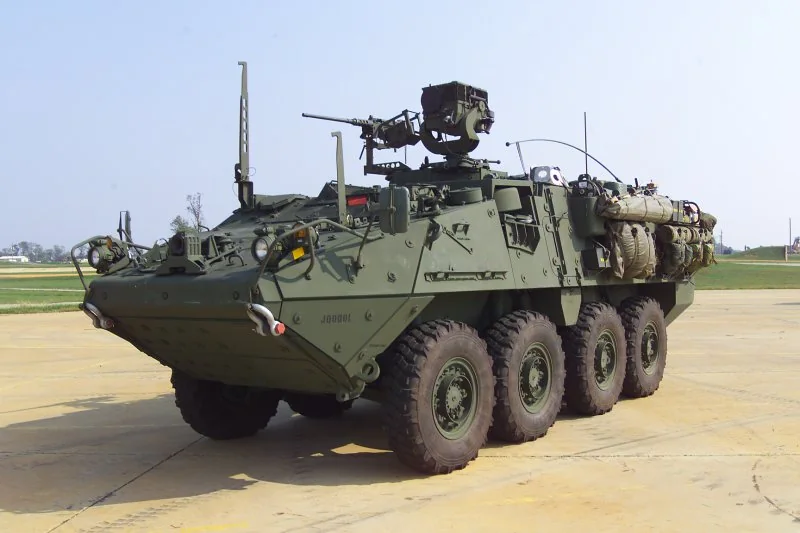
Requirement and development
The M1127 was created as the reconnaissance member of the Stryker family rather than as a stand-alone scout-car program. U.S. Army ODIN identifies it as an eight-wheeled vehicle derived from the Canadian LAV III and produced as part of the wider General Dynamics Land Systems Stryker fleet. The key idea was commonality: reconnaissance troops could use a platform with automotive, protection, communications, and support relationships similar to the infantry, command, engineer, mortar, and other variants in the brigade. This approach traded the extreme compactness of traditional scout cars for protected volume and integration within a medium-weight brigade structure. 1, 2, 3
Layout, crew, and architecture
The M1127 uses the Stryker 8×8 hull adapted for scouts, surveillance equipment, radios, and reconnaissance tasks. ODIN describes selectable drive arrangements and a mission focused on reconnaissance and surveillance. Compared with a very small purpose-built scout, the Stryker hull offers more space for crew, dismounts, communications, and equipment, but it is also larger and more conspicuous. The vehicle’s design therefore assumes that reconnaissance within a Stryker brigade may require protected mobility for a team and its sensors rather than only a tiny crew. Family commonality also simplifies support, an important advantage when scouts operate far forward but remain tied to brigade logistics. 1, 2, 3
Mobility and operational reach
Wheeled Stryker mobility emphasizes road speed, operational reach, and reduced track-related maintenance while retaining useful off-road performance through an 8×8 chassis. ODIN notes that the M1127 can shift between four-wheel and all-wheel drive arrangements. This makes the vehicle well suited to the distributed movement expected of Stryker brigades across road networks and mixed terrain. It is not as small as Fennek or as cross-country specialized as a light tracked scout. Army professional writing has repeatedly discussed the challenge of matching reconnaissance vehicles to terrain, protection, and observation requirements, underscoring that the M1127’s mobility is part of a broader brigade tradeoff rather than an absolute advantage. 1, 2, 3
Protection and survivability
The M1127 provided scouts with the protected volume of the Stryker platform rather than a small open vehicle. Protection nevertheless depended on the actual hull and equipment state. Later fleet programs, including changes to hull shape and armor, should not be applied automatically to every original reconnaissance vehicle. The larger carrier also imposed a concealment and weight tradeoff. Protection, observation and dismounted scouting remained complementary requirements rather than proof that the vehicle could replace a tank in direct combat. 1, 2, 3
Weapons, sensors, and reconnaissance task
ODIN states that the M1127 provides a platform for reconnaissance and surveillance and identifies use by RSTA squadrons and battalion scouts. The vehicle’s value lies in moving scouts and their equipment, supporting observation, and transmitting information to the brigade. Its weapon station provides self-defense and security capability, but the platform is not intended to win a direct-fire duel with heavier armored fighting vehicles. Army material describing reconnaissance squadrons as the brigade’s “eyes and ears” captures the doctrinal point: the M1127 is useful when it helps scouts find, understand, and report the enemy early enough for the commander to act. 1, 2, 3
Variants and configuration changes
The M1127 belongs to a large Stryker family whose members share the basic 8×8 platform but differ markedly in mission systems. Infantry carriers, command vehicles, fire-support vehicles, engineers, mortar carriers, antitank variants, medical vehicles, and CBRN reconnaissance systems should not be conflated with the M1127 scout. Upgrades across the Stryker fleet have also produced different hull, power, protection, and weapon configurations over time. The safest way to discuss the reconnaissance vehicle is therefore to tie claims to the original RV role and a dated source rather than assuming every feature of a newer Stryker applies automatically to all M1127s. 1, 2, 3
Operational service and employment
M1127 vehicles have supported reconnaissance organizations within Stryker brigade combat teams, where scouts operate as part of a combined network of cavalry, infantry, fires, engineers, and command systems. A 2016 U.S. Army unit article describes the reconnaissance squadron as the “eyes and ears” of a Stryker brigade, emphasizing the mission rather than a particular weapon. Army professional discussions have also examined whether Stryker reconnaissance offers the right balance of observation, mobility, protection, and concealment against heavier opposing forces. Those debates are evidence of a broader truth: fielding the vehicle does not settle reconnaissance doctrine; commanders still have to decide how aggressively scouts fight for information. 1, 2, 3
Limitations and tradeoffs
The M1127 combines reconnaissance equipment and protected team transport within the Stryker family. Its larger hull affects concealment and payload, but those tradeoffs require actual configuration and terrain context. The retained sources do not supply a universal performance ranking against small wheeled or light tracked scouts. Vehicle protection, sensor use, dismounted observation and reporting are related requirements; none alone guarantees the quality of the information reaching a commander. 1, 2, 3
Historical place
The M1127 represents reconnaissance carried within a wider brigade vehicle family. Common ancestry connects it to other Stryker support functions, while its reconnaissance mission and equipment distinguish it from the infantry carrier. That relationship should not be described as the replacement of every earlier U.S. cavalry approach, nor as proof of superiority over Fennek, Rooikat or a tracked scout. Those vehicles arose from different requirements that need their own dated evidence before a comparison is made. 1, 2, 3
Sources and further reading
References and further reading are listed below. Image identification, credit and reuse terms remain with each photograph.
- U.S. Army ODIN , M1127 Stryker Reconnaissance Vehicle
- U.S. Army , 5-1 Cavalry Squadron (RSTA)
- U.S. Army eARMOR , Armored Reconnaissance Squadron in Decisive Action
Visit an Armor Museum
Explore the worldwide museum directory to find armored vehicles, collections, and visitor-planning information.
Browse armor museums