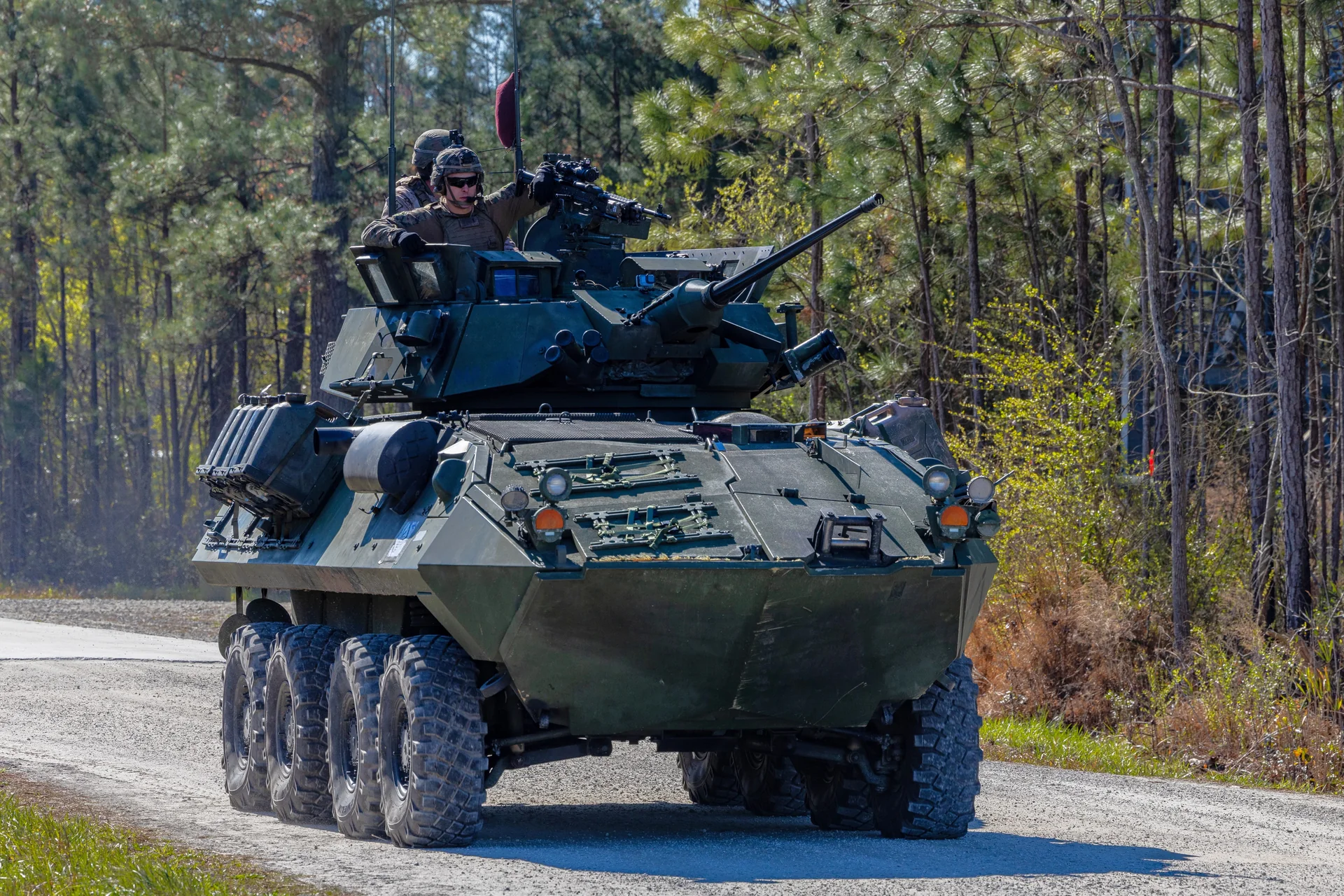
Development and requirement
The Marine Corps identified a need in 1980 for more mobility and firepower in rapid-deployment forces. Rather than begin with a clean-sheet U.S. vehicle, it evaluated existing designs and selected the General Motors of Canada vehicle that became the LAV-25. A production contract was awarded in September 1982 alongside development work for several companion variants. 1, 2
The resulting family included cannon, antitank, mortar, command-and-control, logistics, and recovery configurations. That family approach let light armored units combine reconnaissance, security, direct fire, communications, and support on closely related automotive platforms. 1, 2
Seen in its period, the LAV-25 Family answered a broader problem than the vehicle label alone suggests. A light armored reconnaissance / security had to move at the tempo of the formation it supported, survive ordinary battlefield hazards long enough to complete its mission, and fit the unit's transport, maintenance, and communications system. The chosen emphasis on 8×8 wheeled therefore shaped far more than road speed: it influenced weight, internal volume, obstacle crossing, strategic movement, and the amount of protection or equipment the chassis could carry. It reflects a modern requirement in which protection, sensors, networking, electrical power, growth capacity, and integration with precision weapons matter alongside basic mobility and firepower. The result is best judged against that original requirement, not against a modern main battle tank or a vehicle from a completely different role. 1, 2
The Marine Corps’ 3d Light Armored Reconnaissance Battalion history distinguishes several early milestones that are easy to compress into a single introduction date. Its indexed account places the production contract with General Motors of Canada on 27 September 1982, with development of five supporting types alongside the LAV-25. Those roles included recovery, logistics, mortar support, antitank work and command and control. The account then identifies a reinforced company activated in May 1983 and that company’s first LAV arrivals in April 1984. Contract award, unit activation and equipment delivery were therefore separate steps. The April date belongs to the unit described and is not used here as a claim about the first vehicle delivered anywhere in the Marine Corps. The supporting variants also show that the LAV program concerned a reconnaissance formation’s needs, not just the purchase of wheeled vehicles with cannon turrets. 1
Design, protection, and mobility
The LAV-25 mounts the M242 25 mm cannon in a two-man turret with coaxial and pintle-mounted machine guns. Marine doctrine treats the vehicle and its scouts as a combined reconnaissance system: the vehicle provides mobility, sensors, protection, communications, and firepower, while dismounted scouts extend observation and security beyond the hull. 3
Its wheeled configuration emphasizes operational and tactical mobility rather than tank-like protection. The LAV can move rapidly on roads, operate cross-country, and conduct amphibious movement under suitable conditions, giving Marine light armored reconnaissance units a wide operating radius. 3, 4
The wheeled character of the LAV-25 Family is central to how it was intended to be used. Wheeled armored vehicles generally trade some soft-ground and obstacle performance for road speed, range, reduced automotive complexity, and easier long-distance movement without heavy transporters. That trade is especially valuable to reconnaissance, security, and rapidly moving infantry formations, where arriving first, screening a broad frontage, or shifting quickly between sectors can matter as much as maximum armor thickness. Tires, driveline arrangement, suspension travel, and vehicle weight therefore become tactical questions rather than engineering trivia: damage that slows the vehicle can also reduce the unit's ability to observe, disengage, reinforce, or deliver troops on time. 1, 2
Reconnaissance places unusual pressure on internal layout and protection. The vehicle must carry radios, observation equipment, ammunition, and scouts while remaining mobile enough to avoid decisive engagement. The configuration also includes 3 crew with embarked scouts. Protection is valuable because reconnaissance units operate forward and can be discovered unexpectedly, but excessive weight can undermine the very mobility that lets them break contact. The practical design goal is therefore not invulnerability; it is enough protection and firepower to survive contact, report, maneuver, and continue the reconnaissance mission. 1, 2
Firepower and battlefield role
The vehicle’s principal armament, 25 mm M242 automatic cannon, defines much of how the LAV-25 Family can contribute after contact. Cannon and antitank weapons can allow an infantry or reconnaissance vehicle to suppress positions, engage light armor, and threaten heavier vehicles under favorable conditions without depending on a tank for every target. That firepower changes tactics because the carrier can support the infantry before and after dismount, cover movement, and respond quickly to targets that would otherwise require a separate support weapon. At the same time, mounted firepower does not erase the distinction between an IFV and a main battle tank: protection, ammunition, sensors, and survivability remain optimized around different missions. 1, 2
Service, variants, and modernization
Marine LAV units deployed to Southwest Asia in 1990, screening along the Saudi-Kuwaiti border during Desert Shield and advancing during Desert Storm. The platform continued through later operations and modernization programs intended to sustain the fleet into the 2030s. 4, 5
The LAV-25 is therefore best understood as a reconnaissance and security vehicle with meaningful direct-fire power, not as an infantry fighting vehicle whose primary purpose is delivering a full infantry squad into close combat. 3
The service life of the LAV-25 Family also shows why armored fleets rarely remain frozen in their original configuration. The fact card places its fielding or production in Early 1980s. Threats, radios, night sights, navigation, identification systems, mine protection, electronic countermeasures, and crew expectations all change faster than a complete vehicle fleet can usually be replaced. Modernization can therefore extend relevance by improving the parts of the system that most constrain current operations, but each upgrade consumes weight, space, electrical power, cooling, money, and training time. Long-lived families often reach a point where a new engine, suspension, or electrical architecture becomes necessary simply to carry the protection and electronics added during earlier upgrades. 1, 2
How the vehicle fits the formation
In formation use, the LAV-25 Family is most valuable when it helps commanders understand the battlefield before the main body becomes decisively engaged. Reconnaissance crews and scouts screen routes, identify obstacles and enemy positions, watch flanks, and maintain contact while trying to preserve freedom of movement. Mounted weapons are important because reconnaissance units cannot assume they will remain hidden, but the preferred outcome is usually to gain information without becoming fixed in a fight that should belong to heavier forces. This is why speed, communications, observation, and disciplined disengagement are as important to a reconnaissance vehicle as its cannon or armor. 1, 2
Strengths, limitations, and family boundaries
The Armor Archive places the LAV-25 under Armored Reconnaissance / Armored Car because Marine organization, doctrine, and employment center on reconnaissance, counter-reconnaissance, screening, and security. Its ability to carry scouts does not by itself turn it into an APC or IFV. 3, 4
The principal strength of the LAV-25 Family is the mobility and flexibility that come from its wheeled architecture and mission fit. It can cover large road distances efficiently, shift between sectors without the same transporter dependence as many tracked vehicles, and support dispersed operations over a broad frontage. The tradeoff is that wheels, ground pressure, and suspension geometry impose different limits in deep mud, severe obstacles, and some forms of cross-country movement, while protection and turret weight can erode the original mobility margin. The design is strongest when commanders exploit its speed and reach instead of forcing it to imitate a heavier tracked vehicle. 1, 2
Family names can also obscure important differences. A common hull or manufacturer does not mean every derivative belongs in the same operational category. Command posts, mortar carriers, antitank vehicles, recovery vehicles, reconnaissance versions, air-defense systems, and direct-fire variants may share engines and running gear while performing fundamentally different tasks. For that reason the Armor Archive keeps the LAV-25 Family tied to its lineage but classifies individual branches by what they actually do on the battlefield. That approach preserves engineering relationships without turning one successful chassis into an all-purpose label that hides the history of the specialized vehicles built from it. 1, 2
Sources and further reading
References and further reading are listed below. Image identification, credit and reuse terms remain with each photograph.
- U.S. Marine Corps, 3d Light Armored Reconnaissance Battalion history (indexed excerpt)
- Marine Corps Systems Command, Before there was an MCSC, there were LAVs
- U.S. Marine Corps, MCTP 3-10D Employment of Light Armored Reconnaissance Units
- 1st Light Armored Reconnaissance Battalion, unit history and mission
- Marine Corps Systems Command, effort to extend LAV service life
Visit an Armor Museum
Explore the worldwide museum directory to find armored vehicles, collections, and visitor-planning information.
Browse armor museums