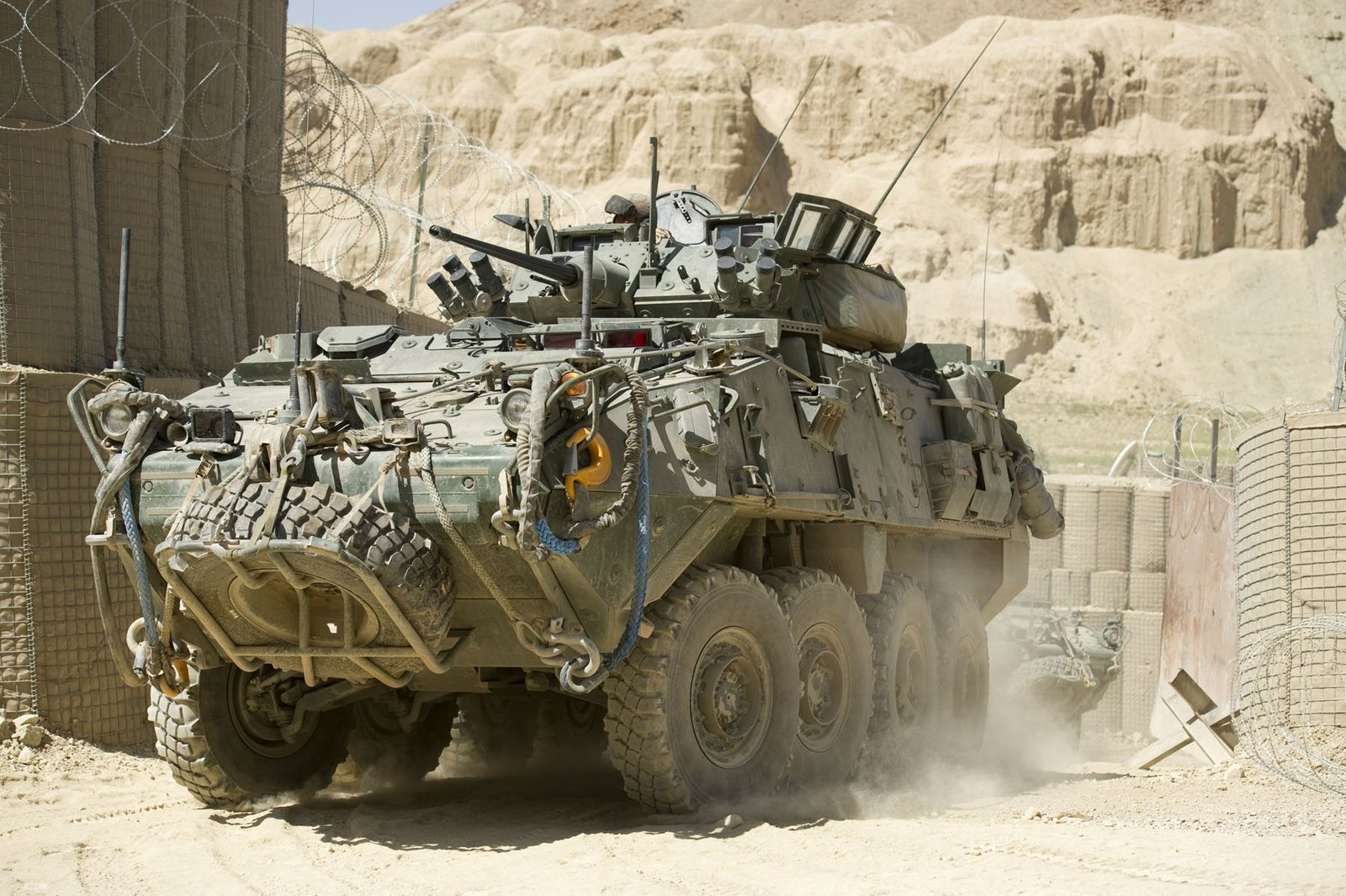

Development and requirement
Canada adopted the LAV III as a third-generation light armored vehicle based on the Piranha lineage. In 2000 the U.S. Army selected this wheeled design for its Interim Brigade Combat Team program, and the vehicle was named Stryker in 2002. The goal was a medium-weight force more deployable than heavy armor but better protected and more mobile than light infantry. 1, 2
Design and fighting role
Canadian LAV III infantry vehicles use a turreted 25 mm cannon and carry a section, while the U.S. M1126 Stryker ICV emphasizes squad transport with a remote weapon station. Both use an 8x8 automotive architecture and share family concepts, but national requirements produced different armor, weapons, electronics, and fleet variants. Canada’s LAV 6.0 further increased protection and automotive performance. 1, 2
Service and evolution
Stryker brigades deployed to Iraq beginning in 2003 and later served in Afghanistan and other theaters. Canadian LAV IIIs also saw extensive operational use and were upgraded to LAV 6.0. Both fleets generated reconnaissance, command, engineer, mortar, medical, and other mission variants, demonstrating the value of common wheeled chassis at brigade scale. 1, 2, 3
Archive boundaries
The family is classified under APC/infantry carrier because the U.S. Stryker ICV is central to the lineage. Canadian cannon-armed LAV III sits closer to the IFV boundary. Mobile Gun System, Dragoon, SHORAD, and other role-changing variants should be classified by mission while linked to this family. 1
Sources and further reading
Representative source set used for this profile. Primary image source and reuse terms are listed with the image.
- Canadian Army — LAV III
- U.S. Army Center of Military History — From Transformation to Combat: The First Stryker Brigade at War
- U.S. Army TRADOC ODIN — M1126 Stryker Infantry Carrier Vehicle