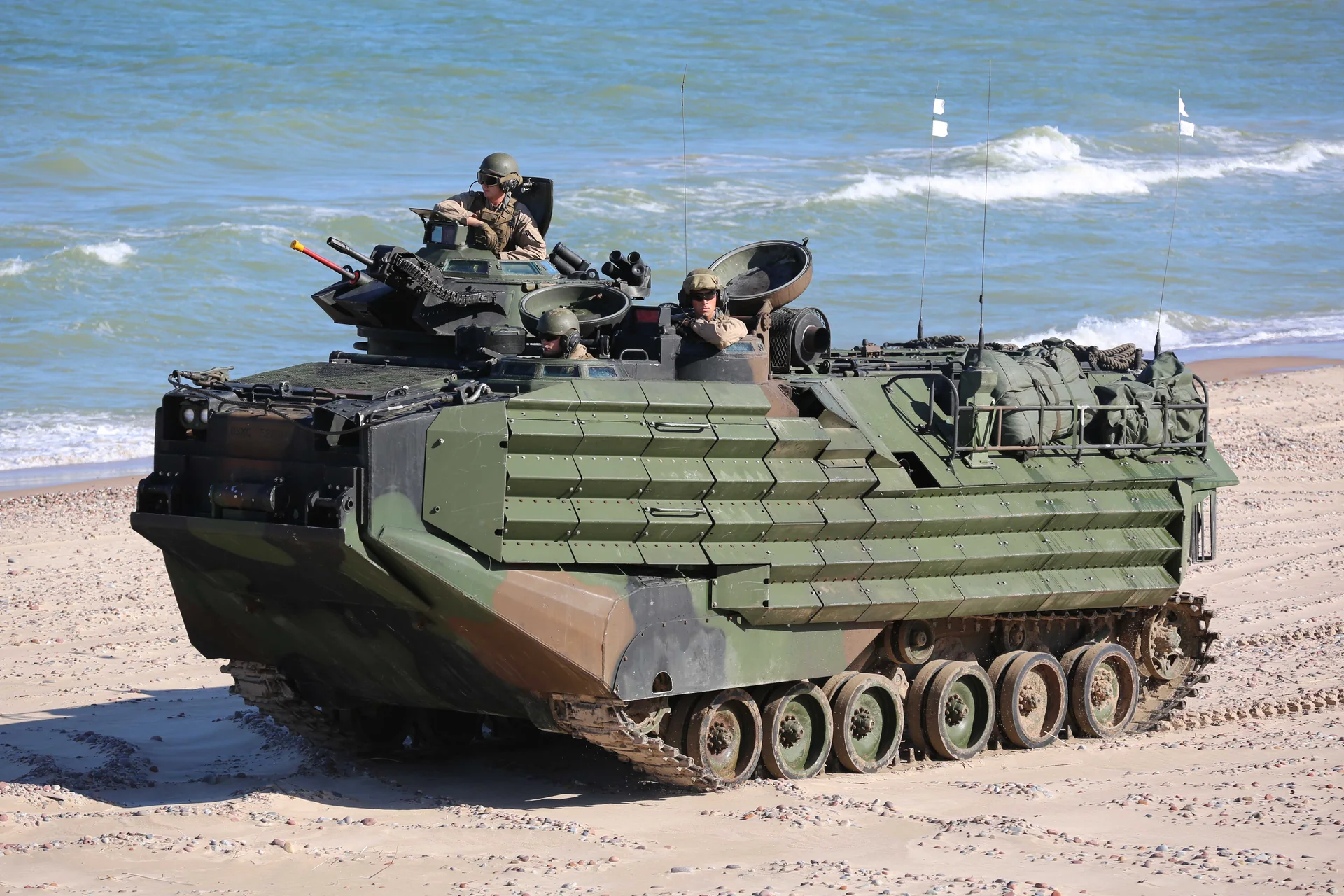
From LVTP-7 to AAV7A1
Introduced in 1972 as the Landing Vehicle, Tracked, Personnel-7, the LVTP-7 combined waterjet propulsion with a stern ramp for moving troops and cargo between ship and shore. Service-life extension work in the 1980s brought changes to engines, transmissions and weapon stations. The subsequent AAV7A1 designation belonged to an improved vehicle family, not to a completely unrelated amphibious design. 1
BAE Systems dates the introduction of the AAV7A1 to 1984. That date distinguishes the improved configuration from the original LVTP-7’s earlier entry into service. Later vehicles could share the AAV7A1 name while carrying different weapons, protection additions or automotive rebuilds. 2
Movement afloat and ashore
BAE’s basic AAV7A1 description specifies a 400-horsepower turbocharged V8 diesel and two waterjet pumps, with a published water cruising speed of seven knots. On land, torsion-bar suspension and tracks supported a nominal maximum of 45 mph. Those figures describe the stated configuration rather than every subsequent rebuild. The vehicle had to function as both a swimming carrier and a tracked machine after leaving the water, with personnel or cargo remaining aboard through the transition. 2
Firepower improvements included a station combining a .50-caliber machine gun and Mk 19 40 mm grenade launcher, while applique armor was another part of the upgrade history. The main family designations separated the AAVP7A1 personnel carrier, AAVC7A1 command vehicle and AAVR7A1 recovery vehicle. Their common amphibious origins did not make their internal equipment or duties interchangeable. 2
BAE Systems' current AAV7A1 description dates that improved configuration to 1984 and lists a 400-horsepower turbocharged V8 driving two waterjets. It also identifies the combined .50-caliber machine-gun and Mk 19 40 mm grenade-launcher station among later firepower improvements. The manufacturer's family labels distinguish personnel, command and recovery versions, so those mission configurations should not be collapsed into one troop-carrier specification. 2
Rebuilding the fleet
Keeping the vehicles usable required organized rebuilding as well as smaller repairs. In 2007, the Marine Corps Systems Command RAM/RS team described a remit covering major sustainment, future upgrades and eventual end-of-life issues. Its work included Inspect and Repair Only as Necessary, or IROAN, alongside the rebuild program. The contemporary objective was to sustain the AAV until the anticipated Expeditionary Fighting Vehicle reached full operational capability; that was the replacement plan at the time, not a description of the vehicle that eventually succeeded it. 3
RAM/RS stood for Reliability, Availability and Maintainability/Rebuild to Standard. BAE’s description of the configuration specified for its Brazilian contract identified a more powerful engine and drivetrain, together with upgraded suspension. These changes were intended to restore or improve on original AAV7A1 performance. RAM/RS was therefore a substantial automotive rebuilding standard, rather than simply another name for the baseline 400-horsepower configuration. 4
Weapon installations also continued late in U.S. service. At Camp Pendleton in September 2021, Tobyhanna Army Depot contractors worked with Marines to install 54 Common Remotely Operated Weapon Station systems on AAVs from several units. An official photograph records installation of the operator’s seat at the Assault Amphibian School. The project documents a defined group of vehicles, not conversion of the entire international AAV fleet. 5
Combat service and overseas programs
U.S. Marine Corps service extended beyond the waterline. AAVs carried personnel and supplies in Grenada, Somalia, the Persian Gulf and Iraq, combining amphibious duties with inland protected transport. Their long service included humanitarian work as well as combat employment, so the family’s history cannot be reduced to opposed beach landings alone. 1
In December 2015, BAE announced a contract to modernize and deliver 23 RAM/RS vehicles for the Brazilian Marine Corps. The package included maintenance tools, test equipment, spare parts, field support and user training, not just vehicle hulls. Work was assigned to York, Pennsylvania. The announcement scheduled deliveries from February through the end of 2017; those dates expressed the contract’s planned delivery sequence. 4
A different kind of record appeared in July 2023, when the U.S. Defense Security Cooperation Agency notified a possible sale to Romania. The proposed package listed sixteen personnel carriers, three command vehicles and two recovery vehicles, accompanied by weapons, enhanced applique armor, thermal equipment, spares and training. The specialist mix shows how an amphibious unit required command and recovery capability alongside troop transport. A sale notification records a proposal, however, and is not by itself evidence that those vehicles were delivered or entered service. 6
End of U.S. service and the separate ACV family
The U.S. Marine Corps formally decommissioned the AAV at a sundown ceremony at Camp Pendleton’s Assault Amphibian School on 26 September 2025, after 53 years of service. Its successor, the Amphibious Combat Vehicle, is an eight-wheeled platform with its own personnel, command, recovery and fire-support variants. That transition ended the AAV’s U.S. Marine Corps service; it should not be read as a simultaneous retirement announcement for every overseas operator. 1
Sources and further reading
References and further reading are listed below. Image identification, credit and reuse terms remain with each photograph.
- U.S. Marine Corps Training and Education Command, Marines bid farewell to the Assault Amphibious Vehicle, 2 October 2025
- BAE Systems, Assault Amphibious Vehicle (current manufacturer-described configuration)
- Marine Corps Systems Command, AAV RAM/RS Team mission, updated 25 April 2007, archived 21 March 2008
- BAE Systems, Brazilian Marine Corps AAV modernization contract, 21 December 2015
- U.S. Marine Corps, Tobyhanna contractors install CROWS systems on Marine AAVs, September 2021
- Defense Security Cooperation Agency, Romania: Assault Amphibious Vehicles, 27 July 2023
See Armor in Person
This vehicle family is connected to 1 verified museum through 1 documented display record.