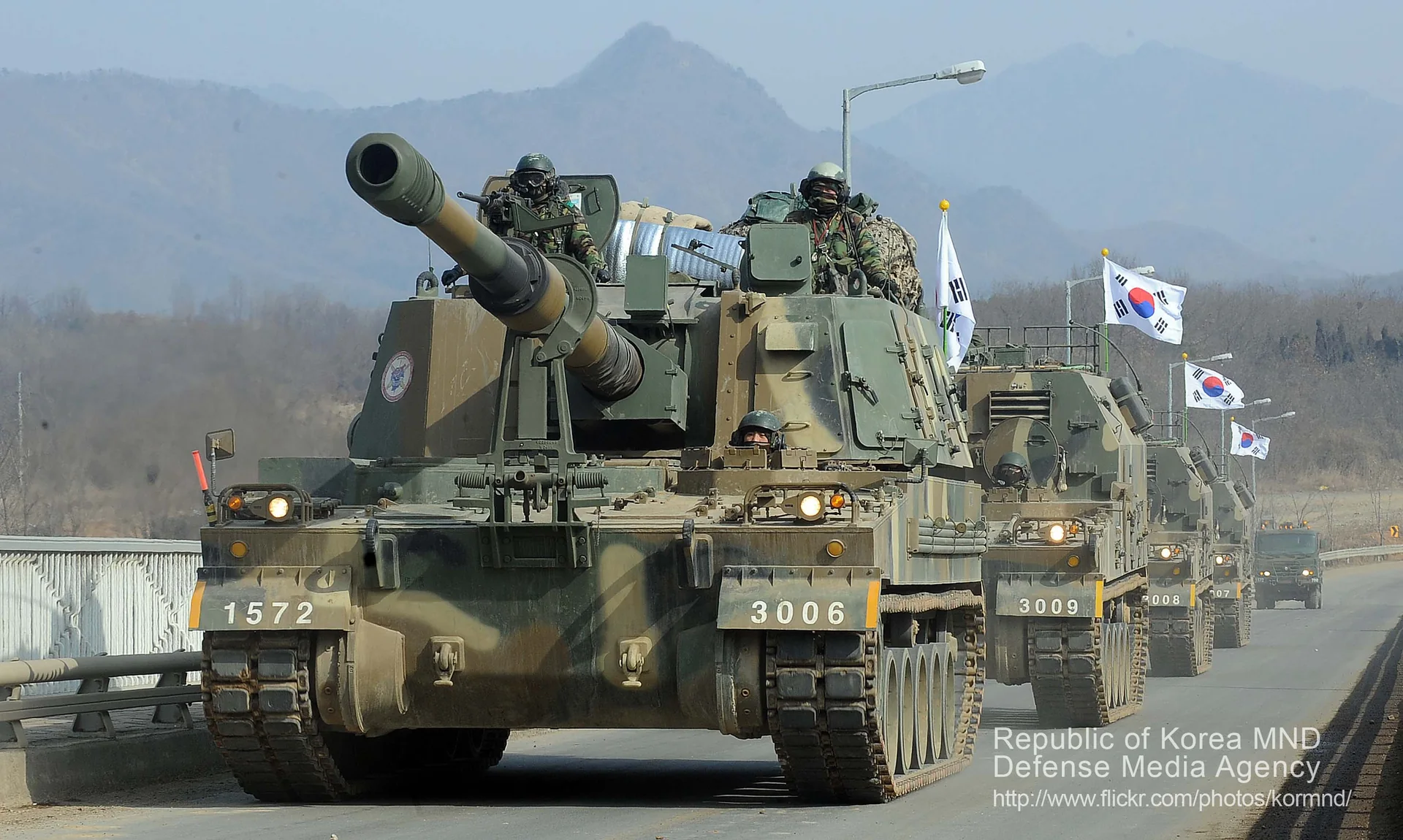
Development and design
The K9 was developed to give South Korea a new generation of self-propelled artillery beyond the older systems then in service. Weaponsystems.net places its service entry in 1999, while Hanwha’s current and historical material describes a 155 mm/52-caliber platform designed for long-range fire, high mobility, and rapid firing. The national requirement was shaped by the Korean peninsula, where artillery has exceptional strategic importance and forces must operate across mountainous terrain under the threat of counter-battery fire. 1, 3
A conventional tracked layout refined for modern artillery
The original K9 and K9A1 use a tracked hull with a forward driver and a large crewed turret carrying the 155 mm weapon. The chassis and gun were designed together for mechanized artillery service. Later proposals should not be confused with that baseline: a more automated K9A2 turret changes crew arrangements, while a wheeled K9-related offering is not simply another automotive specification for the tracked Thunder. 1, 2
The 155 mm/52-caliber standard
Hanwha identifies the K9’s principal weapon as a 155 mm 52-caliber gun and publishes range figures above 40 kilometers with appropriate ammunition. Those numbers are ammunition-dependent and should not be treated as a fixed range for every projectile. The more important design fact is the adoption of the long 52-caliber barrel that became a widely used standard for modern NATO-compatible artillery. It gave the K9 a growth path with evolving projectile and propelling-charge technologies. 1, 2
Service history
The K9 entered Republic of Korea Army service around the end of the 1990s. Its role must be understood in the context of a peninsula where both Koreas maintain large artillery forces and where the distance between potential firing positions and major population centers gives counter-battery readiness unusual strategic weight. A modern self-propelled howitzer offered mobility, protection, and faster fire-control processing than the older equipment it replaced. 3
From Korean system to multinational artillery ecosystem
The K9 became one of South Korea’s most prominent defense exports. Hanwha’s dated newsroom material documents adoption by multiple countries and emphasizes an expanding user community. Different customers acquired complete vehicles, local assembly arrangements, or variants adapted to national requirements. Turkey’s T-155 Fırtına, Poland’s K9-family acquisitions, India’s K9 Vajra-T, and other programs illustrate how the base design can be localized rather than exported in only one standard configuration. 1, 2
The K10 ammunition resupply vehicle
The K10 ammunition resupply vehicle is an important part of the K9 family because sustained artillery fire depends on logistics. Hanwha describes the K10 as using the same general mobility base as the K9 and carrying a much larger ammunition load for replenishment. A 2022 company release states that the K10 carried 104 rounds in the configuration demonstrated in the United States and used an automated transfer system to support the howitzer. 2
Hanwha presents the K10 ammunition resupply vehicle as the companion to the howitzer family, emphasizing automated transfer rather than exposed manual replenishment at the gun. That pairing matters because a high firing rate is useful only if ammunition can reach the vehicle quickly enough. Exported K9 users may field different support packages, so the K10 relationship is a family capability rather than a universal national organization. 1
NATO ammunition and international testing
As the K9 expanded internationally, ammunition compatibility became increasingly important. Hanwha’s report on the 2022 U.S. demonstration describes K9A1 and K10 operation with several U.S. 155 mm ammunition and charge types during testing at Yuma Proving Ground. The event was conducted under a cooperative research and development framework with U.S. Army organizations. The significance was not that all ammunition becomes interchangeable without qualification, but that the platform was being evaluated within the broader NATO-standard artillery ecosystem. 2
K9A1, K9A2, and increasing automation
Hanwha's product description separates K9A1 from K9A2. It describes K9A2 with a fully automated turret and a three-person crew, while listing Korean fielding in 2027 as a plan. That future date is not evidence of completed fielding. The distinction also prevents the A2's loading arrangement or crew reduction from being assigned retrospectively to original K9 and K9A1 vehicles. 1
A flagship of South Korea’s defense-industrial expansion
The K9 family's importance is not just its export record but the continued evolution of a common 155 mm tracked architecture. Hanwha's current K9A1 material describes a 52-caliber gun, ranges beyond 40 kilometers with appropriate ammunition, and automated handling that supports a high short-term firing rate. Those are current manufacturer figures for K9A1-class equipment, not specifications to be applied automatically to every national K9 derivative. 1
Historical place
The K9 family developed from a Korean tracked-artillery requirement into a wider industrial and export program. The K10 resupply vehicle and later automation work show that development extended beyond the gun itself. Licensed production, customer-specific equipment and future turret proposals must still be distinguished from one another rather than folded into a single specification for every Thunder. 1, 2, 3
Sources and further reading
References and further reading are listed below. Image identification, credit and reuse terms remain with each photograph.
- Hanwha Defense USA, K9 and K9A1 land systems (current manufacturer-described configuration)
- Hanwha Aerospace — K9/K10 U.S. interoperability and AUSA 2022
- Weaponsystems.net — K9 Thunder
Visit an Armor Museum
Explore the worldwide museum directory to find armored vehicles, collections, and visitor-planning information.
Browse armor museums