Development and acceptance
The K806 and K808 were developed to improve Korean infantry mobility across expanding unit areas. In 2012, the Defense Acquisition Program Administration selected Hyundai Rotem to lead system development. Prototypes underwent development and operational testing before receiving a combat-suitability determination on 9 May 2016. Establishment of the defense standard on 30 May marked completion of development, distinct from the later process of putting production vehicles into units. 1
A September 2017 Defence Daily factory report describes the transition from development to anticipated delivery. It traces the program to a 2012 contract and reports that the first deliveries were expected in December 2017. The report's forecast of a larger fleet is not used here as a final production total. More revealing is its description of the production method: vehicles moved through an assembly flow instead of remaining at fixed work stations, while design changes reduced the number of separate parts in an important fabrication process. These were contemporary manufacturing preparations, not retrospective proof of every production target having been met. 5
Six wheels, eight wheels and different duties
The six-wheeled K806 was intended for rear-area mobile response and protection of important facilities, including air bases. The eight-wheeled K808 was associated with rapid infantry concentration and dismounted combat. In the 2017 factory configuration, the larger K808 carried additional armor and waterjets, with a K6 heavy machine gun or K4 automatic grenade launcher; the K806 used a 7.62 mm machine gun. 2
Inside the K808, a steering wheel and automatic gearbox gave the driver a layout resembling a large commercial vehicle. A separate control operated the waterjets. The troop seats had individual belts and head supports, while periscopes, a front thermal camera and a rear camera helped occupants observe outside. Climate-control outlets served the compartment, and the rear ramp incorporated a firing port. These details addressed the experience of moving an infantry squad as well as the vehicle’s ability to carry it. 2
The running gear combined independent suspension with run-flat tires and central tire-pressure adjustment. The 2019 account also identified automatic fire suppression and an overpressure system for protection against contaminated outside air. Waterjet propulsion was specifically associated with the K808; the family designation alone does not mean that every version had the same amphibious equipment. 1
Hyundai Rotem's current product page keeps the K806 and K808 missions distinct. It describes the 6x6 K806 for rear-area facility defense, troop movement, convoy and reconnaissance tasks, while the 8x8 K808 is presented for rapid infantry deployment and reconnaissance with amphibious capability. The page lists a 420-horsepower engine for both and, for the K808, central tire inflation and water propulsion. These are current manufacturer-described configurations rather than proof that every vehicle was delivered identically. 4
Hyundai Rotem's specifications separate the two carriers rather than assigning one family-wide weight and mobility table. The K806 is the six-wheeled vehicle associated with rear-area facility protection, convoy work and reconnaissance. The K808 is the eight-wheeled carrier described for infantry operations and amphibious movement. The product page lists different combat weights and gives a water speed for the K808, not for the K806. A statement that the family is amphibious therefore needs a vehicle qualification. Shared automotive ancestry does not make every configuration's swimming equipment interchangeable. 4
The manufacturer also identifies a 420 hp engine, automatic transmission and tire-management equipment. Its weapons listings include options rather than one fixed installation for all customers. This distinction matters when reading photographs of an open weapon station and a remotely operated station: the photograph establishes the visible fit of that vehicle, while the catalog describes available arrangements. Neither source alone demonstrates a universal standard across every order. 4
The reporter's driving and interior observations also bring the crew into the account. The driver's automatic controls were compared with familiar commercial-vehicle arrangements; water propulsion used its own control input. Seat restraints, viewing equipment, a rear camera and air conditioning formed part of the usable vehicle, alongside the headline engine and armor features. These observations document what was inspected in 2017 rather than a guarantee that later orders retained every fitting unchanged. 5
Initial fielding and combined training
After production-quality checks, vehicles went to the Army’s 25th and 37th Divisions in March 2018 for four months of field-operating trials. This provided a unit-level stage between prototype acceptance and wider use. 1
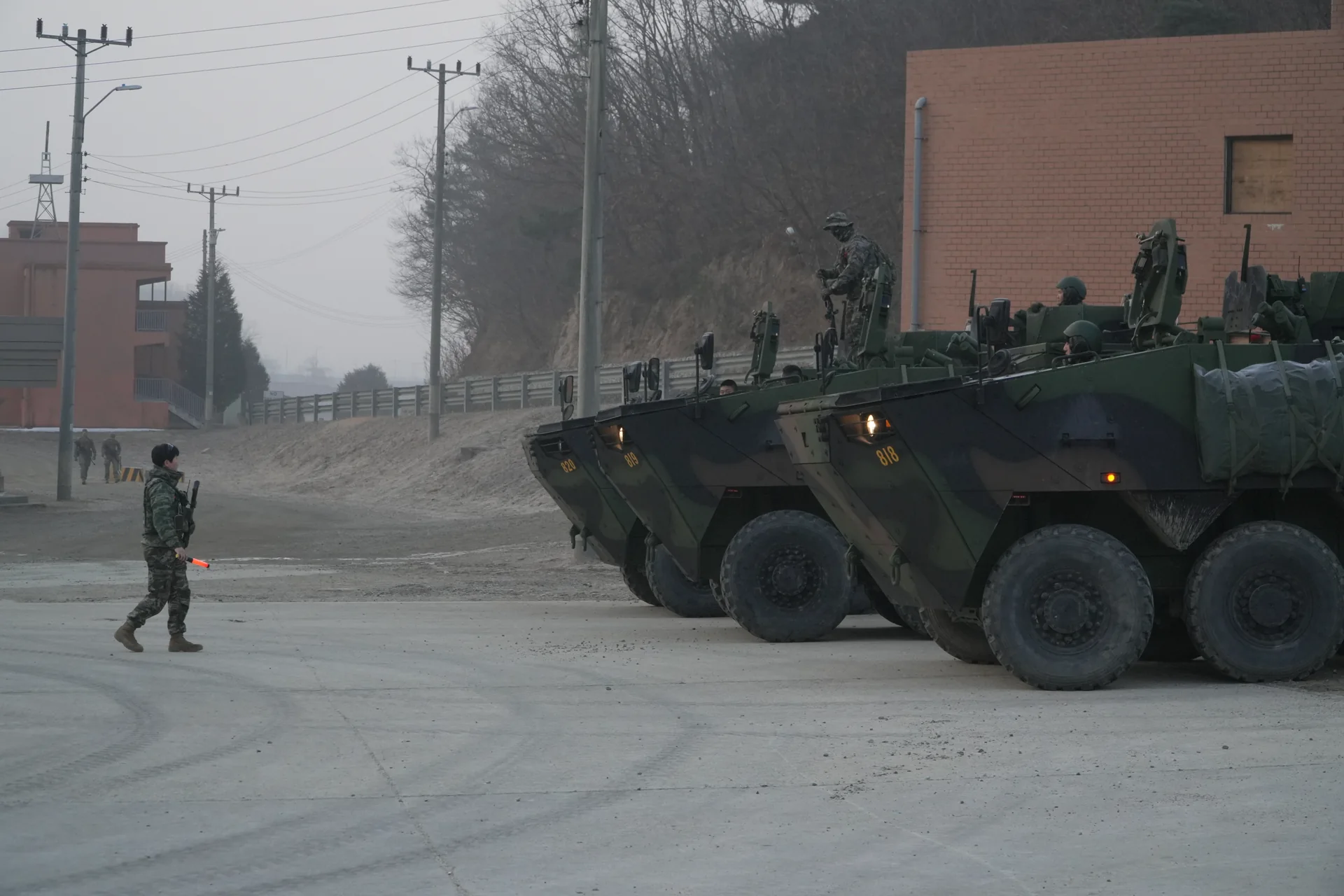
K808s also appeared in combined training at Rodriguez Live Fire Complex on 11 March 2025. During Korean Marine Exchange Program 25.1, a Republic of Korea Marine from the 3rd Engineer Company, 1st Engineer Battalion, guided the carriers. The official U.S. Marine Corps caption describes equipment familiarization between Marine and Army units, placing the photographed vehicles in a training event rather than documenting a combat action. 3
Manufacture and specialist development
Production used a moving assembly flow rather than completing each vehicle at a stationary tank-style assembly position. Greater use of bent structural components reduced the number of welded parts from 247 to 108. These were manufacturing changes, not additional operational variants. 2
The 2019 development outline envisaged command-post and 30 mm antiaircraft vehicles using the wheeled chassis. Such specialist applications had different equipment requirements from infantry carriers. That contemporary outline described development plans, not completed deliveries of every proposed version. 1
The family relationship extends to the separately designated K877 and K870 command-post vehicles. Hyundai Rotem describes them as WAV-derived mobile command posts with networked command systems, internal displays and meeting equipment. The published crew arrangement differs from the troop carrier's, and the manufacturer specifically assigns water propulsion to the K877. These are not merely infantry carriers photographed with extra radios. Reorganizing the protected volume for command work changes the occupants, fittings and purpose even when much of the automotive foundation remains familiar. Their appearance in the catalog demonstrates an offered family architecture, not the number accepted by a particular headquarters. 6
Sources and further reading
- Shin In-ho, Defense Media Agency, K806 / K808, 13 May 2019
- Kim Chul-hwan, Defense Media Agency, Driving the K808 wheeled armored vehicle, 24 September 2017
- U.S. Marine Corps, Lance Cpl. Thomas Vu, KMEP 25.1 official photo caption, 11 March 2025, preserved on Wikimedia Commons
- Hyundai Rotem, K808/K806 wheeled armored vehicles
- Korean Defence Daily, K806/K808 factory and driving report, September 2017
- Hyundai Rotem, K877/K870 command-post vehicles
Visit an Armor Museum
Explore the worldwide museum directory to find armored vehicles, collections, and visitor-planning information.
Browse armor museums