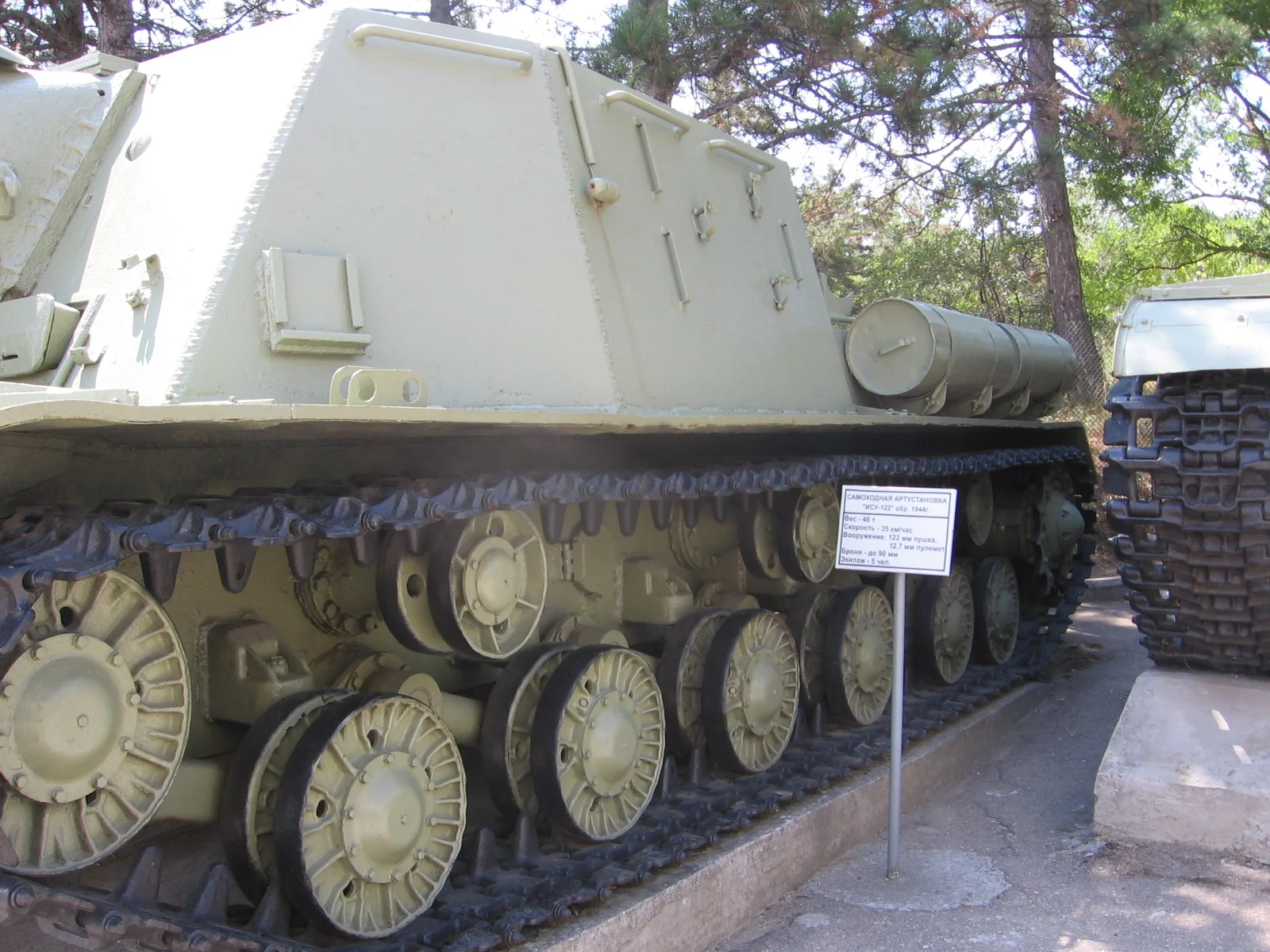
Requirement and development
The ISU family moved the heavy self-propelled-gun concept from the KV-based SU-152 onto the IS tank’s automotive foundation, but the 122 mm and 152 mm branches followed different weapon histories. The Padikovo museum describes the ISU-122 as Object 242, developed in December 1943 partly because A-19 guns were available while ML-20S supply constrained ISU-152 output. Object 242 underwent trials that month and was accepted by State Defense Committee decree on 12 March 1944. 4
The Padikovo account identifies the experimental 122 mm installation as Object 242 and dates its trials to December 1943. It separates adoption on 12 March 1944 from the start of series production at Chelyabinsk in April. Thus the ISU-122's arrival followed a distinct development and acceptance sequence within the broader ISU program. The common chassis did not make the gun installation administratively or mechanically interchangeable with an ISU-152 straight from the production line. 4
For the 152 mm vehicle, the museum places design work at Plant 100 between June and October 1943 and acceptance on 6 November. That chronology belongs to the IS-chassis machine, not the earlier KV-based SU-152. The distinction is especially important in accounts of 1943 battles: the later ISU designation should not be projected backward onto every heavy Soviet self-propelled gun armed with a 152 mm weapon. 5
Layout and engineering
A common armored foundation connected the family, while each gun installation imposed its own demands. The ISU-152 development record describes improvements relative to the SU-152 alongside remaining problems with seating, guarding, and ventilation. 1
The fixed compartment housed the driver and gun crew together with the breech, recoil system and ammunition. Replacing the tank turret with a casemate made room for a larger gun, but seating, ventilation and access still required development work. 1, 2, 3
The ISU-152's five-man crew included both a loader and a breech operator. This distribution of work reflected the scale of the separate-loading ammunition: the projectile and propellant were handled as separate items, while the breech and recoil system occupied much of the enclosed compartment. The museum lists twenty-one rounds for the vehicle and a high-explosive projectile weighing 43.5 kilograms. Those figures describe a substantial physical workload and a restricted supply of ammunition, rather than simply an impressive bore diameter. 5
Armament and direct-fire role
The ISU-152 carried the 152 mm ML-20S gun-howitzer. The ISU-122 used a 122 mm A-19-derived installation, while the ISU-122S introduced the D-25S. Shared mounting ancestry helped make the prototype conversion practical, but gun, ammunition, and handling distinctions remained important between the production versions. 1, 2
The D-25S’s semiautomatic breech did not make the vehicle an autoloading system. Human ammunition handling remained part of the firing cycle. Equally, a larger shell and a higher-velocity gun offered different benefits; the family cannot be ranked by caliber alone without identifying the task and ammunition involved. 2
Protection and survivability
The IS-based armored hull and superstructure enclosed the crew and weapon. The casemate had its own plate arrangement and openings rather than reproducing the turret armor of an IS tank. 1, 2
Access and observation remained important in the protected compartment. Loading a heavy projectile, moving around the breech and watching the approaches placed competing demands on a relatively small crew working inside a fixed structure. 1, 2, 3
Mobility, reliability, and logistics
The common IS automotive foundation supported related heavy-vehicle production, but the initial manufacturing transition was not free of mistakes or corrective work. The ISU-152 record describes substantial drawing and production revisions as the vehicle entered manufacture. 1
Commonality with the IS automotive family simplified the choice of engine, transmission and running gear. Introducing the self-propelled installation nevertheless required its own drawings, assembly work and production corrections. 1, 2, 3
Variants, production, and naming
Object 241 identifies the ISU-152 development vehicle; Object 242 identifies the ISU-122 branch. Object 236 belongs to the earlier SU-152, not to the ISU family. The ISU-122S designation further distinguishes the D-25S-armed production development. 1, 2, 3
The museum chronology places ISU-122 production after its March 1944 acceptance, rather than treating every IS-based heavy self-propelled gun as a late-1943 vehicle. This matters when identifying photographs and unit histories: an ISU-152 can belong to the family’s first production phase, while an ISU-122 appearance must fit the later acceptance and production sequence. 4
Operational service
The ISU-152 production introduction came late in 1943. ISU-122 manufacture followed in 1944. That chronology rules out assigning ISU vehicles to the July 1943 Kursk fighting; the relevant earlier heavy self-propelled weapon was the SU-152. 1, 2
The family supplied heavy direct fire in the final campaigns of the war. Assault support and antitank tasks overlapped, while the 122 mm and 152 mm weapons offered different combinations of ballistic performance, projectile effect and loading demands. 1, 2
The museum also follows some retired vehicles beyond their gun-armed service into ISU-T and BTT-1 tractor or recovery-related conversions. Those later lives help explain why a surviving heavy chassis may no longer retain its original fighting compartment. Its displayed ISU-122 carries markings representing a vehicle of the 301st Guards Heavy Self-Propelled Artillery Regiment around Danzig in April 1945. That is the historical identity chosen for the display, not a stated proof that this particular chassis served with that regiment. 4
Limitations and tradeoffs
The fixed mounting limited the gun’s freedom, while large ammunition and weapon mechanisms placed sustained demands on the crew. The ISU-122S addressed part of the firing-cycle problem through its breech arrangement, but it did not abolish the manual work or space constraints of the vehicle. 2
Assessment and related development
The ISU name covers related heavy self-propelled guns with materially different armament. The 122 mm and 152 mm installations shared the IS-derived foundation but placed different demands on ammunition handling and crew work. Their relationship to SU-152 is developmental and doctrinal; the change from KV to IS chassis remains an essential identification point. 1, 2, 3, 4, 5
Sources and further reading
- Tank Archives — The Most Numerous Heavy SPG
- Tank Archives — Heavy Tank Destroyer
- Tank Archives — SU-152: From Assault Gun to Tank Destroyer
- Museum of National Military History, ISU-122 exhibit
- Museum of National Military History, ISU-152 exhibit
See Armor in Person
This vehicle family is connected to 2 verified museums through 2 documented display records.